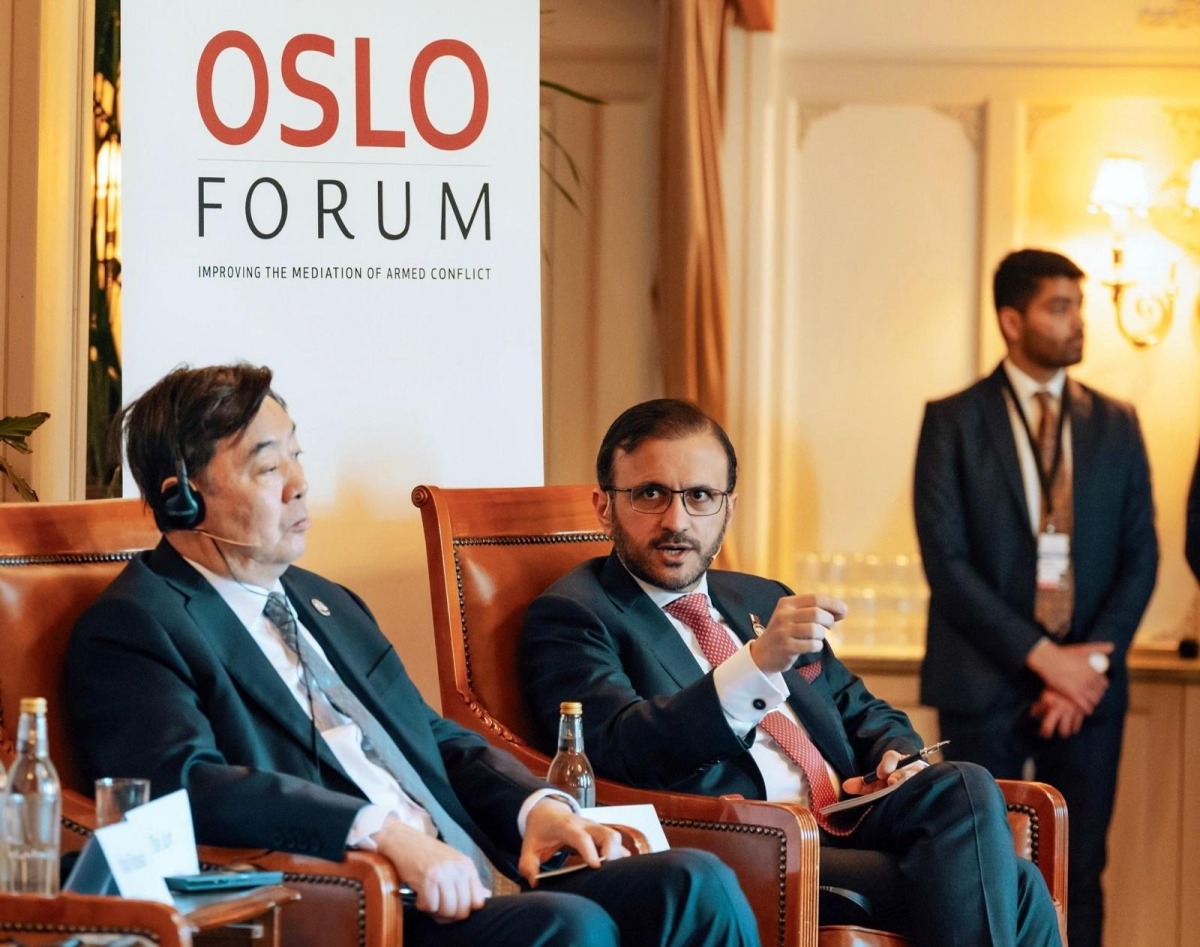
Oslo: Advisor to the Prime Minister and Official Spokesperson for the Ministry of Foreign Affairs Dr. Majed bin Mohammed Al Ansari participated as a speaker in the first high-level session of the annual Oslo Forum, held in Norway, to discuss mediation efforts in the Middle East.
In his remarks during the session, Dr. Al Ansari emphasized the significance of building international alliances and partnerships for peace by unifying the efforts of countries and coordinating their various tools and capabilities, in order to enhance the effectiveness of mediation and prevent it from being limited to individual initiatives.
He pointed out that mediation is witnessing a worrying shift from focusing on ending wars and achieving sustainable peace to merely reaching ceasefire agreements.
He indicated that this shift reflects the decline in international aspirations for peace as a result of the current situation. He further noted that the efforts of mediators are now focused on moving from high-intensity conflicts to low-intensity conflicts, instead of addressing the causes of conflicts and reaching sustainable settlements.
Al Ansari pointed out that the increasing number of crises and conflicts around the world makes it difficult to focus international efforts on mediation and peacemaking, which requires the development of more effective mechanisms capable of responding to growing challenges.
The Advisor to the Prime Minister and Official Spokesperson for the Ministry of Foreign Affairs stressed that crises do not arise in a vacuum, but rather are formed within complex regional and international contexts, which necessitates that the countries of the region play a positive and responsible role in supporting settlement efforts and promoting stability.
In this regard, he cited the ongoing developments in the Gaza Strip and the current tensions in the region as examples of the importance of the regional role in containing crises.
Concluding his remarks, Dr. Al Ansari highlighted the importance of mediating powers in the international system, stressing that cooperation and coordination among them can contribute to a tangible global impact and enhance security, stability, and peace at both regionally and internationally.