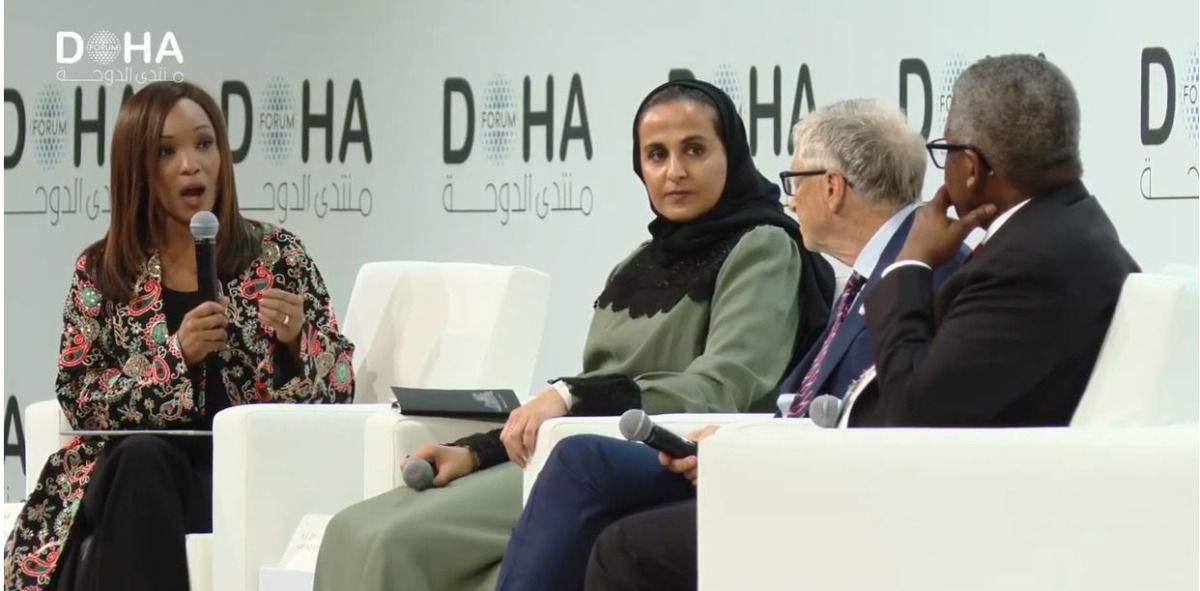
Chairperson of Qatar Museums H E Sheikha Al Mayassa, Co-chair of the Bill & Melinda Gates Foundation Bill Gates and President of the Dangote Foundation Aliko Dangote during the panel discussion.
Doha, Qatar: In a landmark panel discussion titled “Humanity’s Next Chapter: Innovation and Impact from the Global South,” three of the world’s most influential figures — H E Sheikha Al Mayassa bint Hamad Al Thani, Bill Gates, and Aliko Dangote – urged the Global South to seize control of its own narrative through culture, technology and African-led industrialisation.
Moderated by Al Jazeera’s Folly Bah Thibault, the session highlighted how strategic investments in creativity, health, education and agriculture as the bedrock of sustainable empowerment.
H E Sheikha Al Mayassa, Chairperson of Qatar Museums, described culture as the most potent form of soft power that ultimately fuels hard economic transformation. “When we started building museums years ago, culture was seen as ‘nice-to-have.’ Today it is the first sector nations turn to when redefining identity and dignity,” she said. She pointed to the Doha Film Institute (celebrating its fifteenth anniversary) and M7 fashion incubator as proof that consistent, long-term vision can create globally competitive creative industries. “Who will tell our stories if not us?” she asked, stressing the importance of authentic storytelling from Arabia, Africa and Southeast Asia.
Bill Gates, co-chair of the Bill & Melinda Gates Foundation, framed the demographic reality bluntly: by mid-century, most children born on earth will be African. “That is either the world’s greatest dividend – in creativity, sport, fashion, science – or its greatest burden,” he warned. Gates argued that eradicating diseases like malaria, scaling primary-health systems and deploying AI-driven agricultural advisors could turn Africa into a net food exporter within two decades. Crucially, he promised that new AI tools – virtual doctors, tutors and farm advisors accessible free via mobile phones – would leapfrog traditional infrastructure gaps. “The cloud cost is modest; rich countries and philanthropies should cover it so no one in the Global South pays,” he declared.
Aliko Dangote, President of the Dangote Foundation and Africa’s wealthiest individual, announced plans to launch a $700 million education fund next week, supporting 155,000 students from secondary school through university over ten years. He described building industrial ecosystems that prioritize local employment and training, noting that his 650,000 barrel-per-day refinery employed 50,000 Nigerians compared to just 17,000 foreign workers. Dangote emphasized agriculture’s potential, establishing rice mills with processing capabilities while providing farmers with fertilizers and guaranteed purchases. He advocated for tax incentives encouraging corporate investment in creative industries, noting that over 70 percent of Africa’s population is under 35.
“Nobody from outside will come and do it for us. We Africans must start first; then partners will follow,” he said.
All three panellists agreed that technology, particularly AI, must not deepen the North-South divide. Sheikha Al Mayassa revealed Qatar’s “Applied Imagination” initiative, which uses cultural spaces to humanise technology and is developing Arabic-language AI applications and games that feel authentically local rather than imported.
The session closed on an optimistic note: when culture reclaims identity, when health and education unlock human potential, and when African entrepreneurs and Gulf visionaries collaborate rather than compete, the Global South is not merely catching up – it is writing humanity’s next chapter.