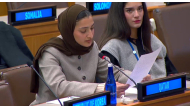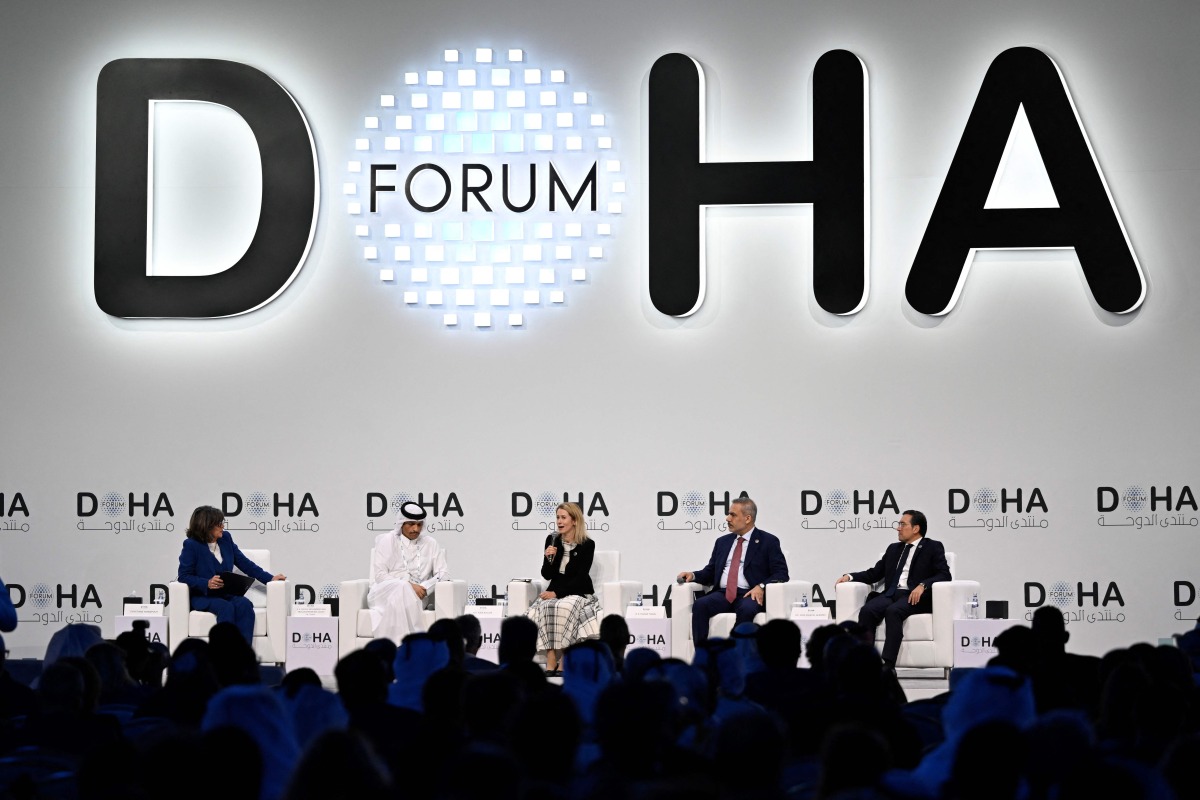
Prime Minister and Minister of Foreign Affairs H E Sheikh Mohammed bin Abdulrahman bin Jassim Al-Thani with other panelists during a session held yesterday at Sheraton Grand Doha. (AFP)
Doha, Qatar: The participants of a high-level session, ‘Mediation in a time of fragmentation,’ lauded Qatar’s mediation efforts for the resolution of conflicts in the region and beyond.
The session was attended by Prime Minister and Minister of Foreign Affairs H E Sheikh Mohammed bin Abdulrahman bin Jassim Al-Thani, Minister of Foreign Affairs of Turkiye H E Hakan Fidan, Minister of Foreign Affairs of Spain H E Jose Manuel Albares, and European Union High Representative for Foreign Affairs and Security Policy and Vice-President of the European Commission H E Kaja Kallas.
Minister of Foreign Affairs of Turkiye H E Hakan Fidan said that Turkiye is ready and prepared to do whatever is necessary to contribute to ongoing peace efforts in the Gaza Strip.
“Broad discussions are currently underway regarding the formation of an international stabilisation force to be deployed in the Gaza Strip... we should be realistic on the mandate of this force... the joint force faces major challenges in its establishment, including the countries contributing troops, the command structure, logistical arrangements, and many other agreed-upon details.”
Fidan also highlighted Turkiye’s mediation and peace initiatives in the region, including Gaza, the Russia-Ukraine conflict, and Syria.
On Russia-Ukraine war, he noted that the best way to end the war in Ukraine is through the engagement of all conflict parties in peace negotiations conducted with sincerity, determination, and innovative solutions. “The peace talks do not end the war immediately, but they help reduce human suffering.”
In the same session, Minister of Foreign Affairs, European Union and Cooperation of Spain H E Jose Manuel Albares, also took part, and he lauded Qatar’s mediation efforts in conflict resolution. “The armed conflicts are incapable of settling disputes... Qatar’s engagement in sensitive mediation tracks has emerged as a notable example of how diplomacy can pave the way for peaceful solutions.”
He also highlighted Spain’s recognition of the State of Palestine, saying that the decision had strengthened Spain’s credibility and influence in efforts to advance peace in the Middle East. “Spain’s recognition (of the State of Palestine) followed by similar moves from other European and international partners signals a growing global consensus that the two-state solution remains the only realistic framework for achieving lasting peace and stability in the region.”
“The durable peace requires a set of essential steps including ending settler violence and halting settlement expansion, rebuilding Gaza, re-establishing a unified Palestinian leadership capable of governing both the West Bank and Gaza, and ultimately creating an independent Palestinian state with East Jerusalem as its capital, living alongside Israel in peace and mutual respect.”
On his country’s defence budgets, he said that Spain did not intend to increase its defence budget to 5 percent of GDP, further saying that the country’s sustainable ceiling is 2.1 percent. However, he noted, Spain fully honours its NATO commitments, contributes personnel to allied missions, and plays an active role in safeguarding Baltic airspace through its military deployments.
Kaja Kallas also lauded Qatar’s active role in effective international mediation efforts aimed at resolving global conflicts.
“Qatar’s mediation role serves as a vital model for upholding international law and the global rules-based system.”