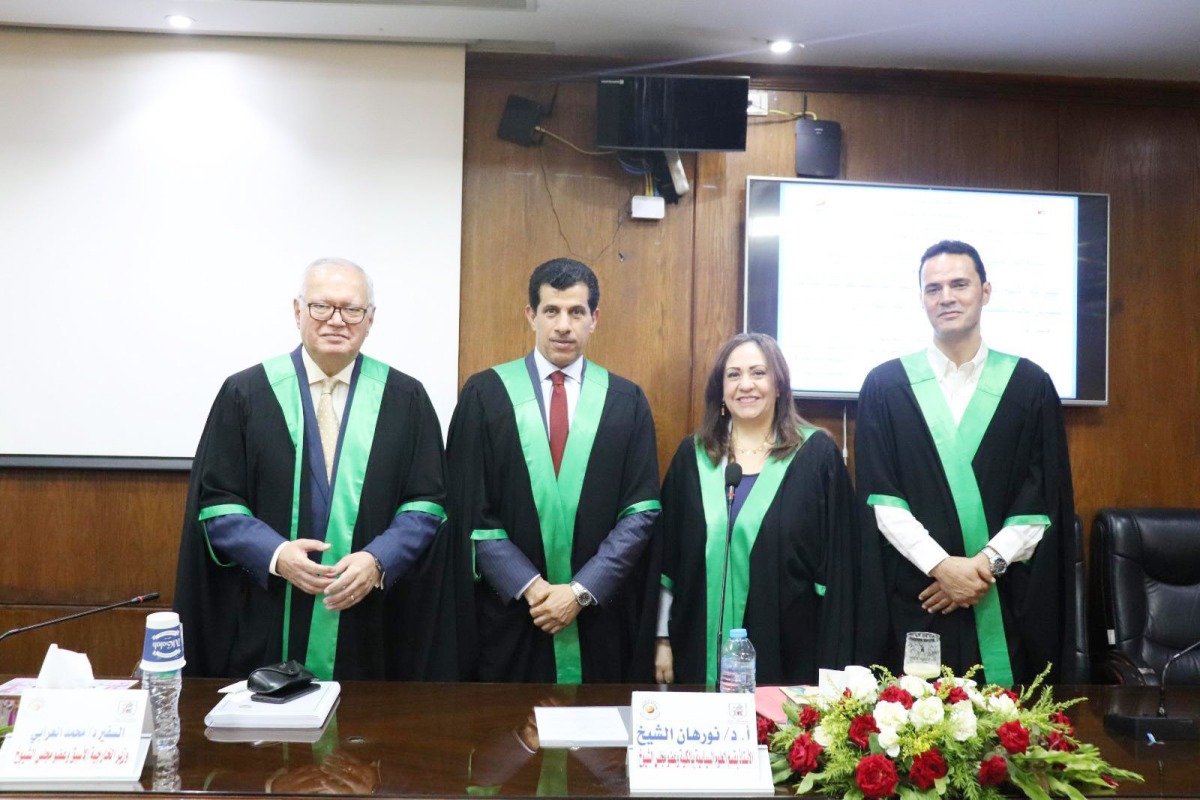
Dr. Salem with the dissertation committee after successfully defending his PhD dissertation.
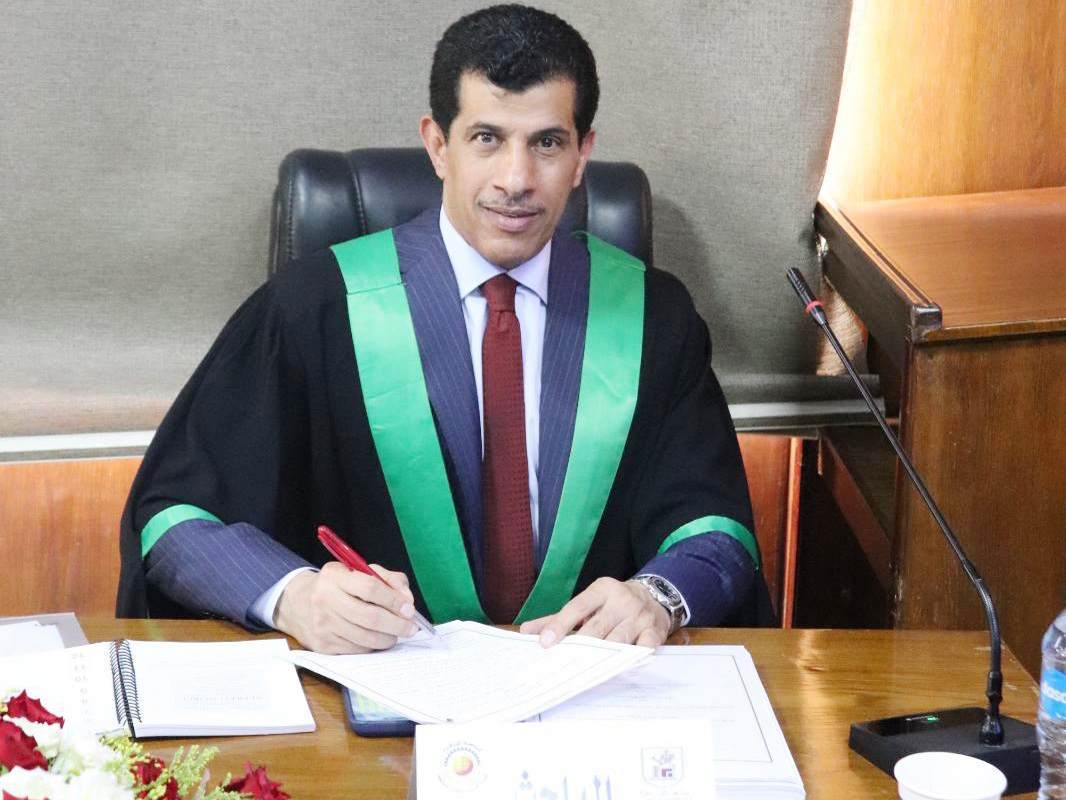
The Ambassador of Qatar to Spain H E Dr. Salem bin Mubarak Al Shafi recently defended his doctoral dissertation titled Strategic Partnership between Russia and China: The Impact on the Two Countries’ Policies toward the Middle East (2013–2023); at the College of Political Science, Cairo University, in partial fulfillment of the requirements for the PhD degree.
The dissertation examines the evolution of Russian-Chinese relations, which have followed an upward trajectory marked by growing mutual trust and expanding political, economic, and military cooperation.
This development has strengthened a multidimensional strategic partnership between the two countries and raised important questions about its implications for their foreign policies.
Against this backdrop, the study investigates the extent to which this strategic partnership has influenced the foreign policies of Russia and China, with particular emphasis on the Middle East—one of the world’s most strategically significant regions, where the interests of major powers converge and geopolitical competition continues to intensify.
To achieve this objective, the dissertation analyses two key case studies: the Syrian crisis and the Iranian nuclear issue. These cases represent two of the most significant instances of major power interaction in the region and provide a suitable framework for assessing the extent to which the Russian-Chinese strategic partnership has contributed to the convergence of Russian and Chinese positions and policies toward Middle Eastern affairs, while taking into account the national interests and strategic considerations that continue to shape each country’s foreign policy.
Accordingly, the study seeks to answer the following central research question:
“To what extent has the Russian-Chinese strategic partnership influenced the foreign policies of Russia and China toward Middle Eastern issues, particularly the Syrian crisis and the Iranian nuclear issue? Has this partnership resulted in greater policy convergence, or has each country maintained an independent margin in its approaches and mechanisms for addressing these issues?”
This central question gives rise to several subsidiary questions concerning the motivations and determinants of the Russian-Chinese strategic partnership, its dimensions and areas of cooperation, and its impact on the positions and policies of both countries regarding the Syrian crisis and the Iranian nuclear issue. The study further examines the extent of coordination and policy convergence between Russia and China, while identifying the areas and limits of divergence in the policies and instruments adopted by each country in addressing these two major regional issues.
The study covers the period from 2013 to 2023, a decade marked by significant developments in the Russian-Chinese strategic partnership and its implications for the Middle East. The year 2013 was selected as the starting point because it coincided with the accession of Chinese President Xi Jinping and the subsequent strengthening of strategic coordination between Moscow and Beijing.
The year 2023 was chosen as the endpoint because it marked another important stage in the evolution of the partnership, highlighted by the commitment to deepen the Comprehensive Strategic Partnership of Coordination. This timeframe therefore provides an appropriate basis for analysing the partnership’s impact on the foreign policies of Russia and China toward the Middle East.
The significance of the study stems from several considerations. First, it examines the Russian–Chinese strategic partnership within the broader context of transformations in the international system and the expanding role of major powers, making it an important factor in shaping the evolving global balance of power. Second, it focuses on the Middle East as one of the principal arenas of international competition by analysing Russian and Chinese policies toward the Syrian crisis and the Iranian nuclear issue.
This analysis highlights both the areas of convergence and the limits of divergence between the two countries’ approaches to regional affairs. Finally, the study contributes to filling a gap in Arabic academic literature by examining the impact of the Russian-Chinese strategic partnership on the foreign policies of both countries toward the Middle East.
With regard to the previous literature, the study classifies earlier research into three main categories. The first examines the origins, determinants, and dimensions of the Russian-Chinese strategic partnership. The second focuses on Russia’s policy toward Middle Eastern issues, particularly the Syrian crisis and the Iranian nuclear issue. The third analyses China’s policy toward the Middle East, with particular emphasis on the two issues examined in this study.
A review of these studies indicates that, although they have made significant contributions to the existing body of knowledge and provided a solid theoretical foundation for the present research, they have generally examined these topics in isolation.
The present study seeks to bridge these strands of scholarship by analysing the impact of the Russian-Chinese strategic partnership on the policies of both countries toward the Middle East, while identifying the areas of convergence and the limits of divergence in their approaches, particularly with regard to the Syrian crisis and the Iranian nuclear issue.
From a theoretical perspective, the study adopts Alliance Theory as its principal analytical framework, as it provides a useful basis for understanding the formation of international alliances and the factors underlying their development.
The study also employs the National Interest approach, considering national interest to be one of the fundamental determinants of foreign policy. In this context, national interest refers to the objectives and priorities that a sovereign state seeks to achieve and protect through its foreign policy, thereby shaping its behaviour in the international system.
The research is organised into four chapters. The first presents the conceptual and theoretical framework, the second examines the evolution and dimensions of the Russian-Chinese strategic partnership, the third analyses Russian and Chinese policies toward the Syrian crisis, and the fourth compares their approaches to the Iranian nuclear issue.
The study concludes that the Russian-Chinese strategic partnership developed significantly between 2013 and 2023, evolving from pragmatic cooperation into a long-term strategic relationship based on shared political, economic, and security interests. Both countries have increasingly coordinated their efforts to promote a multipolar international order, oppose Western intervention and unilateral sanctions, and expand their influence, particularly in the Middle East. However, the partnership remains a flexible strategic arrangement rather than a formal military alliance.
Regarding the Middle East, the study finds growing policy convergence alongside continued pursuit of distinct national interests. In the Syrian crisis, both Russia and China supported Syria's sovereignty and opposed external intervention, but Russia relied mainly on military means while China emphasised diplomacy and political solutions. On the Iranian nuclear issue, both countries opposed nuclear proliferation, supported Iran's right to peaceful nuclear energy, and rejected unilateral sanctions. Nevertheless, China prioritised economic interests and energy security, whereas Russia approached the issue from broader geopolitical and strategic perspectives.
Overall, the study concludes that the partnership has strengthened policy coordination without eliminating the independent foreign policy objectives of either country. Their relationship is therefore characterized by strategic coordination and complementary roles rather than full strategic integration.
The study recommends that Arab states adopt more balanced and diversified foreign policies by strengthening cooperation with emerging powers, particularly Russia and China, while avoiding excessive reliance on any single global actor.
It also highlights the need to enhance economic resilience, regional cooperation, technological development, and research-based policymaking. Looking ahead, the study expects the Russian-Chinese partnership to deepen further as global competition intensifies and the international system becomes increasingly multipolar, making pragmatic and interest-based diplomacy even more important for Arab states.