Tokyo: Three lions at a Tokyo zoo have died from suspected heatstroke and others are under treatment, a spokeswoman said on Tuesday, with the big cats struggling with high humidity. Japan sweltered through its hottest summer on record last year and parts of the country have hit 40C in recent weeks, qualifying for the new designation "cruelly hot day", with thousands of people hospitalised. Ten of the 16 lions in Tama Zoological Park have suffered symptoms such as "loss of appetite and decreased activity" since mid-July, and three lionesses died, the zoo said in a statement. One three-year-old female died on Tuesday, another aged 11 died on Friday, and the third on Sunday aged 15. The Tama Zoological Park said the lion enclosure, where visitors can normally be driven around in zebra-pattern "safari" buses, was closed to the public until further notice. "According to our veterinarian, the cause of the deaths is suspected to be heatstroke" because dehydration and multiple organ failure were observed, a spokeswoman told AFP. "Even though lions are thought to be resistant to heat, zoo keepers have been strengthening countermeasures to cope with Japan's summer heat in recent years. Heat here comes with high humidity; that is different from heat with dry air in Africa," she said. The spokeswoman said the heat "arrived suddenly" this summer after the rainy season ended in late July. "We are strengthening measures against the heat (further), sprinkling water, improving ventilation and installing spot air conditioners," she said. Several lions are still being treated, she added. 'Profits' Animal rights group PETA said the lions named Mugi, Ichigo and Luena "were born, lived, and died in confinement, deprived of everything that makes life worth living for a wild animal". "Zoos are not rescues or sanctuaries; they exist to display animals for profit, not to put animals' needs first," PETA said in a statement. Close to 18,600 people were taken to hospital for heatstroke between July 20 and 26, with 45 of them pronounced dead on arrival, according to the fire and disaster management agency. Japan experiences about 1,300 heat-related deaths annually and is aiming to halve that number by 2030. Scientists say human-induced climate change is increasing the frequency and intensity of extreme heat events in Japan and elsewhere. Its highest recorded temperature of 41.8C was registered on August 5, 2025, in Isesaki, north of Tokyo. Authorities have adjusted the timing of several cultural and sporting events in recent years because of the heat, including the World Cosplay Summit in Nagoya, which held its final summer edition last weekend.
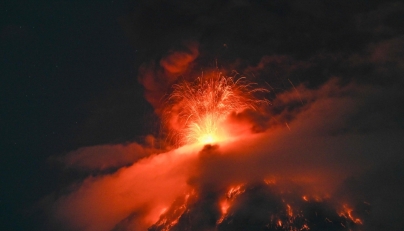
Guatemala City: Guatemalan authorities issued the country's second-highest emergency alert level on Monday after a major eruption of Central America's most active volcano, prompting the evacuation of nearby villages. Fuego erupted on Monday morning and had intensified by nightfall, with lava flows and huge plumes of ash spewed about six kilometers (four miles) into the air. "An orange (danger) alert has been declared nationwide due to the eruption of the Fuego volcano," disaster coordination agency Conred said on X. The alert level is one below the highest level of red, which indicates the most serious emergency. Officials began evacuating on Monday two villages near the volcano, which is located 35 kilometers (22 miles) from the capital Guatemala City. Footage released by the emergency services showed the powerful eruption turning clouds red and lava flowing down the slopes of the 3,763-metre-high (12,346-foot) volcano. "If an evacuation is ordered or conditions pose a risk to your life, follow the principle of self-evacuation," Conred spokesperson Valeria Urizar said in a video posted on social media. The country's Institute of Volcanology warned in a statement that the volcano was "moving towards a more explosive phase". It warned of hot volcanic debris flows down Fuego's slopes, with communities on the western and southern flanks at the greatest risk. Classes suspended The education ministry ordered the suspension of face-to-face classes in communities within two municipalities near the volcano as a precaution. Traffic police also closed a road encircling the mountain range that connects the south coast with the colonial city of Antigua, the country's main tourist destination and a UNESCO World Heritage site. The Institute of Volcanology reported that ash plumes were rising to more than 6,000 meters, with ash falling on nearby communities. There have been several such mass evacuations in recent years because Fuego erupted. Guatemala lies on the Pacific "Ring of Fire" and experiences frequent seismic and volcanic activity. Authorities evacuated more than 500 people last year after Fuego spewed gas and ash, with residents moved to shelters from communities near the crater. The government suspended local school activities and closed a road linking the south of the country to Antigua.

Llantrisant, United Kingdom: At the heart of Britain's coin factory, old Bank of England telephones are stripped down and dipped into giant vats to recover a hidden treasure: the gold in their circuits. Behind barbed wire and coded security gates at its site near Cardiff in Wales, the Royal Mint -- the state-owned maker of British coins as well as medals -- is turning electronic waste into luxury jewellery. The initiative remains unusual in a sector where much electronic waste never reaches proper recycling facilities. Opened two years ago, the plant can process around 4,000 tonnes of electronic waste a year, containing "about 400 kilos of gold", said the Mint's development director, Sean Millard. Behind him, a largely automated line of chemical vats is off limits to cameras because the process is patented by a Canadian company, Excir. New process Each Bank of England office phone recycled here contains around 30 milligrammes of gold, worth around three pounds ($4.00) at current prices. A modern smartphone contains roughly four pounds' worth of the metal. Gold is prized in electronic circuits because it conducts electricity well and does not corrode. But its chemical stability also makes it difficult to recover from electronic waste. Unlike many recyclers, which melt electronic waste in bulk, the Royal Mint dismantles devices first. Copper, tantalum and even the plastic from circuit boards are sorted and sold to specialist recyclers. Gold is traditionally recovered either by smelting at very high temperatures or by using corrosive acid mixtures that generate hazardous waste. Instead, the Royal Mint uses a process that dissolves the gold at room temperature. "There's no external energy input and it can be reused for batch after batch of feedstock," said Kate Griffiths, a chemical analyst at the Royal Mint. She demonstrates the process by placing electronic components in a chemical bath and adding reagents one by one until a fine gold powder forms. Win-win Once refined to improve its purity, the extracted gold is used to make jewellery for the Royal Mint's "886" brand, which refers to the date the institution was founded. The mint also uses recycled silver, some of it extracted from old radios supplied by British hospitals. In the jewellery workshop, quieter than the Royal Mint's coin-pressing halls where he used to work, 63-year-old John Powell carefully polishes a ring. "I wouldn't be able to tell you whether I'm working with the recycled or the normal," he said. Worldwide, only 22.3 percent of electronic waste was properly collected and recycled in 2022, according to a United Nations report. Improper recycling can release lead, mercury or plastics into the environment and contribute to climate change, the report warned. At the same time, soaring gold prices have made recovering increasingly attractive. The metal climbed to a record high of nearly $5,600 an ounce at the end of January amid global economic uncertainty, though it has since fallen back to around $4,000. "When the price of gold is really high, the cost of processing the waste to recover the gold is irrelevant," making alternative solutions commercially viable, said Jason Hallett, a professor of sustainable chemical technology at Imperial College London. "It's a win-win," he said, as long as the extraction processes do not send energy consumption or emissions soaring.
 Oman grants 14-day visa-free entry to citizens of over 100 countries
Doha, Qatar: Oman has exempted citizens of more than 100 countries and territories from entry visa requirements for stays of up to 14 days, as part of efforts to facilitate tourism and enhance visitor services. According to Omani authorities, the...
Arab League Secretary-General, Iraqi foreign minister discuss tense regional situation
Cairo, Egypt: Secretary-General of the Arab League Nabil Fahmy discussed during a phone call with Iraqi Foreign Minister Fuad Hussein the tense regional situation and ways to achieve security and stability in the region A statement issued by the Arab...
Suspected heatstroke kills three lions at Japan zoo
Tokyo: Three lions at a Tokyo zoo have died from suspected heatstroke and others are under treatment, a spokeswoman said on Tuesday, with the big cats struggling with high humidity. Japan sweltered through its hottest summer on record last year...
Britain's Royal Mint strikes gold in electronic waste
Llantrisant, United Kingdom: At the heart of Britain's coin factory, old Bank of England telephones are stripped down and dipped into giant vats to recover a hidden treasure: the gold in their circuits. Behind barbed wire and coded security gates...
Gunmen kidnap at least 52 people in northwest Nigeria: residents
Jos, Nigeria: Gunmen kidnapped at least 52 people, including children, in a weekend attack on a village and military base in northwest Nigeria's Zamfara state, local sources told AFP on Monday. Kidnappings have become a major source of income for...