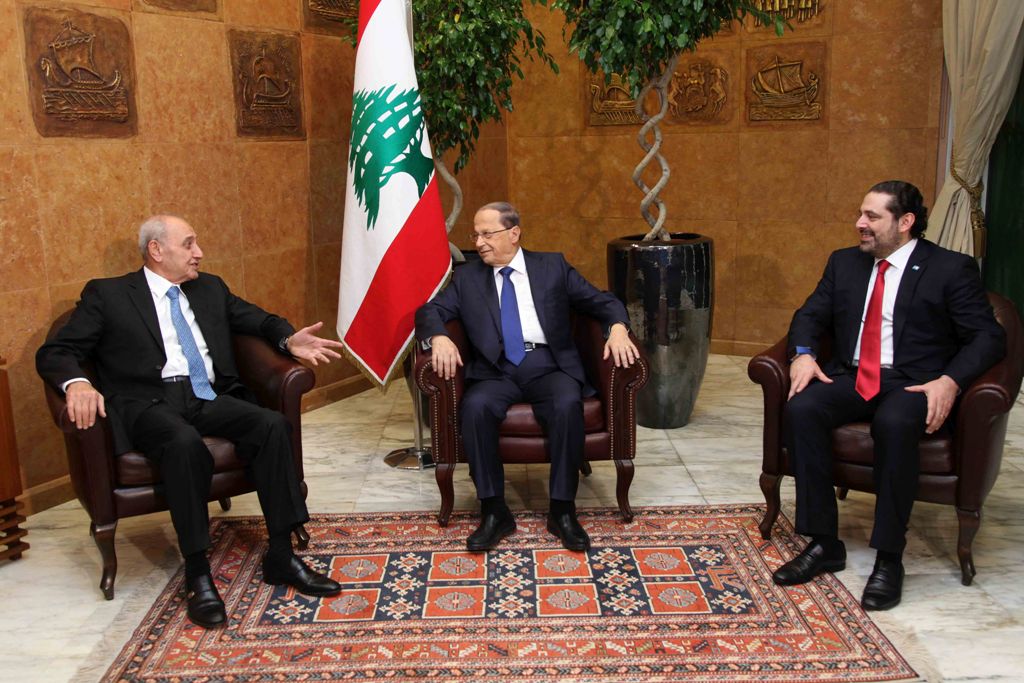
BEIRUT, LEBANON - DECEMBER 18: Lebanese President Michel Aoun (C), Lebanese Prime Minister Saad Hariri (R) and Lebanese Parliament Speaker Nabih Berri (L) meet to discuss government formation process in Beirut, Lebanon on December 18, 2016. ( Dalati Nohra
BEIRUT: Lebanon on Sunday unveiled a 30-member government drawn up from the country’s most political groups.
“This is a government of national unity that will tackle all crises,” Prime Minister Saad al-Hariri told a press conference.
He said the government’s first mission will be to reach a new electoral law “that abides by proportional representation and the right representation."
“The government will maintain security, stability amid fires that have ravaged the region and shield our country from the negative consequences of the Syrian crisis,” he said.
The new government includes 23 newcomers and one woman.
Hariri said the Christian Phalangist party has rejected the portfolio it was offered.
Hariri, a Sunni politician who leads Future movement, was appointed last month following the election of President Michel Aoun late October, ending almost two years of presidential vacuum.
Lebanon’s political forces are divided between supporters of the March 14 alliance -- which backs the armed opposition in next-door Syria -- and the March 8 alliance, which includes Hezbollah and supports Syria’s Assad regime.
A third, centrist bloc, meanwhile, is led by Druze politician Walid Jumblatt and former Prime Minister Najib Mikati.
In 1943, Lebanon’s Muslims and Christians agreed to distribute the country’s three most important political posts between them.
Ever since, according to an unwritten National Charter that remains in effect until today, the president (who serves for non-renewable six-year terms) should be a Maronite Christian; the prime minister a Sunni Muslim; and the speaker of parliament a Shia Muslim.