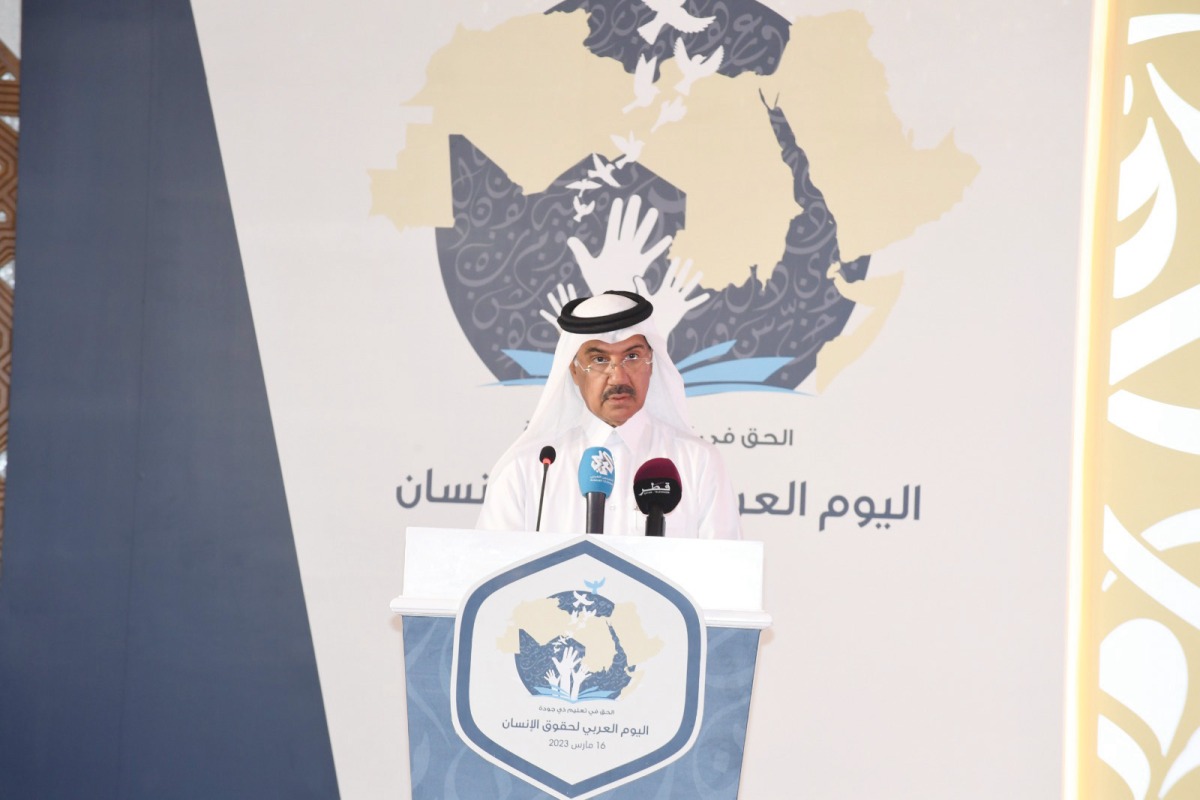
Secretary General of the Ministry of Foreign Affairs H E Dr. Ahmed bin Hassan Al Hammadi speaking at the event marking Arab Human Rights Day.
Doha: Qatar marked the Arab Human Rights Day, which falls on March 16 of each year under the theme “the right to quality education.” The event was co-organised by the Ministry of Foreign Affairs, the Ministry of Education and Higher Education, the Arab League, the Qatar National Commission for Education, Culture and Science, and the Arab Bureau of Education for the Gulf States.
In her speech marking the occasion, Minister of Education and Higher Education H E Buthaina bint Ali Al Jabr Al Nuaimi stressed that obtaining a quality education is the bedrock to achieving the sustainable development goals (SDGs) and the actual portal to enjoy all other rights.
She added that the Qatar’s wise leadership led by H H the Amir Sheikh Tamim bin Hamad Al Thani, has a strong belief that education is a human right for all who reside in Qatar, a pillar of progress for societies, and a basic right to achieve democracy and sustainable development. According to her, education is the first driver for development, as well as being an effective and dependable tool to push life forward.
The Minister indicated that promoting and protecting human rights, including the right to education, has become a strategic choice for Qatar. Qatar National Vision 2030 includes axes and pillars that deal with human rights in education, health, environment, expat labour rights, child and elderly rights, and women empowerment. She noted the role of the National Human Rights Committee (NHRC), which seeks, in cooperation with ministries, institutions, civil society organisations, and international and regional organisations, to raise awareness among citizens and residents on the right to education.
Al Nuaimi explained that Qatar’s interest in education was not limited to providing only internally, but has adopted national, regional, and international initiatives to provide quality education to millions of children deprived of it due to poverty, armed conflicts, insecurity, natural disasters, and racial discrimination. She noted that H H Sheikha Moza bint Nasser was the first to adopt these initiatives by establishing the Education Above All Foundation, out of which several programs emerged, such as Educate A Child (EAC), Al Fakhoora, Protect Education in Insecurity and Conflict (PEIC), and Reach Out To Asia, among other initiatives with the United Nations where a resolution submitted by Qatar on the Right to Education in Emergency Situations was adopted unanimously. The Minister also cited H H Sheikha Moza’s meeting with members of the UN Security Council in 2011 resulting in the Council Resolution No. 1998, which criminalizes attacks on schools and hospitals. A proposed Social Forum of the Human Rights Council 2019 in Geneva to allocate an international day to protect education, and adoption of September 9 to mark International Day to Protect Education from Attack.
The Minister also stressed the role of Qatar Fund For Development (QFFD) in supporting education in developing countries by providing financial grants and joint agreements with relevant organizations and supporting development projects to provide education in all its stages.
Secretary General of the Ministry of Foreign Affairs H E Dr. Ahmed bin Hassan Al Hammadi affirmed the right of every individual to enjoy the right to education as an inherent human rights that includes the full development of the human personality and the preservation of human dignity, and the empowerment of every person to contribute effectively to society, and the development of the human element and investment in human being in a way that leads to the consolidation and respect for human rights.
He pointed out that education is of self-importance and is often described as a “double” right, as the degree of access to education affects the level of enjoyment of other human rights. He also noted the vital role of education in empowering women, protecting children from exploitative labor and sexual exploitation, protecting the environment, and other positive returns, indicating that education is one of the best financial investments in which countries can invest.
The Fifth United Nations Conference on the Least Developed Countries, which recently concluded in Doha, adopted concrete measures to implement the Doha Program of Action, which aims to renew and strengthen commitments between the least developed countries and their development partners, representing a strong turning point for the most vulnerable countries in the world to enable them achieve the goals of sustainable development, Dr. Al Hammadi said, noting that the adoption of the Doha Program declaration represents the beginning of a new era of solidarity and the enormous social and economic benefits for the least developed countries, especially since one of the main axes of the conference is human development, investment in people, poverty eradication and capacity building through good education.
Dr. Al Hammadi referenced H H the Amir’s speech before the Inter-Parliamentary Union where he stated, “Education in our time has become a social right that has turned into an integral part of human rights, and has been included in the goal 4 of the 2030 Sustainable Development Goals. Investing in quality education is one of the most important elements of building the economy, advancing societies, and achieving growth and prosperity. But ignorance is one of the most important obstacles to peoples growth and renaissance. It also stokes intolerance and racism, and facilitates the dissemination of preconceived notions against the different other.”
Meanwhile, Director of the Arab Bureau of Education for the Gulf States Abdulrahman Al Assimi expressed his pride that the Gulf States have achieved the noble goal and won the first place in human right to education, thanks to the support of the wise political leaders to the educational system.
He pointed out that the role of the Arab Bureau of Education for the Gulf States in developing the educational system and achieving the integration of the education process in the member states comes as a natural result of the generous help and continuous support given by the leaders of the member states to the Bureau.
Chairman of the Arab Human Rights Committee (Charter Committee) Jaber bin Saleh Al Marri also expressed his pride in marking the Arab Human Rights Day in Qatar and its significance which reflects the achievements showcased during the World Cup, especially on human rights. Despite unjustified campaigns and criticism for undisclosed purposes, the people of determination in Qatar made their achievements a subject of admiration for all due to the accuracy of the prepared plans, the speed of implementation, the observance of standards, and the parallelism on various aspects, he said.
He explained that these efforts prompted the International Labor Organization, to praise the workers’ file and the protection and care given to them, and these efforts contributed to the opening of an office for the National Human Rights Committee at Hamad International Airport to receive expatriates and to provide human rights awareness services in addition to many other services.
Al Marri also noted that this model is an extension in various Arab countries, adding “this prompts us to continue working within a unified framework under the umbrella of the Arab League to achieve more progress.”
The two-day celebration of Arab Human Rights Day included a theatrical show for school students introducing the educational process in Qatar and the great leaps witnessed in a few years, along with Qatar’s contribution to the dissemination of education and the promotion of human right to obtain a quality education in all environments without discrimination. Several dialogues and discussions shedding light on international cooperation efforts towards protecting the right to education and the concept and standards of quality in education were also held.
The second day of the event includes a panel discussion on the role of the national committees for education, culture and science in supporting the achievement of the Goal 4 of sustainable development, and a student debate on the right to quality education, and a session on the impact of digital transformation on the quality of education.