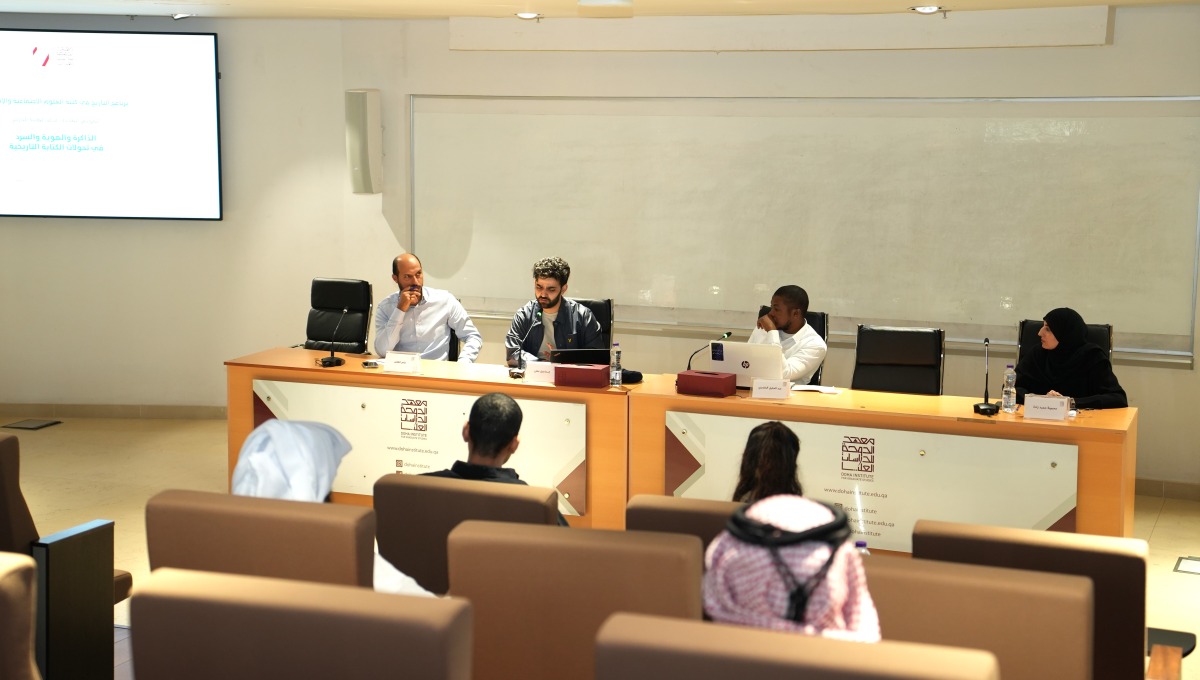
Participants during the conference.
DOHA: The History Programme at the Doha Institute for Graduate Studies (DI) organised its third student conference, titled “Memory, Identity, and Narrative in the Transformations of Historical Writing.”
The conference witnessed wide participation from graduate students, alumni, and young researchers from the History Programme, in addition to participants from related academic disciplines, reflecting a diversity of knowledge and interdisciplinary dialogue in approaches to studying history and its transformations.
In his opening remarks, Dr. Issam Nassar, Head of the History Programme at the Doha Institute, emphasized that the conference serves as an annual platform for presenting and discussing student research projects within a critical academic environment.
This contributes to refining their methodological skills and enhancing their engagement in theoretical discussions related to memory, identity, and historical narratives. He explained that this research path allows for a re-reading of the past in light of social, political, and cultural transformations, thus solidifying the DI’s position as a vibrant intellectual space for the production of historical knowledge in the region.
The conference activities extended throughout the day, comprising four research sessions that collectively reflected a rich body of knowledge and a clear diversity of methodological approaches and geographical perspectives in the study of history.
These sessions included scholarly papers that addressed history as a multi-layered field, where the cognitive intersects with the social, and the local with the transnational.
The first session addressed issues related to the history of knowledge, archival writing practices, and travel literature, in addition to medical history in colonial contexts. It included research papers on the construction of truth in the records of Ottoman Sharia courts, a comparative reading of Persian travel narratives, and a study of the intersections of medicine and colonialism in Morocco.
The second session focused on urban memory and the challenges of state-building and local identity. Papers addressed the formation of place memory in Old Sana’a, the challenges of the emergence of the modern state in Sudan, and the manifestations of shared identity in Oman, along with an analysis of the role of public councils as active spaces in the production of social and political memory.
In the third session, discussions focused on the intellectual and cultural history of Palestine and its intercultural relations. These discussions included studies examining biblical geography and Protestant Orientalism in Palestine, the Russian Orthodox role in the Holy Land, and an analytical reading of 19th-century Chinese travel literature that challenged other narratives.
The conference concluded with a fourth session that addressed topics in Mediterranean and African history. This included deconstructing conflicting narratives surrounding maritime activity in the western Mediterranean during the modern era, examining the epistemological conflict between colonial and local writings in Nigerian historiography, and analysing the impact of indirect rule on the social and political structure of contemporary Nigeria.