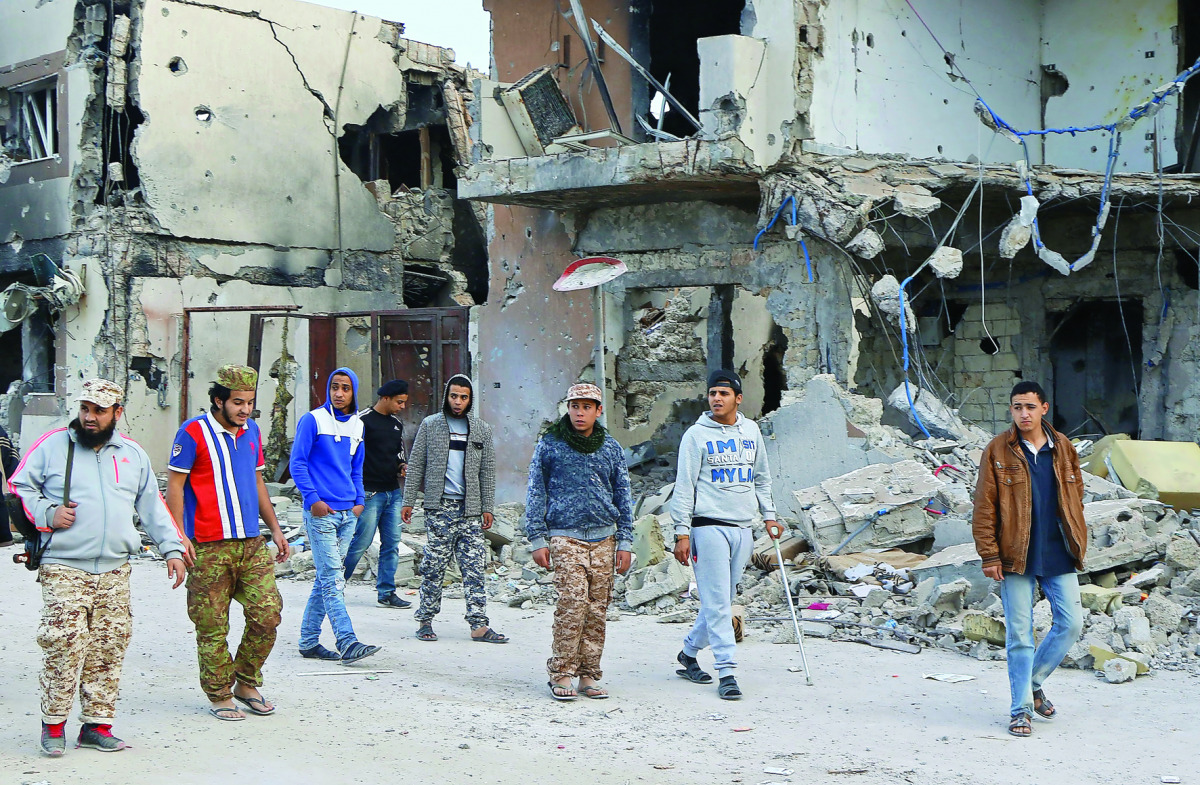
Forces loyal to Libya's UN-backed Government of National Accord (GNA) walk in the Al Giza Al Bahriya area in the former Islamic State (IS) group bastion of Sirte, yesterday.
Tunis: As Islamic State’s last defences crumbled this week in their Libyan bastion Sirte, dozens of women and children used as human shields stumbled dazed and dust-caked from the rubble.
Fighters from the armed groups that defeated the jihadists feted the end of a punishing six-month battle by flying Libyan flags over the Mediterranean city, once known mainly as the home town of late dictator Muammar Gaddafi, more recently as the main stronghold outside Syria and Iraq of Islamic State’s caliphate.
But the campaign has been far from the unifying event some had hoped for. Celebrations have been muted by the risk of jihadist counter attacks and the potential for renewed war among Libya’s military factions. The past week’s developments give a measure of the chaos still enveloping Libya, five years after the Nato-backed uprising that overthrew Gaddafi. Just hours after the last district in Sirte was cleared, fighters in a newly formed force swept up from the desert south of the city towards Libya’s Oil Crescent, looking to recapture ports that had changed hands three months before.
Tripoli has seen its worst clashes for more than a year as the capital’s militias rolled tanks onto the streets in a feud infused with ideological and political disputes. And in the main city in the east, the self-styled Libyan National Army (LNA) continued to suffer heavy casualties as it struggles to secure parts of Benghazi against Islamist-led rivals after more than two years of warfare.
The campaign in Sirte was led by brigades from Misrata, an influential port east of Tripoli. The UN-backed Government of National Accord (GNA) scrambled to take command, but only ever had nominal control over fighters on the ground, some of them with different agendas beyond the campaign in Sirte.