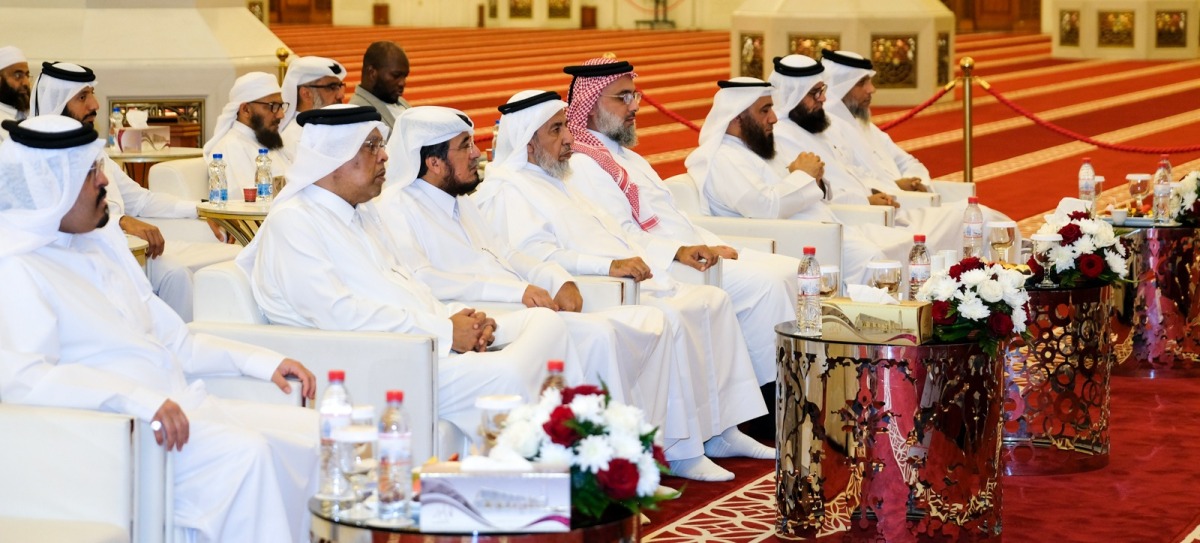
Minister of Awqaf and Islamic Affairs H E Ghanem bin Shaheen bin Ghanem Al Ghanim with other officials during the event.
Doha, Qatar: The Ministry of Awqaf and Islamic Affairs concluded the fourth season of its intellectual and cultural initiative, Nation Seminar, with a symposium exploring the role of divine revelation in reviving the Muslim nation’s civilisational contribution and building individuals capable of shaping the future.
Organised by the Ministry’s Department of Islamic Research and Studies, the seminar, titled, “Knowledge of Revelation: The Path to Civilizational Inheritance,” was held on Tuesday evening at the Imam Muhammad ibn Abdul Wahhab Mosque. The event brought together researchers, academics, scholars and specialists to discuss how a deeper understanding of revelation can help restore the nation’s role in development, reconstruction and civilizational leadership.
The symposium was attended by Minister of Awqaf and Islamic Affairs H E Ghanem bin Shaheen bin Ghanem Al Ghanim, alongside a number of scholars, intellectuals, academics and members of the public. Discussions centred on three key themes: the relationship between revelation and civilisational inheritance, the conditions necessary to attain such inheritance, and rebuilding the Muslim individual’s relationship with revelation as a foundation for cultural and civilisational renewal.
Opening the event, Director of the Department of Islamic Research and Studies Dr. Ahmed bin Mohammed Al Thani, described the Nation Seminar as one of the ministry’s leading cultural and intellectual initiatives, designed to promote knowledge rooted in divine revelation while addressing contemporary intellectual and societal challenges.
He explained that the seminar is held every three months, bringing together leading scholars and thinkers to examine modern cultural and intellectual issues and identify Islamic and scholarly approaches to address social challenges and negative phenomena. The initiative, he said, aims to strengthen public awareness and develop individuals capable of engaging constructively with contemporary issues.
The first session featured Qatari researcher Hassan Abdul Razzaq Al Sayed, a doctoral candidate, who examined the concept of civilisational inheritance through the lens of revelation. He argued that civilisational inheritance extends beyond material achievements to encompass the transmission of values, ethics, knowledge and worldview that preserve a nation’s identity and sustain its mission across generations.
The second session, presented by Dr. Hamid Koufi, professor at the College of Sharia and Islamic Studies at Qatar University, focused on the prerequisites for civilisational inheritance. He stressed that leadership in civilization is not a historical entitlement but a responsibility earned through divine principles and objective conditions.
In the final session, Dr. Alaa El Din Ismail, also from Qatar University’s College of Sharia and Islamic Studies, discussed rebuilding the Muslim individual’s relationship with revelation as the starting point for civilisational revival. He argued that revelation was sent not only to guide personal worship but also to cultivate individuals capable of leadership, development and positive societal transformation.