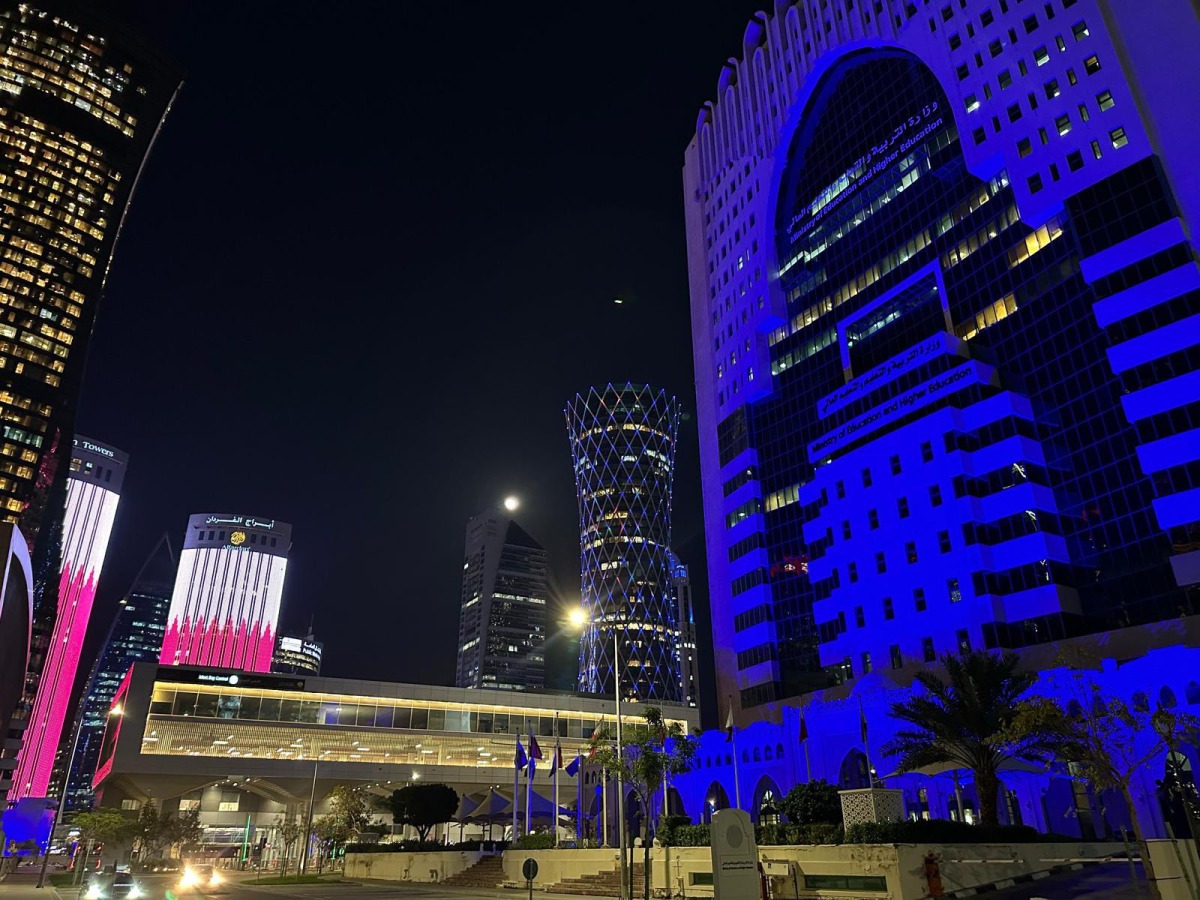
Building of the Ministry of Education and Higher Education was lit up in blue to mark World Autism Awareness Day yesterday.
Doha, Qatar: Marking World Autism Awareness Day, the Ministry of Education and Higher Education (MoEHE) has reaffirmed its commitment to supporting and empowering students with autism spectrum disorder (ASD), advancing inclusive education and fostering greater societal integration.
Demonstrating the efforts of Qatar to support students with autism on the occasion of this day which falls on April 2, the Ministry highlighted that 993 students with autism are currently enrolled across public schools and kindergartens in Qatar, reflecting the growing focus on inclusive educational services nationwide.
It reiterated that these efforts align with the global efforts of promoting awareness, inclusion, and empowerment under the theme “Autism and Humanity – Every Life Has Value.” Autism spectrum disorder is a neurodevelopmental condition that affects communication and social interaction, with varying characteristics and levels of severity from one individual to another. Recognising this diversity, the Ministry continues to implement comprehensive strategies tailored to meet students’ individual needs.
At the core of Qatar’s approach is the provision of inclusive and diverse learning environments. Students are supported through both mainstream inclusion schools and specialised institutions, including Al Hidaya schools and kindergartens, ensuring access to appropriate educational pathways.
These environments are reinforced by early intervention and functional assessment services delivered in collaboration with Hamad Medical Corporation. To further expand educational choices, the Ministry offers educational vouchers for parents who prefer enrolling their children in private schools.
In parallel, internationally recognised programmes are implemented, such as Applied Behavior Analysis (ABA), the Picture Exchange Communication System (PECS), and the TEACCH approach, all designed to enhance communication, behaviour, and structured learning.
A wide range of support services is also provided, including speech and language therapy, occupational therapy, and physiotherapy.
In addition, families benefit from consultations and training workshops aimed at strengthening collaboration between home and school, ensuring a holistic support system for students.
The Ministry has also integrated advanced technologies, providing modern devices and software to facilitate learning and help students develop essential skills. At the secondary level, specialised vocational and technical pathways are available to prepare students for the labour market, promoting independence and long-term success.
Students with autism are actively encouraged to participate in competitions, extracurricular activities, and annual career and technical exhibitions, further enhancing their social engagement and confidence.
Through these comprehensive initiatives, the Ministry continues to emphasise the importance of awareness and inclusion, working toward a more understanding and supportive society. On this global occasion, Qatar reiterates its commitment to empowering individuals with autism to become active and impactful members of the community.
Since the United Nations General Assembly designated April 2 as World Autism Awareness Day (WAAD) in 2007, the UN has worked to promote the full realization of human rights and fundamental freedoms for autistic individuals, ensuring their equal participation in society.