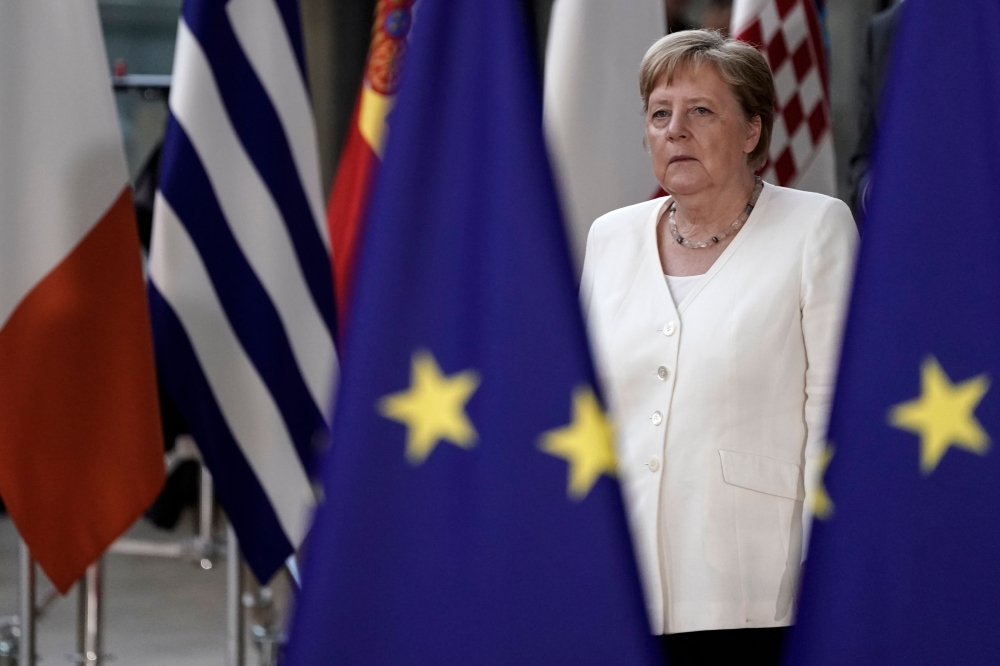
Germany's Chancellor Angela Merkel arrives for European Council Summit at The Europa Building in Brussels, on June 30, 2019. AFP / Kenzo Tribouillard
If there was one thing Angela Merkel didn’t factor into her plan to make Socialist Frans Timmermans the European Union’s next chief executive, was what one official in the room called the "rebellion of rabbits.”
As she flew back from the Group of 20 in Japan, the German chancellor and veteran of many an EU marathon summit was fairly confident that the 58-year-old Dutchman would be accepted by the rest of the leaders gathering in Brussels to decide who to put forward as the next head of the European Commission.
Sure, it was going to be a long night, but she’s faced down worse in her time. As the sun rose, there was no deal and what became clear was that Merkel had miscalculated the degree of opposition on two fronts: from her own center-right political family that felt betrayed she gave away the top prize. And also the smaller countries that often feel unseen that bared their teeth at the what felt like a stitch-up cooked up in Osaka.
With no decision made, Merkel has got a mutiny on her hands: from her colleagues in the European People’s Party (that hold the most seats in the European Parliament) and a coterie of Eastern and central European nations that have ganged up with Italy to double down.
In a bid to win their support, the chancellor wound up holding one-on-one meetings around dawn on Monday. The following is a sketch of all that went wrong from eight officials briefed on the various mishaps over the course of several sleepless hours.
The stage wasn’t properly set. Deals and assurances weren’t put in place. Young powers smelled blood, EU officials said. One person close to the discussions said Merkel was up against "a rebellion of rabbits” -- a reference to the ability of those seen as weak and insignificant to rise up and rebel.
It may not have been of Merkel’s making, and she may have endorsed it only in the spirit of compromise, but the fierce opposition to the plan erodes the chancellor’s grip and authority -- even if an accord is reached. Talks have now gone on longer than the 2015 Greek crunch meeting when she was at height of her power.
The decision on who to nominate to the top EU post is a key piece of a puzzle that includes the bloc’s other top positions, including Mario Draghi’s successor at the European Central Bank. The process has been deadlocked as governments make conflicting pitches and the EU tries to share power across geography, gender and political parties.
A Bad Look
Leaders acknowledge time is running out and the credibility of the EU is at stake. The eastern-led front of skeptics opposes Merkel’s package as a whole, not just the central element that would see Timmermans at the helm of the commission.
He speaks several languages fluently, including English, French and German, so is considered an ideal fit. Yet, having worked in Brussels only since 2014, he isn’t seen as part of the European establishment. And crucially, for eastern countries, in his current role as the commissioner in charge of rule-of-law issues, he’s given Hungary and Poland a tough time over their democratic standards.
The group is within striking distance of a blocking minority to the deal, and European Council President Donald Tusk is reluctant to put the accord to a vote, both because of the optics of division and the real risk of it being rejected.
Some of those center-right leaders who reluctantly accepted the crux of the plan are vying for the presidency of the EU Council as compensation for waiving their claim to the commission. Under what’s now called the Osaka accord, the EPP would only get the presidency of the European Parliament, a largely symbolic role, and the post of the foreign-policy chief.
"As the EPP we haven’t agreed to the package that was negotiated in Osaka,' Irish Prime Minister Leo Varadkar said. 'The vast majority of the prime ministers don’t believe that we should give up the presidency of the commission quite so easily, without a fight. And secondly, a lot of the countries in central and eastern Europe are opposed to Timmermans.'
The crisis between Merkel and the EPP hadn’t been anticipated, a European official said, citing a lack of communication between the chancellor and the EPP. Merkel just didn’t see the clash coming, the official said.
Others lashed out at the chancellor, saying the impasse is a sign of how much of a lame duck she is. There was no plan to come up with a proposal that her own people, lawmakers at the EU parliament and other center-right leaders were going to shoot down in such an insulting manner.
"Merkel is leader of the CDU, not the EPP,” Bulgarian Prime Minister Boyko Borissov told reporters. "Well many other things came from Osaka as well. But nobody has the right to negotiate on our behalf, from EPP, whatever post they have.”
Such open defiance and show of disdain for Merkel would have been unthinkable even a year ago. Today she appears a weakened figure, both at home and internationally, with her term ending in 2021.