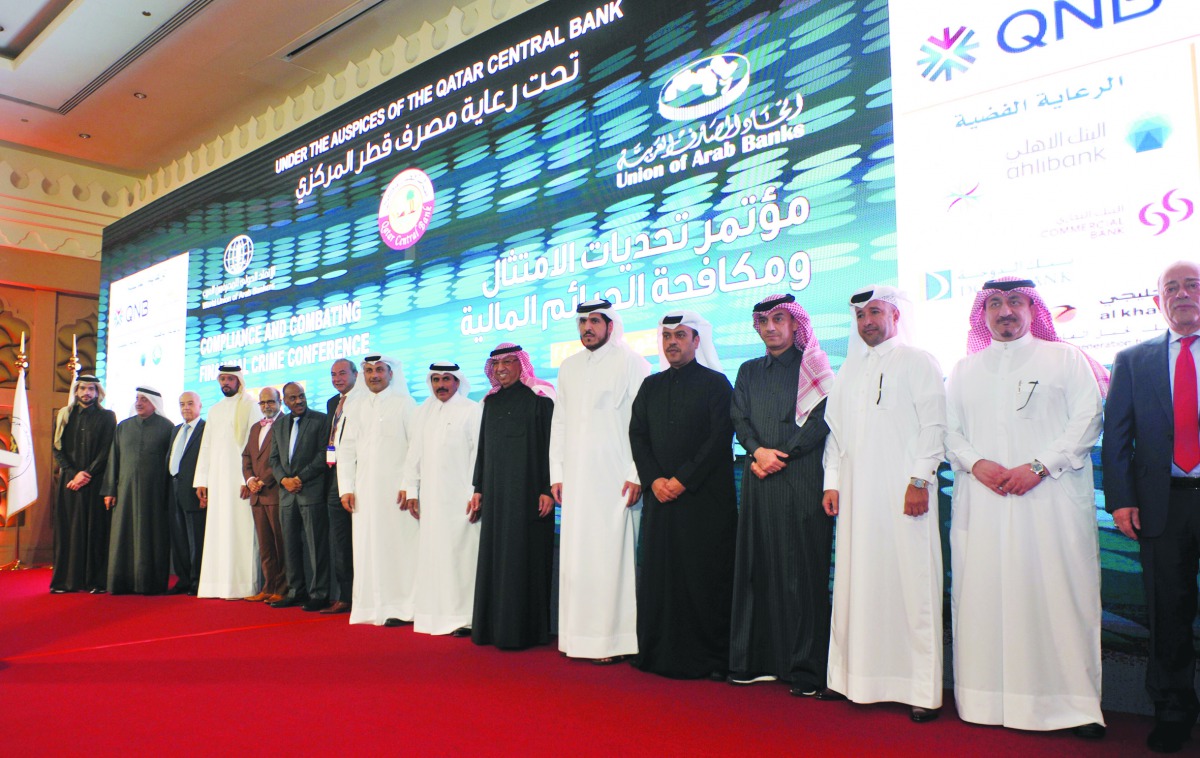
H E Sheikh Abdulla bin Saoud Al Thani, Governor of Qatar Central Bank; H E Sheikh Mohammed bin Hamad Al Thani, Deputy Governor of QCB and Chairman of National Anti-Money Laundering and Terrorism Financing Committee; Chairman of Union of Arab Banks Kuwait,
Doha: H E Sheikh Mohammed bin Hamad Al Thani, Deputy Governor of Qatar Central Bank (QCB), who is also the Chairman of the National Anti-Money Laundering & Terrorism Financing Committee, at an event yesterday stressed on the need to unify efforts to confront and combat financial crimes, which are developing rapidly with the advancement of technology.
In his opening address at ‘Compliance Challenges and Combating Financial Crime Conference, the Deputy Governor of QCB also urged the financial institutions to understand the risks of financial crimes of all kinds and to apply due diligence in combating them according to best practices, adopting financial technology innovations and promoting financial inclusion.
The two-day conference, organised by the Union of Arab Banks and the World Union of Arab Bankers, under the auspices of the QCB, started yesterday with the participation of a group of senior specialists in the field of financial crime, anti-money laundering and terrorist financing from various countries of the world.
During the opening session, speakers stressed on the importance of this conference, which was attended by H E Governor of QCB Sheikh Abdullah bin Saoud Al Thani, and noted the efforts made by Qatar in the field of combating money laundering and terrorist financing.
The two-day conference will discuss the following: Combating Financial Crime: Compliance and Regulatory Issues, Cybersecurity and Transaction Monitoring and Filtering Leveraging Up Technology and Data Analytics, Updating AML Models to Meet Global Ultimate Beneficial Ownership (UBO) Standards, Compliance data protection, securing access among the required channels: Global AML Issues in 2020 and Challenges and Opportunities to enhance the relations with Correspondent Banks.
The Deputy Governor of the QCB said that Qatar has reviewed all legislation related to combating money laundering and terrorist financing in accordance with the international standards issued by the Financial Action Task Force (FATF). He referred to the issuance of law No. 20 of 2019 on combating money laundering and terrorism financing to replace Law No. 4 of 2010 and the issuance of law No. 27 of 2019 on counter-terrorism to replace law No. 3 of 2004.
Sheikh Mohammed also indicated that Qatar has made the necessary amendments to a number of laws related to combating money laundering and terrorist financing which contributes to setting the best legislative practices for an integrated system.
He affirmed the country’s commitment to FATF’s recommendations as a member of both FATF and the Middle East and North Africa Financial Action Task Force (MENAFATF), and through its membership in the Cooperation Council for the Arab States of the Gulf.
On the global challenges related to financial crime, he drew attention to the great development that the technology sector has witnessed during the past two decades. He added that development brought many risks and challenges, and that crime and the diversity of methods of committing it, has evolved, and takes advantage of the latest technology.
He warned that financial crimes are developing rapidly with the progress of technology; pointing out to the impact those crimes have on the economy and financial stability. In this context, the Deputy Governor of QCB emphasised the necessity of uniting efforts in the face of these crimes.
Meanwhile, he urged the financial institutions to understand the risks of all kinds of financial crimes, and called for due diligence at combating it according to the best practices, as well as adopting financial technology innovations and enhance financial inclusion.
At the same level, he emphasised that these challenges place a heavy burden on regulatory authorities to confront it, reducing risks and as a result limiting financial and electronic crimes. At the same time, he pointed out the important role and responsibility of all sectors has in confronting these risks, in addition to the international efforts represented in the designated organizations.
Furthermore, he praised in his speech the support of the Union of Arab Banks for the efforts of central banks and Arab financial institutions in a number of fields including the combating financial crimes.
He also noted the meaningful activities such as conferences, workshops and seminars held by the Union in various Arab capitals, as well as the training and contribution to the develop banking services.
For his part, Vice-Governor of the Central Bank of Lebanon Dr Muhammad Baasiri said that the Arab world has come a long way in terms of combatting financial crimes on the legislative and regulatory levels. He stressed on the importance of fighting all kinds of corruption, and to enhance cooperation with countries like the United States who have all the capabilities needed to tackle financial crimes.