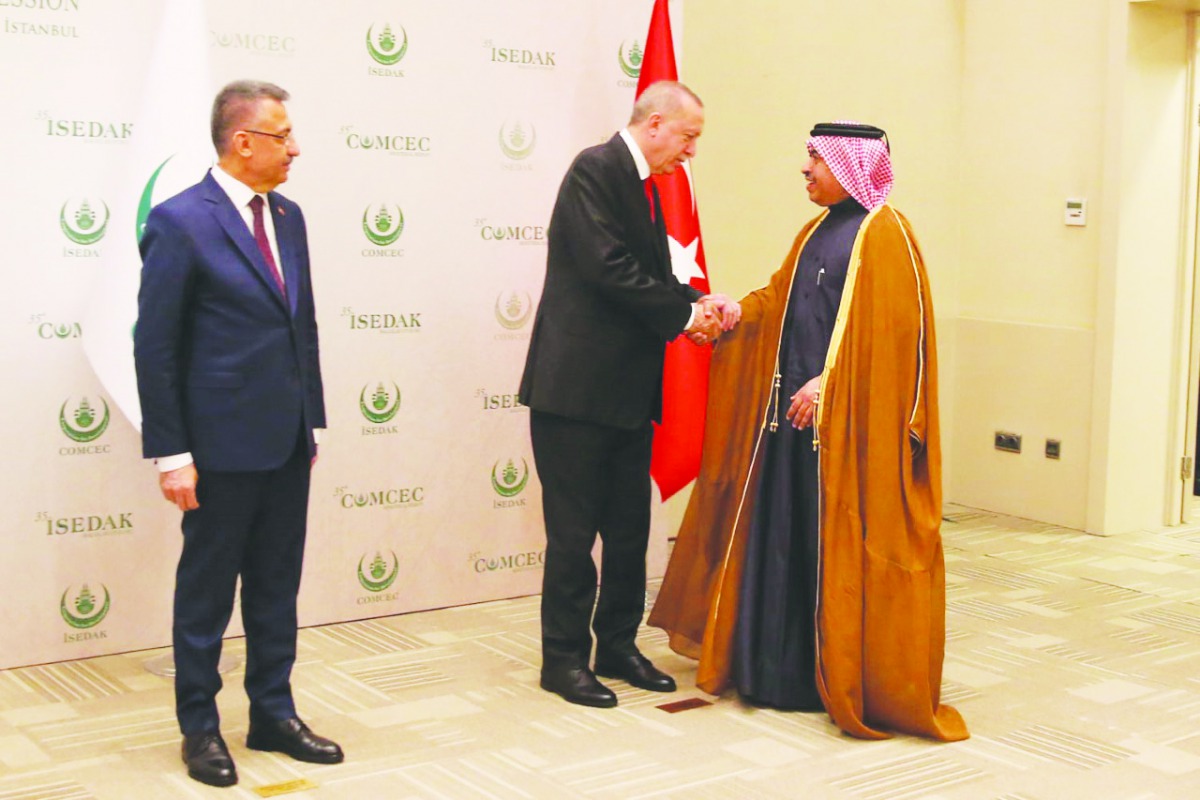
President of the Republic of Turkey, Recep Tayyip Erdogan, receiving H E Ali bin Ahmed Al Kuwari, Minister of Commerce and Industry, during a COMCEC meeting in Istanbul yesterday.
DOHA: H E Ali bin Ahmed Al Kuwari, Minister of Commerce and Industry has hailed Turkey for its efforts taken within the framework of Economic and Commercial Cooperation of the Organization of Islamic Cooperation (COMCEC) to move forward with the implementation of key projects and initiatives that promote economic integration and cooperation among Islamic countries.
Minister Al Kuwari chaired Qatar’s delegation to the 35th ministerial meeting of the Standing Committee for Economic and Commercial Cooperation of the Organisation of Islamic Cooperation (COMCEC). Qatar is representing the Arab group at the four-day event, which is taking place in Istanbul, Turkey, on November 25-28, 2019.
Speaking at COMCEC’s opening meeting, Minister Al Kuwari noted that the meeting in Turkey is taking place at a time of delicate geostrategic and economic changes, a slowdown in multilateral trade and a lack of tangible progress at the WTO’s 11th Ministerial Conference. He warned of the potential negative repercussions of global political uncertainties, which are leading to rising economic nationalism and protectionist measures at the global trade level.
On the potential repercussions of Brexit, the Minister said it would impact many countries, particularly GCC member states that enjoy close and distinguished relations with the UK.
Al Kuwari called for taking a major step in joint Islamic action to establish innovative initiatives that contribute to overcoming difficulties and obstacles facing OIC member states and further efforts within the framework of COMCEC to implement future plans, in particular the economic aspects of the OIC Ten-Year Programme of Action, which calls for a 25 percent increase in intra-regional trade by 2025, as well as gradual measures to establish a free trade area that lifts all customs and non-tariff barriers and restrictions.
In this context, the Minister hailed the efforts of Arab countries in terms of moving forward with the adoption of COMCEC’s recommendations, their effective contribution to the implementation of the ten-year programme, the OIC strategy, and the Arab Customs Union project, which would serve the objectives of Islamic countries and promote joint Islamic action at the economic and commercial levels.
Referring to the definition of food security by the Food and Agriculture Organisation of the United Nations (FAO), the Minister said a food crisis exists in Muslim countries as evidenced by the growing dependence on external sources to meet the nutritional needs of the populations of Islamic countries, the decline in per capita agricultural output and the contribution of the agricultural sector to GDP.
He added that the majority of Islamic countries, especially African countries, are facing a number of challenges relating to food security and agricultural development as these countries tend to provide support for service sectors instead of stimulating agricultural production, which has resulted in a the decline in the average contribution of the agriculture sector to the GDP of Islamic countries from 23 percent in 1990 to 17 percent in 2016. He praised the 2025 Action plan adopted by the 13th Islamic Summit held in Istanbul, noting that the plan represents an important roadmap to achieve the goals and objectives in this field.
The Minister called on the Islamic Organisation for Food Security (IOFS) to prioritize intra-agricultural investments, encourage and channel investments into the agriculture sector in Islamic countries.