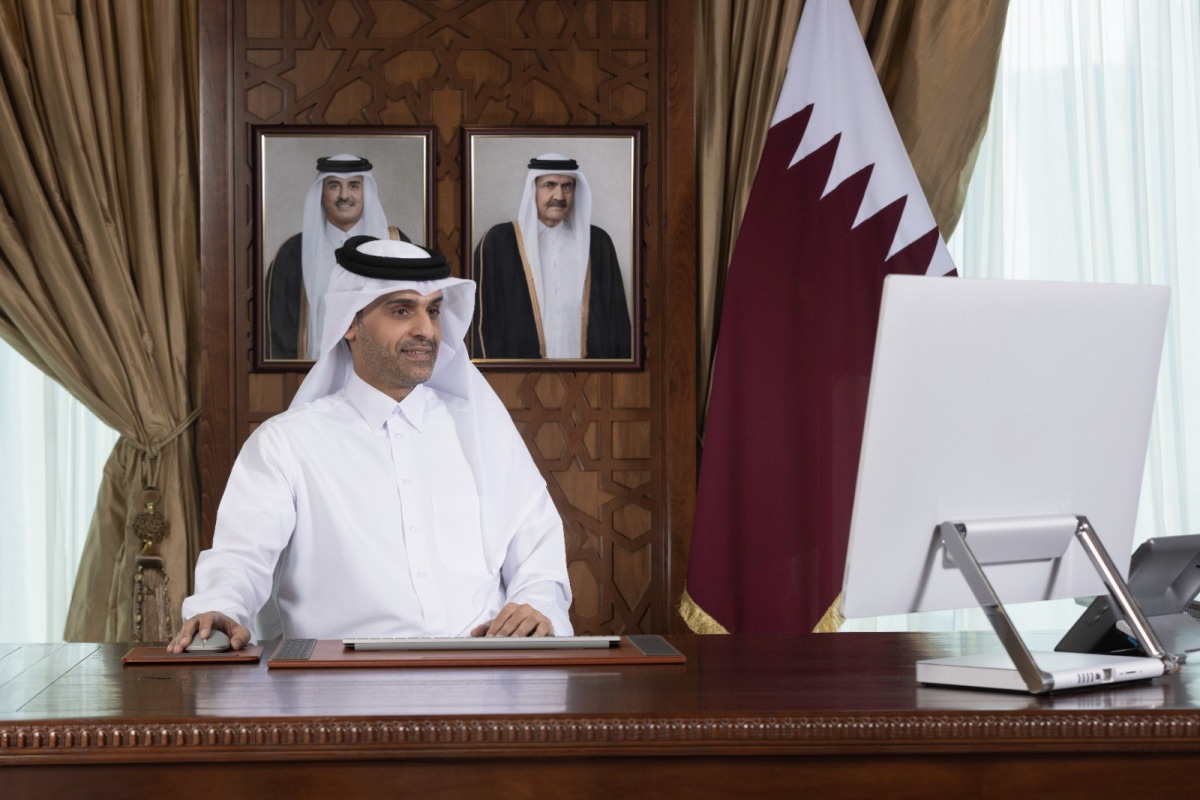
Minister of Transport H E Sheikh Mohammed bin Abdulla bin Mohammed Al-Thani taking part in the 28th extraordinary meeting of the Committee of Transport Ministers of the Gulf Cooperation Council via videoconference yesterday.
DOHA: Qatar’s delegation headed by Minister of Transport H E Sheikh Mohammed bin Abdulla bin Mohammed Al-Thani took part in the 28th extraordinary meeting of the Committee of Transport Ministers of the Gulf Cooperation Council (GCC) states, held via videoconference yesterday.
The GCC transportation ministers in attendance discussed the current regional situation and its impact on supply chains. They also agreed on several recommendations to enhance the sustainability of land and maritime transportation industries in their countries.
They aim to ensure the continuity of supply chains and trade flow amid the current situation in the region.
The recommendations included adopting exceptional and flexible procedures to facilitate land transportation and address the urgent challenges that can impede its smooth flow.
This aims at ensuring the continuity of operational processes and smooth movement of trucks, buses and taxis between member states during the current regional conditions.
They also included applying seamless procedures at ports located outside the Strait of Hormuz for goods destined for the GCC countries, activating green corridors, and enhancing the efficiency of logistic connectivity between these ports and logistic hubs in the GCC countries by improving the readiness of land ports and facilitating the movement of trucks crossing borders.
Furthermore, the Ministers also recommended allocating prioritised logistic routes for goods and essential commodities arriving through alternative ports.
But they underlined the importance of minimising physical inspection procedures and relying more often on advance inspection solutions using modern technologies.
Additionally, it’s been agreed to form a permanent taskforce of representatives from port authorities, land transportation and customs authorities, along with the General Secretariate of the Cooperation Council for the Arab States of the Gulf, to monitor the work progress on this alternative plan and address any obstacles immediately.
Secretary General of the Gulf Cooperation Council (GCC) Jasem Mohamed Albudaiwi indicated that the meeting addressed a number of proposed measures, particularly activating the Green Lanes Protocol, utilizing alternative ports and safe transport routes, in addition to developing joint coordination mechanisms to monitor the situation in real time and address any potential bottlenecks.
The GCC Secretary General said that the escalating challenges witnessed in the region as a result of the blatant Iranian military escalation targeting the GCC countries are no longer a transient situation, but rather constitute a real test of the GCC ability to protect its achievements and ensure the continuity of its vital sectors with efficiency and stability.
He added that the intensive coordination meetings, which have exceeded 35 meetings since the outbreak of the crisis, reflect an advanced level of institutional readiness and a shared awareness of the nature of this phase and its requirements.
He added that maintaining the smooth flow of land, maritime, and air transport is no longer an option, but a strategic necessity that requires additional proactive steps to enhance the readiness of crossings and minimize any potential impact on trade movement and supply chains.
He affirmed that the GCC countries are capable of overcoming crises and challenges with efficiency and competence, based on the strong ties and effective integration that bring them together across all fields. He stressed that this phase requires clarity of vision and speed in decision-making and implementation.