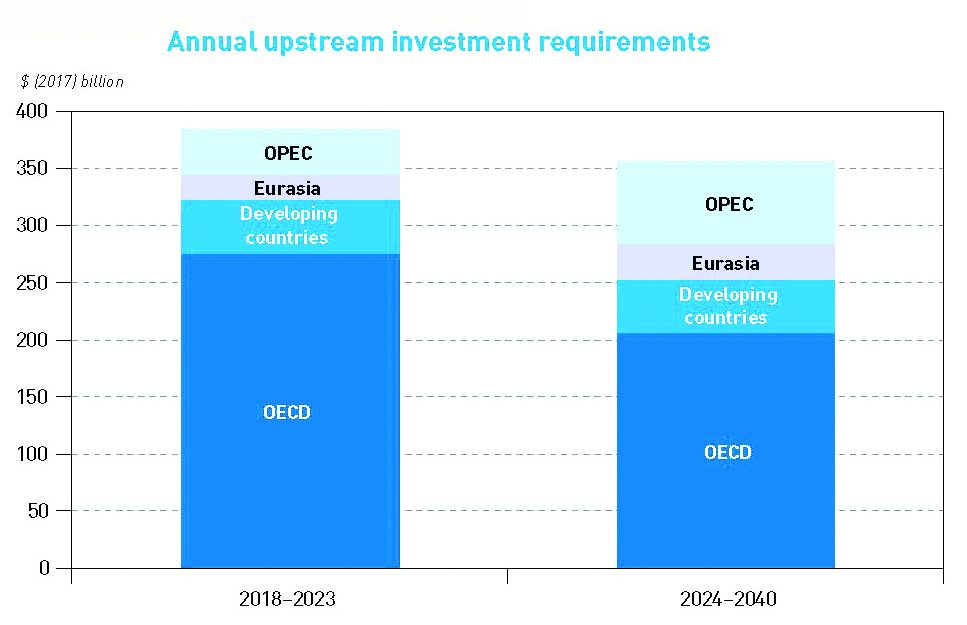
DOHA: Global oil industry is required to invest an estimated $11 trillion over the period to 2040. The upstream investments alone need almost $8.3 trillion during 2018-2040. In the Middle East, petrochemical sector investment is expected to be in the range of $60 to $80bn in the next few years, Opec revealed in its World Oil Outlook (WOO) released yesterday.
The WOO 2018-2040 analyses the industry’s various linkages, its shifting dynamics and considers developments in areas such as the global economy, energy demand, oil supply and demand, both in the upstream and downstream, policy and technology developments, and environment and sustainable development concerns.
Most of the projected investments are in non-Opec countries, and over the medium-term they are estimated to invest on average around $350bn per annum. The medium-term number for Opec Member Countries is an estimated average of more than $40bn per annum, and then over $60bn annually in the long-term. Average annual long-term upstream investment requirements for non-Opec are forecast to decline to around $280bn on the back of declining crude supply. The OECD’s share in global investment is anticipated to be more than 60 percent of the global total given the high costs – for both conventional and unconventional crudes – and decline rates.
The total investment volume of the three downstream categories – known projects, required additions and maintenance/capacity replacement – is estimated at just under $1.5trillion in the period 2018–2040. Of this, $283bn is expected to be invested in known medium-term projects, while $306bn is anticipated to be invested into additions beyond known projects in the long-term. The investment requirement for maintenance and replacement is estimated at around $895bn for the whole period 2018–2040.
Overall, including midstream investments of around $1trillion, in the period up to 2040 the required global oil sector investment is estimated at almost $11trillion.
According to Opec’s World Oil Outlook, long-term oil demand is expected to increase by 14.5 mb/d to reach 111.7 mb/d by 2040. This is slightly higher than last year’s number, in spite of overall demand growth generally slowing over the projection period.
For supply, total non-Opec liquid supply is projected to expand significantly, with the majority of the growth over the next decade coming from US tight oil. Global tight oil supply is projected to expand to 16 mb/d by the late 2020s, making up almost 25 percent of non-Opec supply by then.
The upshot is that the long-term focus for additional liquids remains on Opec. In terms of crude, it is estimated that demand for Opec crude rises by 7.3 mb/d over the forecast period, and for all liquids the figure is 10.5 mb/d. The share of Opec crude in the global oil supply is expected to increase from 34 percent in 2017 to 36 percent by 2040.
Oil is presumed to remain the fuel with the largest share in the energy mix over the forecast period, led by demand from transportation and petrochemicals. Combined, oil and gas are still expected to make up more than 50 percent of the global energy mix by 2040.
The fuel with the largest estimated demand growth is natural gas, increasing by almost 32 mboe/d between 2015 and 2040, an annual average growth rate of 1.7 percent. Consequently, the share of natural gas in the global energy mix accounts for 25 percent in 2040, up 3.3 percentage points from 2015.