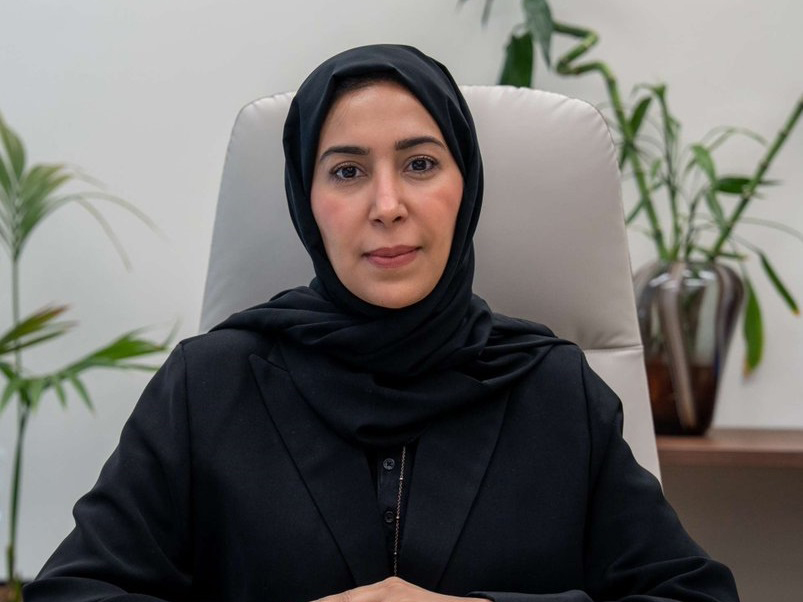
Director of the Curriculum and Learning Resources Department Sara Issa Al Sharim.
Doha, Qatar: The Ministry of Education and Higher Education is stepping up efforts to develop curricula that equip students with knowledge, life skills and future-ready competencies, while strengthening their national identity and Islamic values, said Director of the Curriculum and Learning Resources Department Sara Issa Al Sharim.
Speaking to Qatar News Agency (QNA) ahead of the new academic year, Al Sharim said five school subjects underwent development during the 2025-2026 academic year: history and geography for Grade 11, French and science for Grade 10, and information technology. She noted that 612 coordinators and teachers had been trained on the newly developed curricula.
The department is also responsible for developing 18 compulsory and elective subjects and conducted 106 field visits to schools to monitor curriculum implementation across various subjects, she added.
Al Sharim explained that the Curriculum and Learning Resources Department adopts a continuous, evidence- and data-driven approach to curriculum development, taking into account national and global developments, the needs of learners and society, and learning outcomes. These considerations are then reflected in standards, content and learning experiences that are practical, measurable and responsive to evolving educational needs.
She added that the process also involves ongoing assessment, scientific review and drawing on national and international expertise to ensure that curricula remain aligned with future requirements while preserving Qatar's national identity, reflecting its social context and supporting its future aspirations.
Al Sharim said that the national curriculum serves 154,564 students in government schools, from kindergarten through Grade 12, including adult education students, as well as 193,500 students in private schools who study Arabic language, Islamic studies and Qatar history as part of the curriculum.
She underscored the Ministry's commitment to developing well-rounded learners equipped with the knowledge, life skills and values needed to succeed in life and prepare for the future, while enabling them to pursue lifelong learning and adapt to change.
She stressed that the curricula seek to combine high-quality learning with the promotion of Islamic values and national identity, while fostering critical thinking, creativity, communication and problem-solving skills. They also address the diverse needs of learners by providing flexible and equitable learning opportunities that enable every student to discover and develop their potential.
Al Sharim noted that Qatar's curricula have undergone significant transformation in recent years, moving beyond knowledge acquisition to equip students with the ability to apply what they learn in real-life contexts. The reforms have also strengthened digital competencies and fostered critical thinking, creativity and innovation.
Educational pathways have been diversified, while specialized education has been expanded to better match students' abilities and interests and strengthen alignment with the needs of higher education and the labor market. These efforts also aim to prepare students to play an active role in building strong families and contributing to society, in line with Qatar National Vision 2030's goal of developing qualified human capital to support sustainable development and the knowledge economy.
She noted that the department publishes 535 school textbooks annually, with a total print run of 4,415,260 copies.
Al Sharim emphasized that recognizing the diversity of students' abilities and needs is a fundamental principle in designing the learning process. This is reflected in flexible teaching strategies, learning resources, assessment methods and support systems that provide each student with appropriate opportunities to learn and progress in line with their individual abilities and potential
The Ministry also draws on leading international educational experiences and practices as a source of learning and comparison, she said, noting that these experiences are carefully studied and adapted to align with Qatar's educational priorities, as well as the needs and aspirations of its society.
She stressed that the aim is not to replicate international models, but to learn from the best practices and adapt them in ways that add value to education in Qatar.
Regarding the most prominent challenges facing curriculum development, the Director of the Curriculum and Learning Resources Department at the Ministry of Education and Higher Education explained that the real challenge lies not so much in the speed of updating content, but rather in the rapid pace of change in the world itself, given the accelerating transformations in skills, jobs, and technologies. This makes it difficult to build a curriculum based on detailed predictions of the future job market.
Al Sharim emphasized that the focus is on building students' adaptability by providing them with a strong knowledge foundation and developing core skills such as thinking, analysis, self-learning, technology interaction, teamwork, and problem-solving.
Regarding the role of curricula in consolidating national identity, citizenship values, and social responsibility, she noted that curricula play a pivotal role in preparing a generation proud of its Islamic faith, Arab identity, and Qatari heritage. This is coupled with a focus on 21st-century skills, most notably critical and creative thinking, problem-solving, communication and teamwork, digital skills, research, and self-learning.
She pointed out that these skills developed hand-in-hand with knowledge. Through projects, applications, real-life situations, research, and inquiry, students are able to analyze information, ask questions, find solutions, and make decisions. She noted that the curriculum also extends to life skills such as financial and family literacy, entrepreneurship, and volunteer work, contributing to preparing students for life and future academic and professional paths.
She noted that digital skills are integrated progressively across grade levels, starting with basic technology skills, moving through programming and algorithms, and advancing to topics and applications related to artificial intelligence, robotics, and cybersecurity. The curricula also place strong emphasis on safe and responsible technology use, information verification, and digital output validation, empowering students to conscientiously employ technology in learning, daily life, and preparing them for future studies and work.
She added that among the most prominent strategic projects currently underway at the department is the development of the General Framework for Qatar's National Curriculum and the defining of learner attributes, serving as a benchmark for curriculum enhancement based on targeted future learner specifications.
She explained that this project focuses on building the student's character and identity by instilling national identity and Islamic values, promoting the status of the Holy Quran and the Arabic language, and simultaneously fostering openness to learning international languages, including French, German, and Japanese, alongside efforts to introduce Spanish and Chinese.
The Ministry is also working to strengthen future skills, research, and innovation by expanding digital skills, coding, artificial intelligence, scientific research, STEM projects, and applied learning, alongside nurturing critical thinking, creativity, and independent learning.
She emphasized that the curricula place a strong emphasis on life-oriented learning through financial literacy, entrepreneurship, career pathways, family culture, home economics, and life management skills, helping students take responsibility for themselves, their families, and their communities. Topics on health, physical activity, nutrition, obesity prevention, sustainability, environmental issues, and carbon emissions are also incorporated.
She highlighted the Ministry's commitment to creating a more flexible and inclusive learning environment that accommodates students' varying abilities and interests by providing self-learning materials that support well-being and foster a passion for knowledge.
Concluding her interview with Qatar News Agency (QNA), the Director of the Curriculum and Learning Resources Department reiterated that the Ministry's ultimate goal is to cultivate a learner who takes pride in their identity and values, possesses knowledge alongside life and future skills, and is prepared not merely for a specific job, but as a well-rounded individual capable of continuous learning, adapting to change, creating opportunities, and actively contributing to their family, community, and national development.