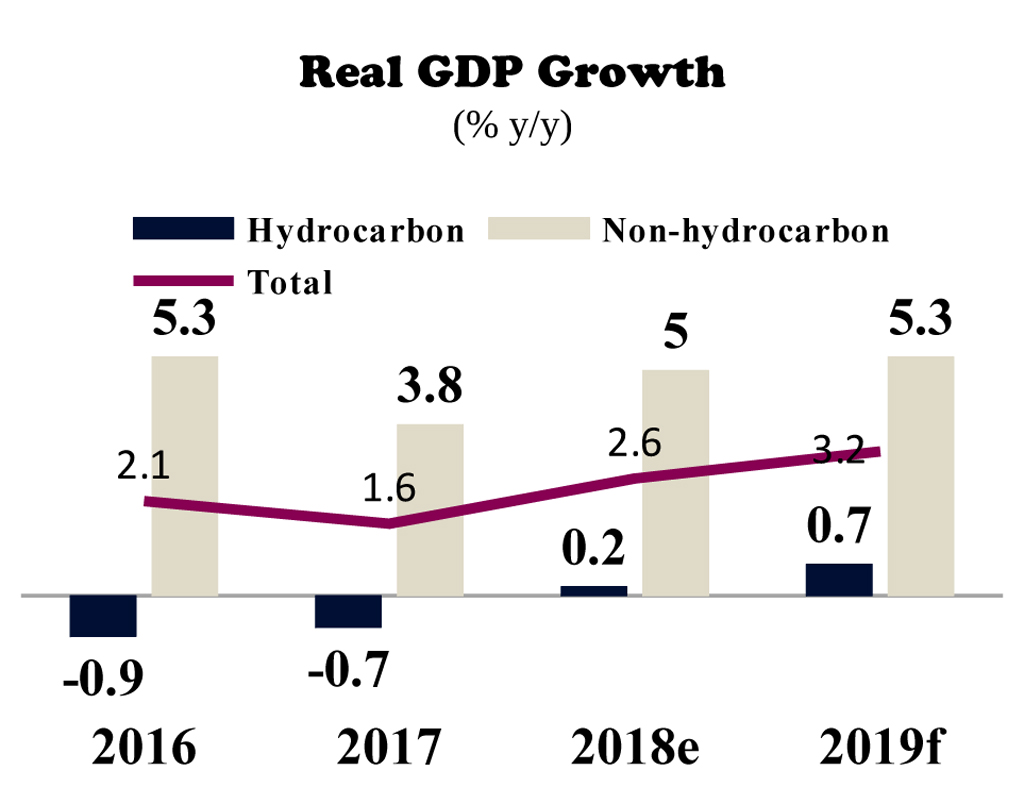
DOHA: Qatari economy is on the course for an overall growth of 2.6 percent and non-hydrocarbon growth of 5 percent. Activity is expected to accelerate further in 2019 with GDP growth of 3.2 percent and non-hydrocarbon growth of 5.3 percent.
QNB noted in its weekly ‘economic commentary’ yesterday that the country’s economy grew by 1.6 percent in 2017 braving an unjust blockade imposed on Qatar by some neighbouring countries. Non-hydrocarbon GDP growth was a solid 3.8 percent in 2017.
The GDP growth is forecast to gain by a solid 2.6 percent in 2018 as the drag from the hydrocarbon sector abates and the non-hydrocarbon sector is supported by construction, agriculture, manufacturing, transportation and storage. Higher oil prices will allow for some positive multiplier effects on domestic demand and also support current account surpluses.
Reflecting recent strength, our oil price forecasts are revised up to $72/b in 2018 and $69/b in 2019 (previously $69/b and $66/b). Strong global demand and various supply disruptions will keep prices firm well into 2019 before slowing global GDP growth and continued increases in US shale supply damp prices somewhat.
On the hydrocarbon side of Qatar’s real economy, a growth of 0.2 percent is anticipated, which would end four years of declines. The lifting of Opec production cuts should modestly boost crude oil production, while the end of maintenance work and temporary shutdowns should start to spur a recovery in LNG output through the year. A further pick up of 0.7 percent in hydrocarbon output is then expected in 2019.
Total non-hydrocarbon GDP growth was a robust 4.9 percent year-on-year in Q1, 2018, starting the year on a strong footing. Non-hydrocarbon GDP is expected to gain by 5 percent in 2018. For 2019 as a whole, QNB forecasts non-hydrocarbon GDP growth of 5.3 percent.
Accounting for 21 percent of non-hydrocarbon output, construction activity was up 17.5 percent in 2017, supported by key infrastructure projects related to Qatar’s Vision 2030 and also the 2022 World Cup. The construction sector’s buoyancy has continued so far in 2018 with the latest data showing output up 17.2 percent year-on-year in the first quarter.
Growth in the manufacturing sector, which accounts for a further 19.5 percent of non-hydrocarbon GDP, recovered to 1 percent in 2017 as projects aimed at greater self-sufficiency and food security start to take effect.
Their impact can be seen more clearly in recent quarters with manufacturing output growth up 3 percent year-on-year in Q1, 2018.
Government policies to promote private-sector development are also lifting domestic demand. Agriculture (8.2 percent growth), manufacturing (3.2 percent), transportation and storage (3 percent) are expected to be the key beneficiaries with growth in these sectors expected to pick up further in 2019.
Continued population growth, with mid-year population expected to hit a record 2.81 million in 2018 then rising further to 2.89 million in 2019, will also work to spur additional domestic demand.
External finances will be robust. The current account surplus should approach 9 percent of GDP in 2018: an improvement of around 4 percent of GDP in 2017 before subsiding to around 7 percent of GDP in 2019 as oil prices slip. Import growth is expected to remain moderate.
Helped by higher hydrocarbon prices, government finances are expected to steadily improve with the budget seen in broad balance in 2018 before a larger surplus emerges in 2019. The introduction of VAT in 2019 will lift revenues and help diversify the tax base.
Reflecting deflation in rental prices and slower food inflation, overall CPI inflation is expected to remain damped until the anticipated introduction of VAT boosts inflation. QNB targets average CPI inflation of 0.5 percent in 2018, rising to 1.9 percent in 2019.
Qatar’s banking system remains healthy with ample liquidity, high asset quality and strong capitalisation. Deposit of 6 percent and loan growth of 5 percent is expected this year, which should result in some further decline in the loan-to-deposit ratio.
From 2019 onwards, the decision to increase LNG output by 30 percent by 2024 will increasingly drive Qatar’s next development phase. The 30 percent increase will boost Qatar’s LNG capacity from 77 million tonnes currently to 100 million tonnes by 2024.
This increase in capacity will require substantial investments both onshore and offshore including the construction of three new LNG trains to process the gas.
Beyond the direct impact on non-hydrocarbon GDP, this new investment phase, which should begin in earnest from 2020 onwards, will generate substantial multiplier effects on the wider economy, lifting demand for goods and services and driving the country’s development in line with the Qatar National Vision 2030.