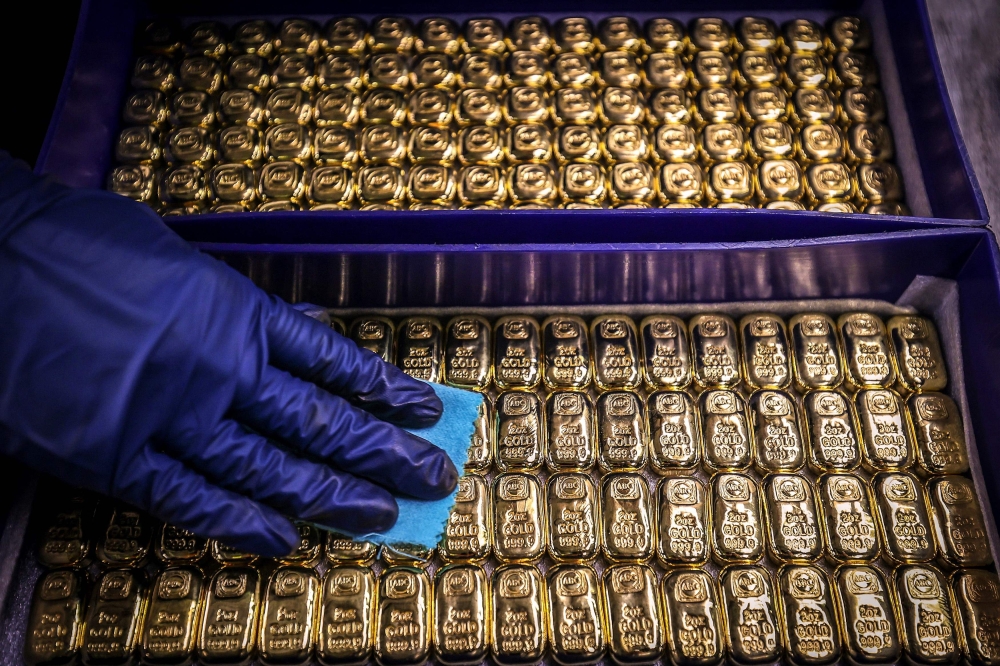
Representational file photo.
Doha: Gold and silver prices recorded unprecedented historic skyrocketing in Monday's trading, with the yellow metal breaking the USD 4,400‑per‑ounce barrier, driven by US economic data showing weakness in the labor market and a decline in inflation rates, further bolstering market bets on a Federal Reserve interest rate cut in January 2026.
Spot gold prices rose by about 1.3 percent, reaching USD 4,398.12 per ounce, while US gold futures increased by 1.02 percent to USD 4,432.20 per ounce.
These price surges coincided with silver climbing more than 3 percent to around USD 69, alongside platinum and palladium hitting their highest levels in years, at a time when markets are witnessing intense physical demand well beyond mere paper speculation.
Qatar News Agency (QNA) reached Ramzi Qasmieh, Investment Director at Qatar Securities Company, who affirmed that these record highs in gold prices have been attributed to multiple factors, primarily the fact that markets are increasingly pricing in bets on US Federal Reserve interest rate cuts in 2026, after softer-than-expected US labor market data.
Gold is also benefiting from a weaker US dollar, which is hovering near its lowest levels since 2022, having dropped more than 10 percent since the start of the year, amid concerns that the US economy may enter a stagflationary phase, Qasmieh highlighted.
He noted that one of the key drivers of the price surge is the increased attention of central banks to gold and their intensified buying, which has accelerated since the onset of the Russia-Ukraine crisis, as many countries seek to diversify their reserves, especially after sanctions were imposed on Russian investments.
Qasmieh pointed out that China's central bank gold reserves have risen for the fourteenth consecutive month, while other central banks, including Turkiye and Kazakhstan, have also increased their holdings, alongside an announcement by South Korea's central bank of its intention to raise gold reserves for the first time since 2013.
Shaken confidence in the performance of major economies, particularly the US and European ones, amid unprecedented levels of debt, has raised misgivings about their ability to meet obligations, enhancing gold's appeal as a hedging instrument and a safer store of value compared to government bonds, Qasmieh elaborated.
He further indicated that major investment firms and banks expect the positive momentum in gold to continue through 2026, undergirded by weak US economic indicators and sustained central bank purchases.
Notwithstanding the record increase in demand for gold, the supply aspect has been relatively stabilized since 2019. Even in the event of an increase in supply, its impact on prices remains limited, given the multiplicity of demand factors, including real bond yields, the US dollar index, central bank purchases, as well as investment flows into the yellow metal, he pointed out.
Qasmieh remarked that gold exchange-traded funds have increased, with holdings reaching record highs, in tandem with rising appetite among institutional and individual investors, alongside currency weakness in some countries and viewing gold as a hedging bet against inflationary pressures, in addition to the growing momentum of speculative activity aimed at achieving quick profits.
Vice Dean for Academic Affairs and Quality at the Jordanian College of Business at Al Al-Bayt University, Dr. Omar Khalif Ghraibe, explained to QNA that the historic surge in gold prices and their approach to the USD 4,400-per-ounce threshold can no longer be explained by relying on traditional analytical tools alone.
The current price behavior does not merely reflect temporary concerns or short-term hedging bets on interest rates; rather, it reveals a far more complex market structure, where psychological factors intersect with structural shifts in global demand, Ghraibe noted.
Ghraibe elaborated that this dynamic has turned gold into a precise barometer of the profound uncertainty gripping the international financial system.
He added that reducing this rally to consternation alone amounts to a superficial reading, as data show that sustained structural demand from central banks, particularly in major economies such as China and Brazil, constitutes one of the key drivers underpinning gold prices.
Ghraibe further noted that central banks' record gold purchases reflect a long-term strategic shift to diversify reserves away from the US dollar, providing structural and lasting demand.
He added that US monetary policy adds further instability, given the unprecedented divisions within the Federal Reserve and the gap between its official guidance for limited rate cuts and market expectations for multiple reductions.
Conflicting projections amplify collective reactions, turning economic signals into exaggerated price waves, Ghraibe underlined, adding that part of the gold rally is driven by psychological factors beyond fundamentals, raising the risk of sharp corrections of 30-40 percent, while emphasizing that such corrections are natural within a long-term upward trend amid persistent instability.
Ghraibe further stressed that the current gold market reflects structural changes rather than simple valuation questions. Investors now view gold not for yield but as a redefined safe-haven, amid eroding confidence in monetary policies and traditional currencies.
Gold, he notes, has become a revealing indicator of broader structural imbalances in the global financial system.