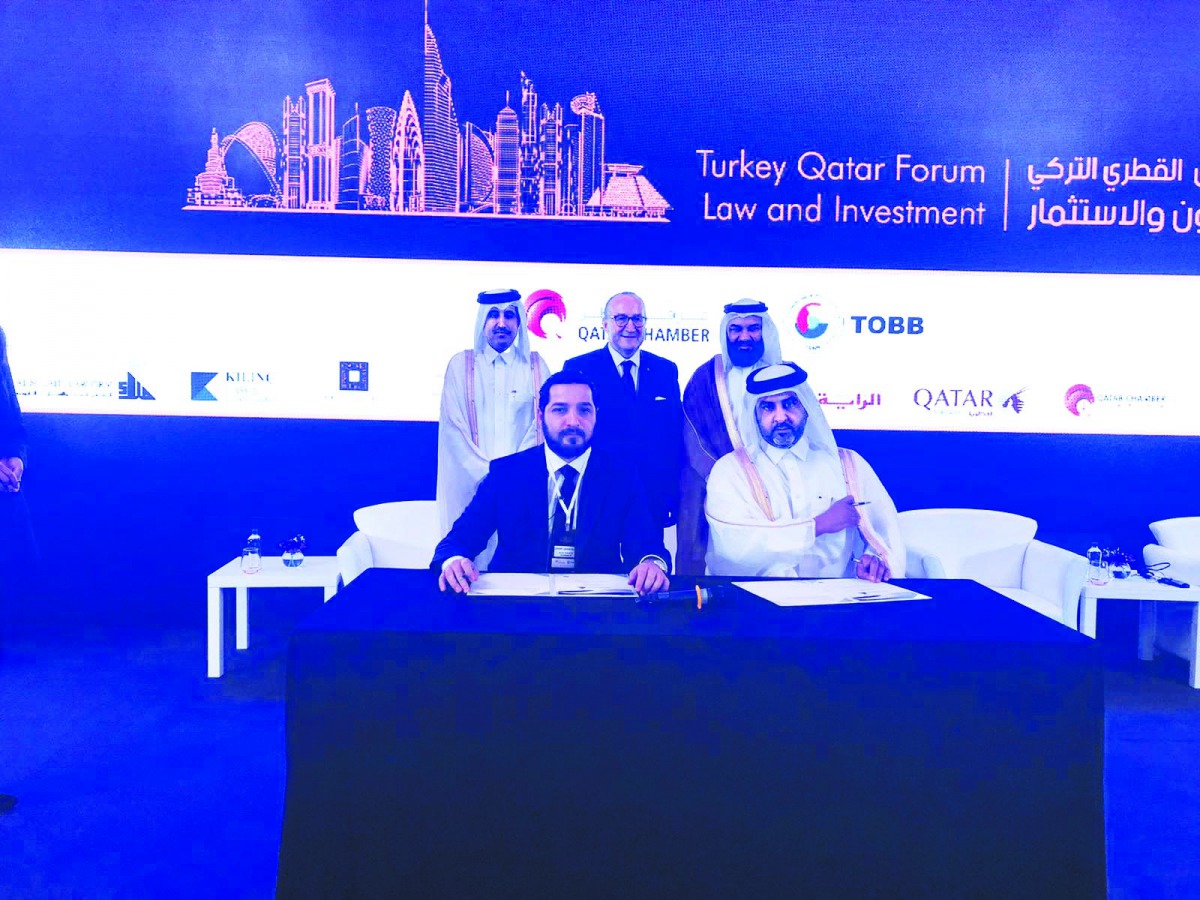
Qatar Chamber Board Member Dr Mohamed Jawhar Al Mohamed (standing right) and QC Director General Saleh bin Hamad Al Sharqi (standing left) witnessing the signing of the two cooperation agreements during the Qatar-Turkey Law & Investment Forum which opene
Trade relations between Qatar and Turkey have seen a significant development over the past few years, with total trade volume between both countries registering a remarkable 85 percent growth from QR4.7bn in 2017 to QR8.7bn in 2018, Qatar Chamber Board Member Dr Mohamed Jawhar Al Mohamed has said while addressing the Qatar-Turkey Law & Investment Forum which opened in Istanbul yesterday.
The forum was organised by Al Sulaiti Law Firm in cooperation with Kilinc Law Consulting and supported by Qatar Chamber and Union of Chambers and Commodity Exchanges of Turkey.
QC Director General Saleh bin Hamad Al Sharqi and Vice President of Turkish Union of Chambers and Commodity Exchanges Ayhan Zeytinoğlu also attended the event.
On the sidelines of the forum, Al Mohamed and Al Sharqi witnessed the signing of two MoUs between the Qatari and Turkish sides.
The first MoU was signed between Al Sulaiti Law Firm and Kilinc Law Consulting. The second MOU was signed between Khalifa Al Kuwari Law Firm and Khalil Arslan Law Firm.
In his speech, Al Mohamed stressed that Turkey is a very attractive destination for investment for the Qatari private sector, assuring that Qatari businessmen are looking forward to further enhancing cooperation ties and building commercial partnerships and alliances with their Turkish counterparts whether in Qatar or in Turkey.
“There are more than 450 Turkish companies operating in the Qatari market with Qatari partners. Turkish companies implemented more than 130 projects amounting to $5bn within the past few years. Also, there are 130 Qatari companies working in Turkey in different sectors,” he added.
Underscoring the resilience of Qatar’s economy, Al Mohamed said that it has managed to overcome the repercussions of the siege imposed on the country for more than two years. He added: “According to the World Bank, Qatar’s economy is expected to grow by 2 percent in 2019, 3 percent in 2020 and 3.2 percent in 2021, driven by higher growth in the service sector as Qatar readies to host the 2022 FIFA World Cup. Governmental measures made by Qatar such as developing legislation governing the business environment, including the law on non-Qatari capital investment in economic activity and free zones law, contributed to strengthening the competitiveness of Qatar economy and attracting more foreign investments to the country”.
Qatar has adopted flexible economic policies and offered a multitude of incentives to attract domestic and foreign investments, as well as establishing an advanced infrastructure, economic logistic zones, industrial lands, and provided facilitations to stimulate foreign companies to enter into the Qatari market.
Al Mohamed called upon Turkish companies to benefit from the pro-investment climate in Qatar and from the incentives offered by the government for investors and to get acquainted with business opportunities available in all sectors.
“Qatari market welcomes Turkish companies. Qatari businessmen are eager to build economic alliances with their Turkish counterparts,” he added.