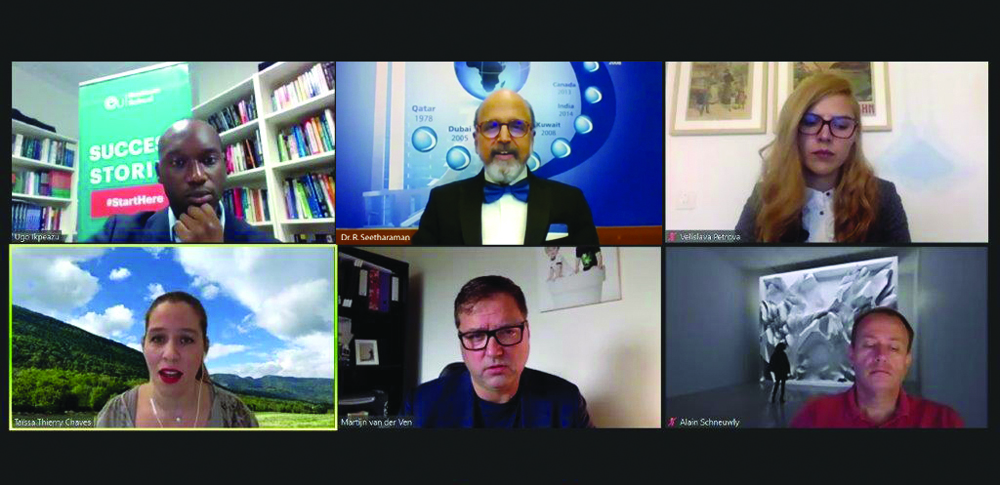
Doha Bank CEO Dr. R. Seetharaman, speaking at a webinar hosted by the European University yesterday.
Technology will augment human jobs and artificial intelligence (AI), algorithms, and intelligent machines will be co-workers to humans, Doha Bank CEO Dr. R Seetharaman said yesterday at a webinar which was hosted by the European University on the theme ‘A Modern day Catalyst for Change: Navigating business, trade and interaction post pandemic’.
During the event, Seetharaman highlighted on the future of work, and referred to the COVID-19 pandemic as a catalyst for change, which has impacted trade and technology.
He added: “Today, smart technology drives smartphones, smart cars, smart homes, smart grids, smart infrastructure, smart cities, and the like. As the smart ecosystem continues to expand, we must consider where smart technology is taking nations and what the smart future will look like for each nation’s ecosystem. For each country it is essential to evaluate, how will cognitive computing, computer vision, voice ecosystem, robots, 5G, AI, and big data promote and shape smart behavior and futures in its Smart ecosystem”.
Speaking about how the pandemic has impacted technology and customer trends, he said: “The digital acceleration, remote working and activation of business continuity plans are some of the developments due to COVID-19. The customer experience management, real time offers, individualisation, service offering and digital as a primary channel are some of the key areas of focus to provide value to customers. The pillars of business transformation include digital, IT, workforce and security. Business transformation needs revenue growth, customer experience, cost reduction & enhanced efficiency with initiatives focusing on financial market place, digital channels, tailored products, and risk management among others”.
Speaking about the global economy, Seetharaman cited the IMF October report, and reiterated that global growth is projected at −4.4 percent in 2020 and 5.2 percent in 2021.
“Growth in the advanced economy group is projected at –5.8 percent in 2020. In 2021 the advanced economy growth rate is projected to strengthen to 3.9 percent. Among emerging market and developing economies, growth is forecast at –3.3 percent in 2020, strengthening to 6 percent in 2021,” he said.
He added that a 9.2 percent decline has been forecast in the volume of world merchandise trade for 2020, followed by a 7.2 percent rise in 2021.
“Strong trade performance in June and July have brought some signs of optimism for overall trade growth in 2020. Downside risks still predominate, particularly if there is resurgence of COVID-19 cases in the coming months. COVID-19 brought about new consumer habits, risk-mitigation business strategies and government emergency measures that resulted in an unprecedented dislocation of international trade and supply chains,” added Seetharaman.