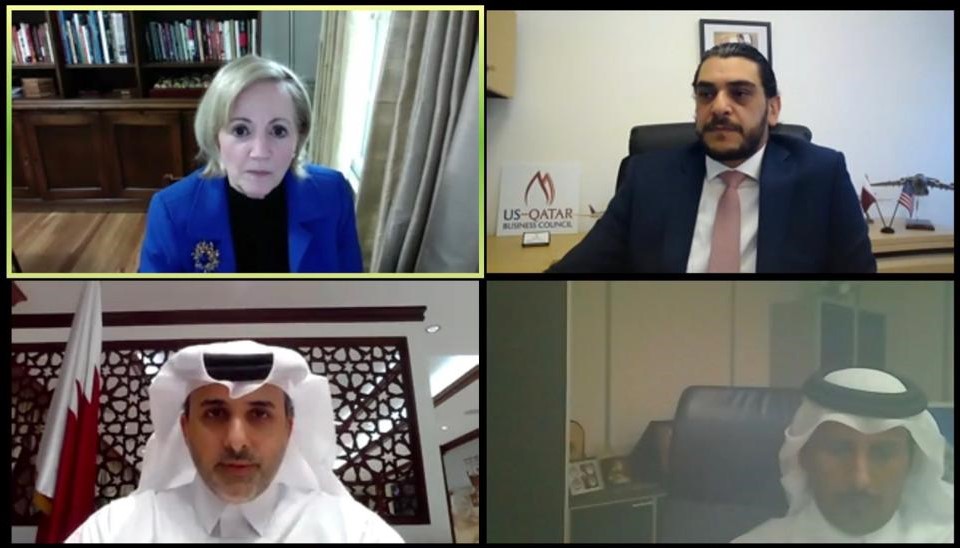
The Minister of Municipality and Environment H E Engr. Abdullah bin Abdulaziz bin Turki Al Subaie (below left) and other dignitaries, including Ambassador Anne Patterson (above left), President of the US-Qatar Business Council, during the webinar, yesterd
The Minister of Municipality and Environment H E Engr. Abdullah bin Abdulaziz bin Turki Al Subaie yesterday said that Qatar’s food security is robust, and not affected due to the COVID-19 as the country has developed many strategies to deal with crises, especially after the unjust blockade imposed on Qatar nearly three years ago.
This came yesterday as the Minister was speaking at a live webinar organized by the USQatar Business Council (USQBC) on “Qatar’s Vision or Sustainable Food Security”.
In addition to the Minister, the Webinar was attended by many other distinguished guests, including Ambassador Anne Patterson, President of the US-Qatar Business Council; Mohamed Badr Hashem Al Sada, CEO of Hassad Foods; and Mohammed Barakat, Managing Director of the business council. H E Minister Al Subaie, said: “For US Partnerships, we are looking specifically to collaborate in the export of crops we are not cultivating here, technology transfer, and strategic development of the Hamad Port.”
Commenting further on Qatar’s food security objective, the Minister noted: “With food security, being self-sufficient does not mean you are secure. Local production will not supersede the importance of international partnerships. “On food security, we have learned the hard way due to the blockade. We developed many strategies to deal with a crisis.
When the global COVID-19 crisis began, the State of Qatar was one of the countries least affected.” Highlighting the importance and scope of Qatar-US bilateral relations, H E Abdullah bin Abdulaziz bin Turki Al Subaie said: “We cherish the US-Qatar relationship. One of our main challenges has been water scarcity and we must always adapt the newest technologies and innovations to overcome this. We see a large opportunity to collaborate in this area.”
H E Minister Al Subaie said: “Post-blockade, Qatar’s food security has focused on four main pillars: international trade & logistics, enable domestic markets, enhance domestic self-sufficiency, and increase strategic reserves.” The Minister added: “We have already begun PPP (public-private partnership) projects for fisheries with our first project almost finished. Fish farming licenses will be floated in the next few months where we expect a lot of private sector interest.” H E Eng Al Subaie further added that the state of Qatar has built into the Qatar National Vision 2030 a great importance on environmental protection.
The upcoming Qatar 2022 FIFA World Cup will be the first world cup that is carbon-neutral. Mohamed Badr Hashem Al Sada, CEO of Hassad Foods, said: “We already have a relationship with the US in food security. We have investments across the United States for dairy, fodder, and other areas. Frozen meat, waste management, and testing/safety would be key areas we’d look for US collaboration.”
On his part, Mohammed Barakat, added: “The green buildings, the carbon-neutral FIFA World Cup, carbon credits, and other initiatives have made Qatar a leader in environmental sustainability in the region.” The USQBC, which is the premier vehicle for enhancing US-Qatar commercial relations, expressed its gratitude to the participants and distinguished guest of the webinar, including the Minister of M u n i c i p a l i t y a n d Environment. During the event it also noted that recently the US engineering giant General Electric won a $703.3m contract to produce F110 engines for Qatar and several other allied countries. While Qatar’s economy is expected to shrink this year due to COVID-19, the IMF expects the country will have a huge bounce back in both oil and non-oil GDP in 2021.
As a result of concerted efforts in boosting the bilateral economic ties, the Qatar-US bilateral trade volume reached at all time high in 2019 breaching the previous peak level recorded in 2014. The total value of goods exchanged between the two countries during the year jumped to nearly QR30bn ($8.15bn), registering a double-digit growth of 36 percent (year-on-year) compared to QR21.84bn ($5.99bn) in 2018, according to official data.