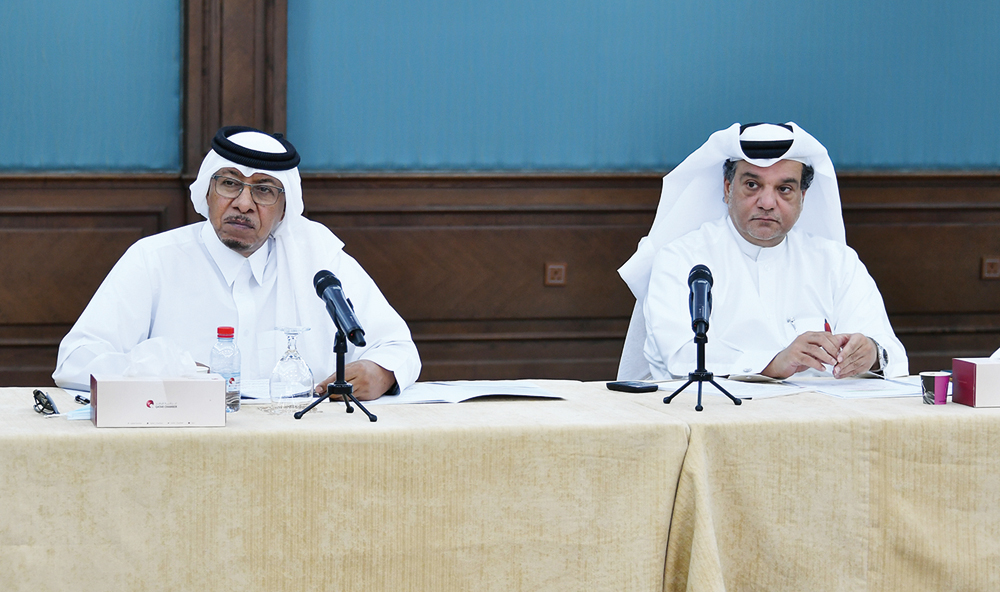
Head of Qatar Chamber’s Food Security and Environment Committee, Mohamed bin Ahmed Al Obaidli (right), with Dr Saif Al Hajari, during a meeting with other members in Doha, recently.
Qatar Chamber’s (QC) Environment Committee, a subsidiary of Food Security and Environment Committee, held a meeting at the Chamber’s venue to discuss decisions proposed by the Ministry of Municipality and Environment on the regulation, recycling and waste treatment.
The meeting was chaired by Head of Food Security and Environment Committee Mohamed bin Ahmed Al Obaidli in the presence Dr Saif Al Hajari and Nasser Ahmed Al Khalaf and the Committee’s Vice Chairman Abdulrahman bin Abdulla Al Ansari.
The meeting was also attended by director of waste management at the Ministry Eng. Hamad Jassim Al Bahr.
The meeting aimed to help attendees learn about the studies conducted by the Ministry of Municipality and Environment and steps taken to adopt these proposed decisions, said Al Obaidli.
He pointed out to the importance of developing the industry of waste recycling to benefit the national economy, stressing that the state has a key role in this regard by offering incentives for the private sector to intensify investments in this sector.
Al Obaidli added: “We coordinate with the Ministry to hold a meeting with the consulting company responsible for doing tests and reports about waste recycling to exchange information on waste management, affirming that this would achieve balance between all parties and that national cadres have participated in the studies provided by the consulting company”.
During the event, Al Bahr also reviewed the decisions and drafts adopted by the Ministry, and reiterated that these proposed decisions would contribute to reducing waste, protecting the environment, and encouraging investments in this sector.
He said that the Ministry has developed a clear strategy in waste recycling based on recent studies and a slew of legislative decisions with the aim of supporting companies and factories in the process of recycling through offering raw materials and minimising financial obstacles related to treatment and transport, as well as preserving the environment by reducing materials which are being buried or burned.
He added that there are eight reports that are currently being prepared in waste management in coordination with the consulting company, noting that these reports include data collection and analysis, infrastructure, awareness of the importance of waste recycling and treatment, and the participation of the private sector in this process and others.
He pointed out that the Waste Treatment Management conducts a survey and study every five years to identify the proportions of waste in household waste per tonne.
For his part, Al Hajari underlined the importance of identifying the correct proportions of household waste, stressing the importance of conducting such tests every year or two years and having a database in order to increase the participation of the private sector in the process of treatment and recycling waste.
The committee recommended the importance of competitiveness between the private sector companies in treatment and recycling of household waste.
It proposed holding a meeting with the consulting company to enable the private sector to learn how to treat waste efficiently based on correct scientific evidence. The committee’s members also discussed three projects related to waste and single-use biodegradable plastic bags which can be used in producing animal feeds.