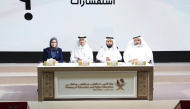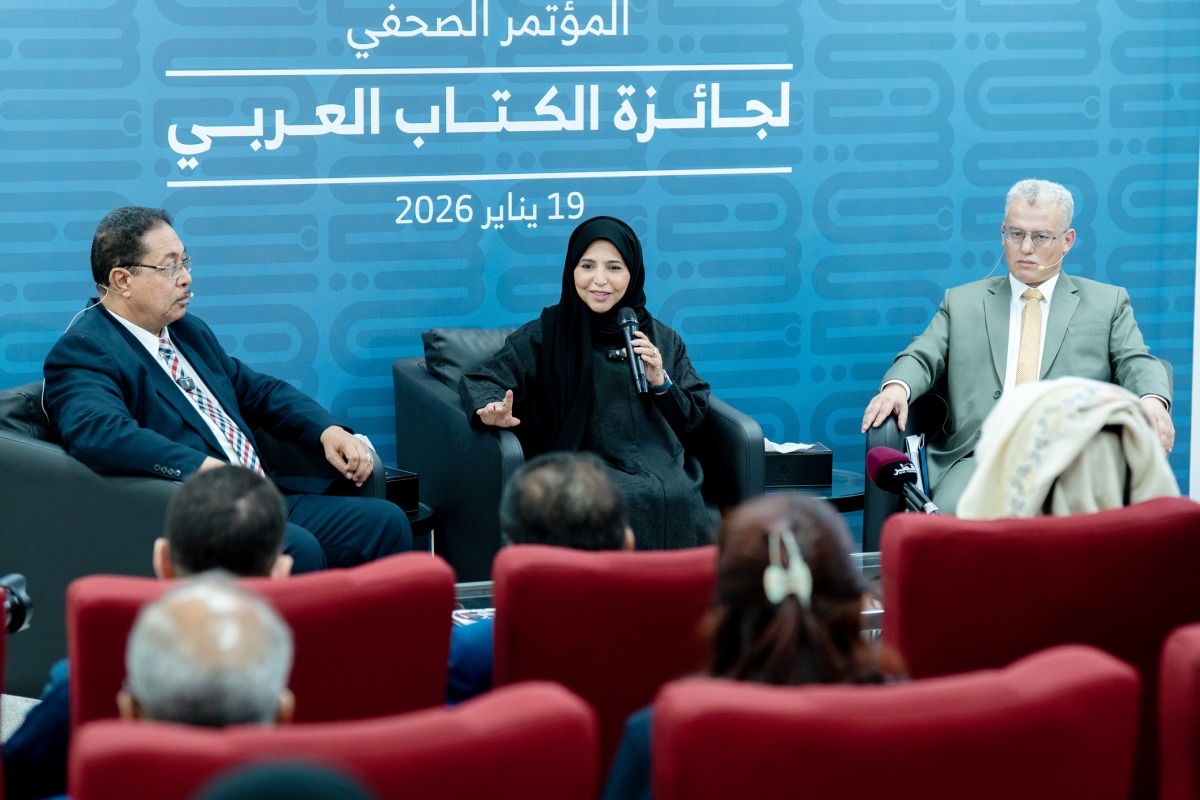
Doha: The Arabic Book Award announced during a press conference held at the Qatar Press Center on Monday that the awards ceremony for the winners of its third edition will be held on January 27.
The event will be held under the patronage of, and in cooperation with, the Qatar National Commission for Education, Culture and Science, underscoring the integration among Qatari cultural institutions, in addition to the accompanying scientific and academic activities.
Media Advisor to the Arabic Book Award, Dr. Hanan Al Fayyad, confirmed in her remarks that the third edition recorded more than 1,000 submissions from over 40 Arab and foreign countries, reflecting growing confidence in the award and its wide dissemination over a short period.
She explained that this presence was the result of an integrated media and institutional plan focused on introducing the award across the Arab world. She noted that cultural and media tours were carried out outside Qatar, including the Arab Republic of Egypt, the Kingdom of Saudi Arabia, and the State of Kuwait, in addition to organizing events and seminars within Qatar.
The awards ceremony will be accompanied by a specialized academic seminar discussing the relationship between the Arab book and cultural identity. The seminar will be held in two academic sessions on the same day, with the participation of a select group of scholars, thinkers, and researchers from various Arab countries.
The press conference also reviewed the third edition of the award, its academic and media trajectory, and the role it plays in supporting scientific research and intellectual authorship.
For his part, Dr. Al-Siddiq Omar Al-Siddiq, a member of the Scientific Committee of the Arabic Book Award, stated that the award was established to encourage rigorous scientific research in knowledge fields that have suffered from limited attention, and that it targets scholars and researchers driven by pure academic motivation.
He noted that the award has evolved into an annual academic season during which around 100 scholars and researchers from different disciplines come together to exchange scientific discussions and develop joint research and intellectual projects. He stressed that this scholarly interaction represents one of the most important gains of the award, in addition to its competitive dimension.
In turn, Director of the Scientific Committee of the Arabic Book Award, Dr. Abdulwahid Al Alami, presented an extensive review of the submissions received in the third edition. He explained that the Scientific Committee dealt with the nominated works through a precise, multi-stage evaluation methodology that takes into account academic quality, originality of the topic, cognitive contribution, and research methodology.
He noted that the variation in participation rates across disciplines enabled the Scientific Committee to form a clear picture of the state of Arab scientific production, both in terms of the density of authorship in certain fields and the evident scarcity in others. He pointed out that this academic diagnosis itself constitutes one of the award’s unannounced roles.
Dr. Al Alami added that a number of works were not accepted due to failure to meet eligibility requirements, stressing that strict adherence to standards is essential to maintaining the award’s credibility and academic value. He emphasized that the award’s objective is not the number of submissions, but rather raising the level of Arab scientific research and motivating researchers to present works characterized by depth, originality, and methodological rigor.
Meanwhile, Executive Director of the Arabic Book Award, Dr. Naji Al Sharif, affirmed during the press conference that the award is not a seasonal event, but a cultural project operating under a long-term strategic plan that includes academic seminars, participation in book fairs, cooperation with academic and cultural institutions, and support for serious publishing houses.
He noted that applications for the next edition will open the day following the awards ceremony, with full details to be announced at a later date.
He also affirmed ongoing efforts to support the Arab book and Arab publishers through cultural projects aligned with the award’s objectives and themes.
Among these efforts is the signing of an agreement next Monday with the Bait Al-Zubair Foundation in the Sultanate of Oman to enhance cooperation between the two sides and promote innovative community initiatives.
At the conclusion of the press conference, Executive Director of the Qatar Press Center, Sadiq Al Amari, delivered a speech welcoming those in charge of the Arabic Book Award and expressing his appreciation for choosing the center to host the press conference.
Al Amari affirmed that the Qatar Press Center places supporting cultural and knowledge initiatives among its priorities and is keen to serve as an open platform for serious intellectual and media discussions. He praised the role played by the Arabic Book Award in serving scientific research and enhancing the status of Arab culture.