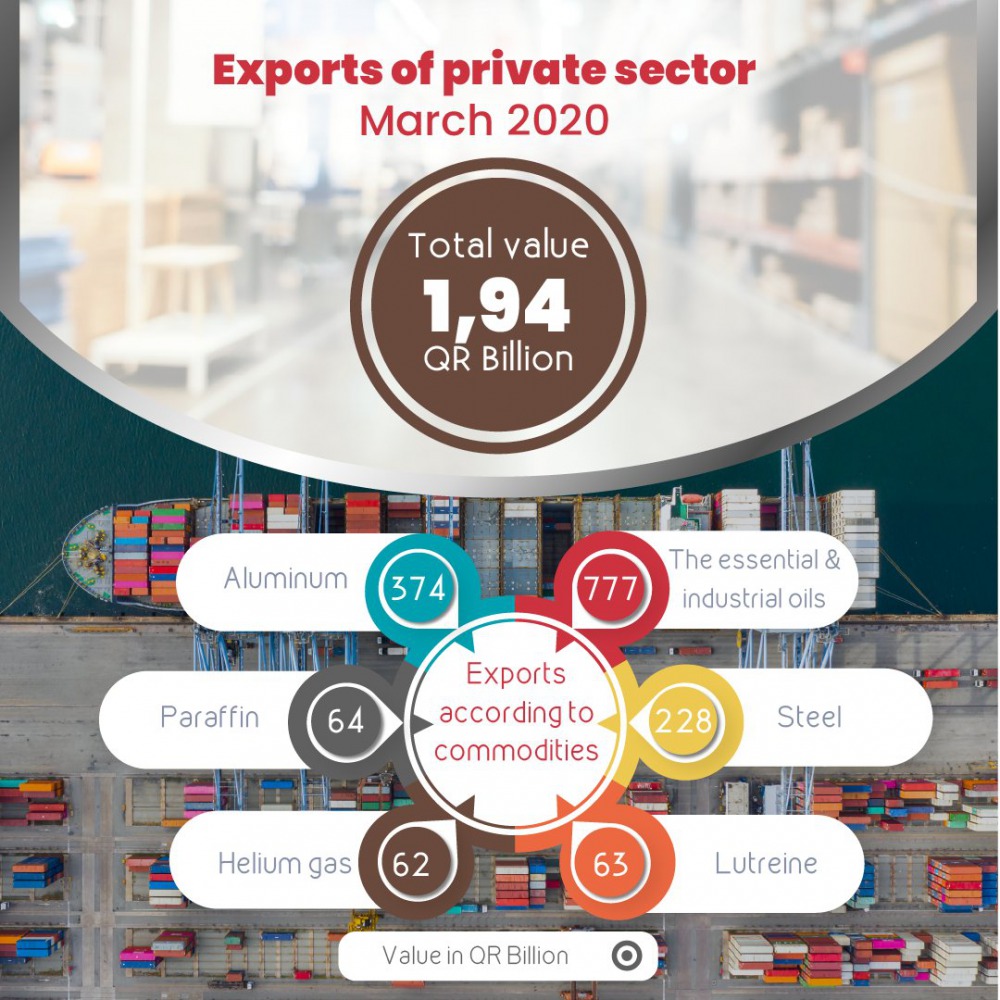
Qatar's private sector exports in March reached QR1.94bn, with a marginal decrease of 0.5 percent compared to QR1.95bn in February, data from the Qatar Chamber’s (QC) monthly economic newsletter for May 2020 revealed.
The QC’s latest report highlights the most prominent trends in the Qatari economy, statistics related to foreign trade, and the preparedness of the private sector to implement the country’s strategies and economic development plans. It also featured the Amir H H Sheikh Tamim bin Hamad Al Thani’s speech, which included directives and decisions representing key features of the roadmap for Qatar toward a more diversified, sustainable, and flexible economy against crises.
Data included in the report showed that the essential & industrial oils group came first in the private sector exports’ list at QR777m, an increase of 40 percent compared to February.
The second was the aluminum group, with exports amounting to QR374m, a decrease of 9.9 percent compared to the previous month. Steel exports, which came in third, reached QR228m, a decrease of 6.3 percent, while the paraffin exports came in the fourth place, with exports reaching QR64m, a decrease of 14.1 percent, followed by Lutreine at QR63m, an increase of 7.4 percent, and helium gas exports at QR62m, an increase of 0.7 percent compared to February. In the seventh place is chemical exports at QR36m, a decrease of 27.4 percent compared to QR50m in February, while chemical substances exports which reached QR33m came in the eighth place, a decrease of 21 percent compared to February. Chemical fertilizers recorded a sharp decrease in March at QR202,000 compared to QR90m in February.
As for the private sector’s trade according to the certificates of origin issued by the chamber for exporting companies, exports through the “General Model” certificate of origin form constituted the largest value at QR817.1m, a decrease of 18 percent compared to February. Exports through GSP came in the second place at QR730m, an increase of 57 percent, followed by exports of the GCC model at QR346.2m (18% decrease) and Unified Arab certificate at QR50.2m. However, no goods were exported through the Unified GCC Certificate of Origin for exporting to Singapore.
The QC report also included figures from the Planning and Statistics Authority (PSA). Total value of foreign merchandise trade in March reached QR24.2bn, which decreased by 16.6 percent from QR29bn in February. Qatar’s total exports of goods (including exports of goods of domestic origin and reexports) in March reached QR15.9bn, while Qatari imports during the same month reached QR8.3bn.
Foreign merchandise trade balance, which represents the difference between total exports and imports, showed a surplus of QR7.6bn, recording a decrease of 44.1 percent compared to QR13.6bn in February. In March, Japan was at the top of the countries of destination of Qatar’s exports with close to QR2.45bn, a share of 15.5 percent of total exports, followed by South Korea with almost QR2.37bn and a share of 14.9 percent, and India with about QR2.21bn, a share of 13.9 percent. China came in fourth place with almost QR2bn, a share of 12.6 percent and Singapore with about QR948m, a share of 6 percent.
With regards to Qatar’s imports according to country of origin in March, the United States was the leading country with about QR1.43bn, a share of 17.3 percent of the total imports worth QR8.3bn, followed by China with almost QR790m, a share of 9.5 percent, and Germany with QR677m, a share of 8.2 percent. UK came in fourth place with about QR601m, a share of 7.2 percent, followed by India with QR473m, a share of 5.7 percent of the total value.
The QC report also elaborated on the global forecasts on the effects of the COVID-19 pandemic on world economies. It reiterated that the US economy is expected to shrink by 5.5 percent in the second quarter of 2020, the steepest drop for 60 years, with a 20 percent unemployment rate. In the Euro area, experts expect a 10 to 15 percent contraction in its economy, while growth in Asian economies will be disrupted for the first time in 60 years. The International Monetary Fund has also warned of economic damage that will be significantly higher than the global financial crisis of 2009 and the Asian Crisis of 1997.