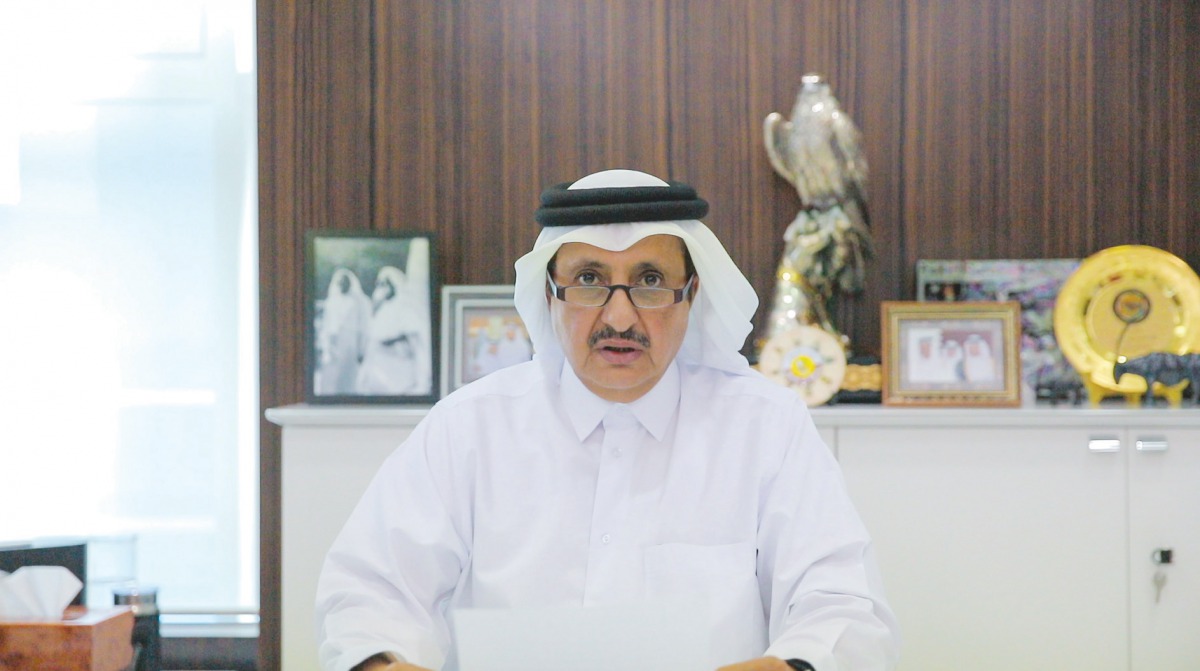
Qatar Chamber Chairman Sheikh Khalifa bin Jassim Al Thani speaking at a webinar held recently.
The State of Qatar was at the forefront of the signatories of the United Nations Convention on International Settlement Agreements Resulting from Mediation, known as the Singapore Convention on Mediation, which entered into force on September 12, Qatar Chamber’s Chairman Sheikh Khalifa bin Jassim Al Thani said.
This came during a webinar held by the Qatar International Centre for Conciliation and Arbitration (QICCA) at Qatar Chamber with the aim of marking the International Law Day and celebrating the Entrance into Application of the Singapore Convention.
The virtual event was attended by many specialists, legal experts and arbitrators.
Sheikh Khalifa also said that the webinar offers a good opportunity for participants to exchange ideas and views on the best mechanisms and means to enforce settlement agreements arising from mediation, as one of the best alternative means of resolving commercial disputes.
Highlighting the importance of mediation, Sheikh Khalifa pointed out that it is a fast, efficient, and low-cost way to resolve disputes that maintains good relations between parties, affirming that mediation has recently acquired increasing importance as one of the most important alternative means for settling commercial disputes.
This has made many countries interested in adopting legislation related to mediation procedures through courts, or through arbitration centers specialized in resolving commercial disputes, he added.
Underlining the Qatar Chamber’s interest in arbitration, Sheikh Khalifa said that the Chamber has established the Qatar International Centre for Conciliation and Arbitration (QICCA) to encourage parties of the commercial relationship to activate the mediation principle in resolving disputes.
QICCA Board Member Sheikh Dr. Thani bin Ali Al Thani said that Qatar was among the first three countries that ratified the convention, citing that the Amir H H Sheikh Tamim bin Hamad Al Thani issued an instrument of ratification approving the Convention on February 12, 2020.
He affirmed that the ratification means enforcing settlement agreements resulting from mediation in world countries, starting with the three countries that have ratified this agreement, namely Singapore, Fiji and Qatar.
Sheikh Thani also said that Qatar’s accession to this Convention would open new perspectives for arbitration and settlement as one of the alternative means of resolving disputes, thus providing an appropriate environment for the success of commercial businesses.
He expressed QICCA’s welcome to the implementation of this Convention in three countries, including Qatar.
“There are 53 countries signed the Singapore Convention. This indicates that world countries are interested in adopting mediation and conciliation as means of settling disputes between commercial companies, economic entities and financial institutions.” he added.
For his part, lawyer Yousif Al Zamman delivered a worksheet titled “Historical Perspective on Mediation as a Method to resolve Disputes in Qatar” in which he clarified the beginning of mediation in Qatar as the first steps for resolving disputes, which was followed by the judicial system in 1971.
Al Zaman indicated that due to the progress of societies and expansion of legislation, the number of cases increased, and accordingly the alternative means for dispute settlement such as arbitration and mediation emerged.
Lawyer Sultan Al Abdulla presented “Mediation: Lost Opportunity” in which he highlighted the differences between mediation and other alternative means of dispute settlement such as arbitration, noting that the low cost of these means and the speed of their procedures contributed to the increasing spread of the culture of arbitration and mediation.
Dr. Riyad Fakhri highlighted the impact of Singapore Convention on encouraging mediation in the Arab World, while Dr. Nader Ibrahim focused on the role of Singapore Convention in enhancing the efficiency of mediation and arbitration clauses, stressing Qatar’s positive and effective role as it is the third countries to ratify the Convention.