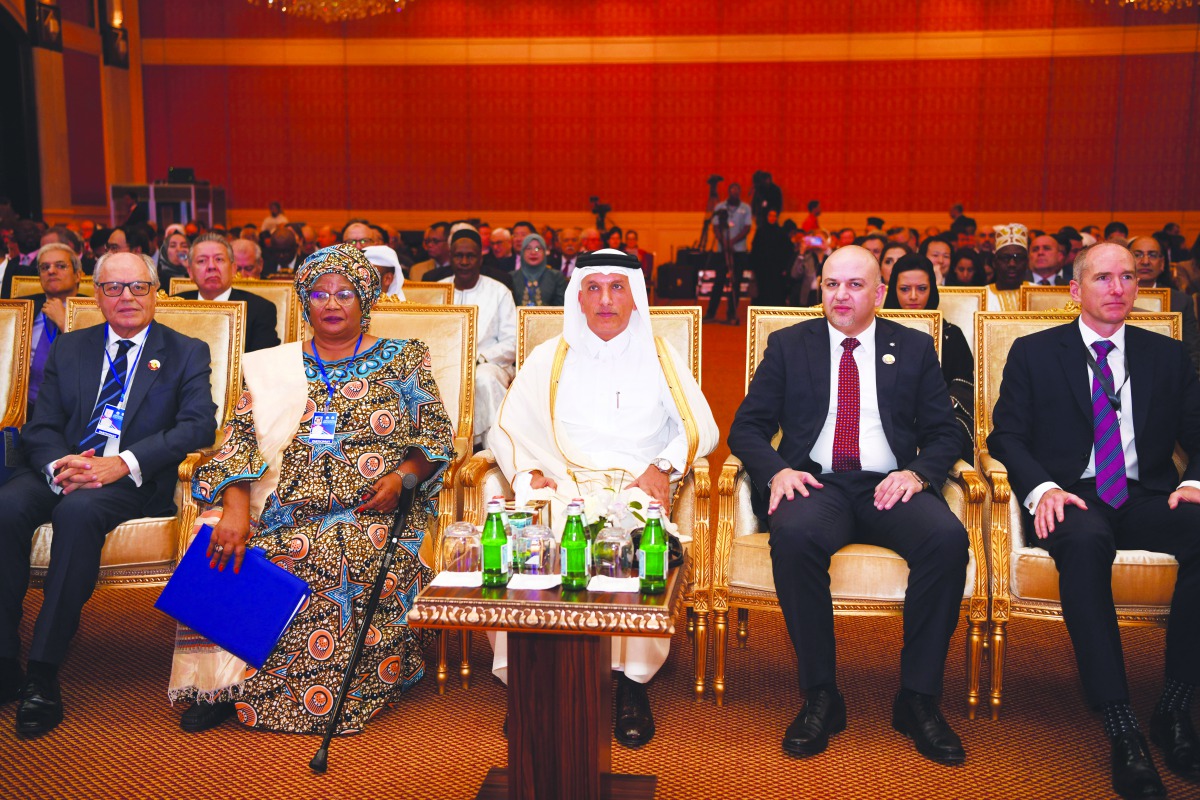
Minister of Finance H E Ali Shareef Al Emadi (centre) and other prominent speakers during the opening session of the 14th Conference on “Enriching the Middle East Economic Future”, yesterday.
DOHA: The opening day of the 14th Conference on “Enriching the Middle East Economic Future” began here yesterday witnessed high-profile political leaders, policy makers and financial experts debating key social, economic and technological challenges faced by the region and around the world.
The event, held in cooperation with the Center for Middle East Development (CMED) University of California- Los Angeles, was inaugurated by H E Ali Shareef Al Emadi, Minister of Finance.
Speaking at the opening session of the conference, former President of the Republic of Malawi Joyce Banda stressed that the countries of the world are required more than ever to support freedom of assembly, press and justice, in addition to addressing the challenges of climate change, especially as these things contribute directly to economic growth in the region. She highlighted the importance of empowering young people, including women in the economic system of the countries of the world.
Banda pointed out that the issue of corruption has become a global issue, calling for bold efforts to combat corruption in all sites and centers, especially since the fight against corruption is one of the prerequisites for economic growth.
Minister of Economy of the Republic of Malta Edward Scicluna said that most of the protests witnessed by many countries in the world were spontaneous, have no leadership, and were not organised by the opposition, pointing out that these protests were the result of social and economic factors such as unemployment, poverty, declining living standards, and the marginalization of young people and others. This has led to the rise of migration and the flow of migrants to the countries of Europe.
He also stressed the importance of combating corruption as one of the factors that inhibit the growth of the economy in many countries, while underlining the importance of developing education and strengthening the technology sector because of its important role in driving economic growth in various countries of the world.
Hani K Findakly of Potomac Capital pointed out the challenges facing many countries in the Middle East such as the lack of job opportunities, the marginalization of youth, unemployment, poverty, corruption and the failure to cope with the huge technological revolutions along with other factors that have a direct impact on economic growth. He underscored the need for countries in the region to benefit from these developments and adopt new constructive policies that contribute to social welfare and economic growth.
Findakly elaborated on the need to change the education system for better quality as well as the need to study the process of climate change and develop solutions to it. He pointed out that there are three key factors that shape the future of the region, the first of which is the high population growth rates, demographic changes and the domination of the young population which is looking for better jobs and life.
He added that the Arab region, for example, will witness significant population growth in the coming years, saying this population growth requires the provision of jobs and all life necessities, which necessitates that countries are in a healthy and good economic situation.
The second factor is the challenges posed by technological development. The changes that technology has brought to the lives of people and to the importance of bridging the gap between technology and planning is critically important.
The third factor, he said, is climate change, which requires advance preparation and has a direct impact on all walks of life.