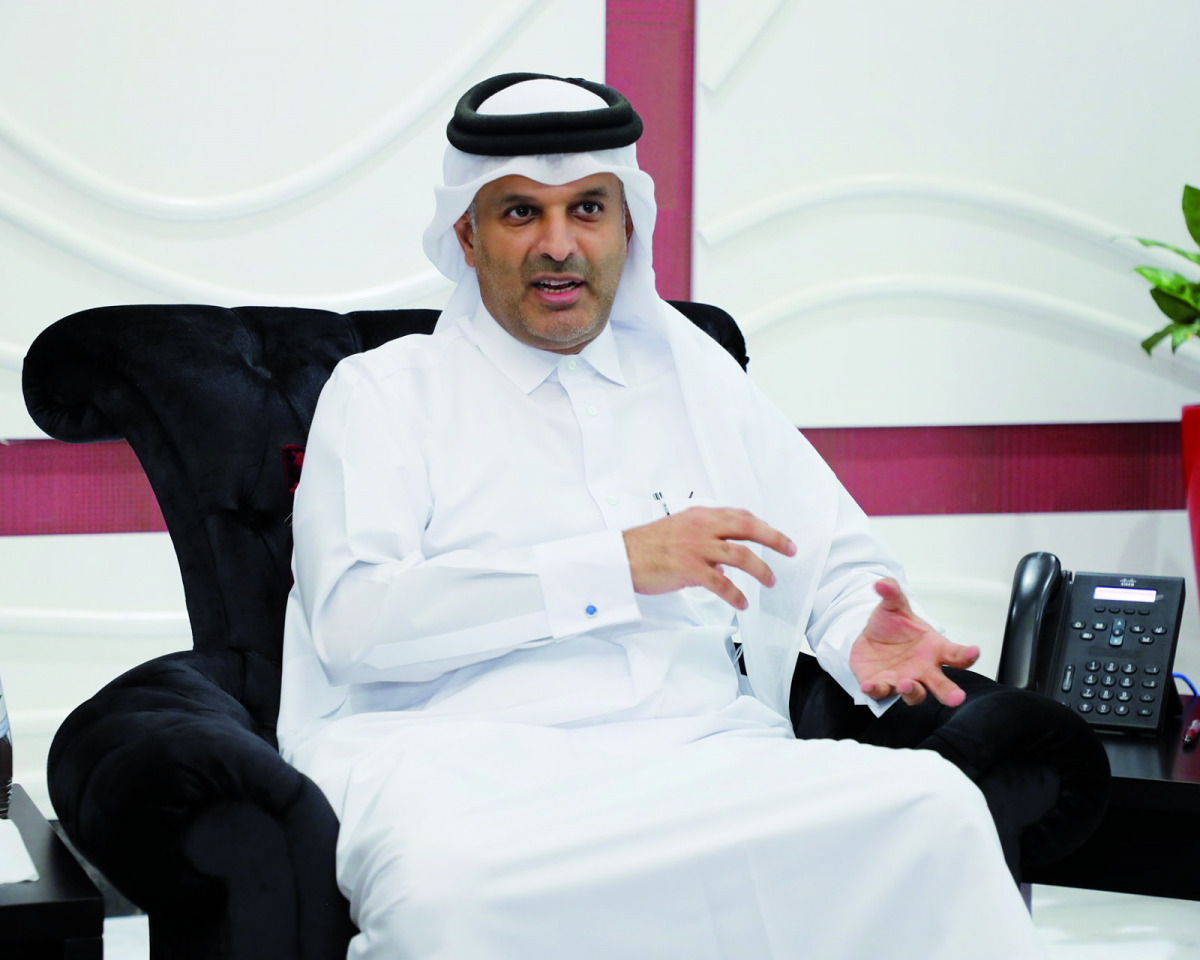
Member of the Board of Directors of International Relations at the Qatar International Center for Conciliation and Arbitration (QICCA) of Qatar Chamber Sheikh Dr. Thani bin Ali Al Thani speaking during the interview.
Doha: The value of cases received by the Qatar International Center for Conciliation and Arbitration (QICCA) at the Qatar Chamber (QC) this year has already exceeded QR1.6bn, according to Sheikh Dr. Thani bin Ali Al Thani, Board Member for International Relations at QICCA.
In an interview with QNA, Sheikh Dr. Thani said the Center considered a total of 162 arbitration cases, and issued an arbitration ruling in 75 of them. He added that the total number of cases for this year reached 30 arbitration cases, and that most of the cases considered by the Center were related to construction contracts, urban development, real estate development and shortage of raw and building materials, as well as energy and labour issues.
According to Sheikh Dr. Thani, the State of Qatar is one of the first countries to join the United Nations Convention on International Settlement Agreements Resulting from Mediation, known as the “Singapore Convention on Mediation”, which entered into force on September 12, 2020. He went on to stress that mediation is a fast, effective and low-cost means to resolve commercial disputes between parties. While it strengthens the legislative structure as it eases the burden on national courts, the use of arbitration also encourages investments in the country, said Sheikh Dr. Thani. He added that arbitration has now become a necessity imposed by the economic development of the Qatari market and the growth of global trade, especially in long-term or multilateral international trade contracts.
Speaking about the role of modern technology amid the COVID-19 pandemic, Sheikh Dr. Thani pointed out that the international and Arab arbitration centers and institutions, especially those in the Gulf Cooperation Council countries, have been operating at full capacity remotely and have issued instructions regarding modern audio-visual techniques that arbitration bodies can use in conducting arbitration procedures based on the rules of arbitration centers.
He said at the onset of the pandemic, majority of international arbitration centers and some international law firms scrambled to issue a set of guidelines, lists or flexible rules that direct how to proceed with remote arbitration procedures using modern technologies. He said these procedures contributed greatly to the development of an organisational framework for holding virtual sessions.
Sheikh Dr. Thani went on to highlight the “Seoul Protocol” regarding the use of visual communication application in international arbitration. He added that the International Chamber of Commerce (ICC) also issued a guidance note on possible measures to mitigate the effects of the pandemic to enhance the effectiveness of arbitration procedures, while the International Centre for Dispute Resolution (ICDR) of the American Arbitration Association (AAA) also issued a set of directives for arbitrators and parties on visual arbitration. Additionally, a number of protocols and mechanisms were issued by several international bodies and international law firms concerned with arbitration.
Speaking about QICCA’s future plans, Sheikh Dr. Thani said the Center aims to promote alternative means of resolving civil and commercial disputes, spread its culture, improve its practices, develop the center’s relationship with regional and international centers, as well as sign MOUs with academic and educational bodies.
He said the Center will also update and revise the procedural rules for conciliation and arbitration and add new clauses related to emergency and visual arbitration.