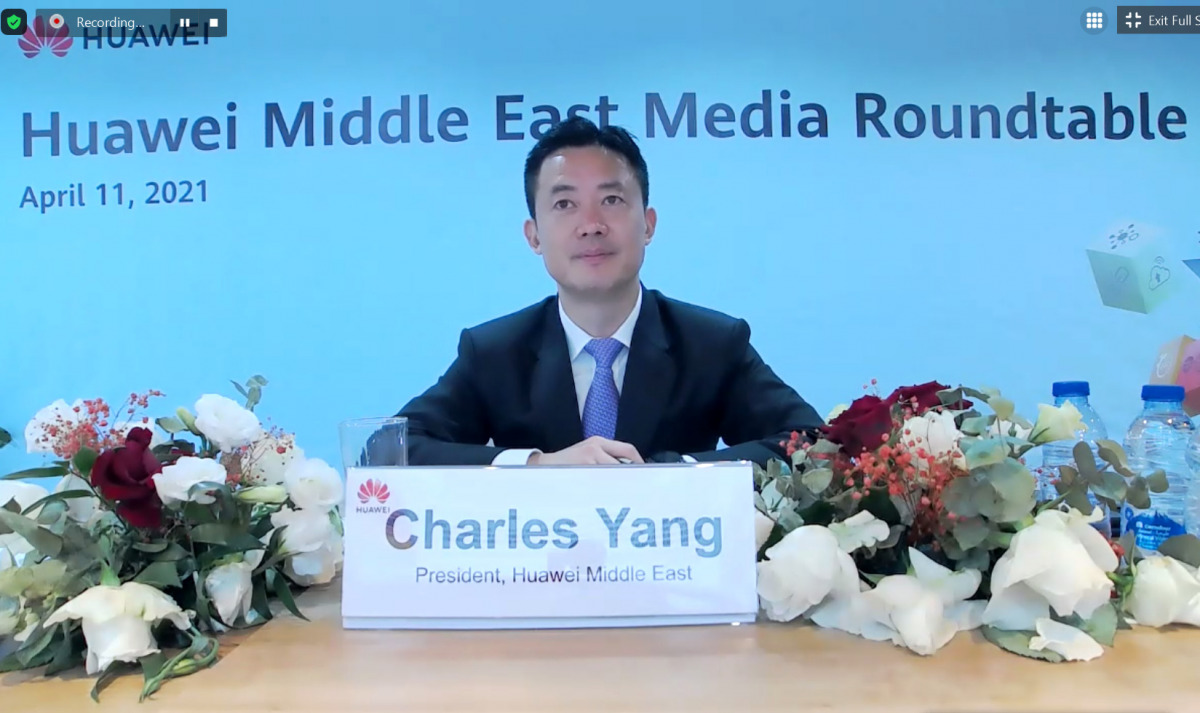
On the sidelines of the SAMENA Leaders’ Summit, the President of Huawei Middle East, Charles Yang (pictured), provided an update on the company’s business globally and across local markets, with his comments following Huawei’s release of its annual earnings results for 2020.
The executive has emphasised the strategic importance of the region to the company internationally, noting Huawei’s commitment to the region, and that there are significant opportunities to enable more aggressive digital transformation in support of national development visions and targets, as well as to grow its market presence.
In Qatar specifically, the company is also exploring how to stimulate economic growth through the expansion of 5G capabilities. Yang has reaffirmed Huawei’s commitment to supporting major events like the upcoming 2022 FIFA World Cup in Qatar, enabling brand new experiences through 5G.
By empowering local partners, bolstering talent development, and committing support to mega projects, Huawei aims to contribute to the digitisation efforts outlined in the Qatar National Vision 2030.
“Digitisation in the Middle East has accelerated remarkably over the last year, with global network traffic having increased by around 50 percent during the pandemic,” noted Yang.
“The ICT industry thus has an important responsibility to create new social and business value for governments, organisations, and individuals. We are fully committed to this value creation. We already bring the power of technologies like 5G to key events such as the annual Hajj pilgrimage in Saudi Arabia, and are now aligning with governments to support mega-events like Expo 2020 in the UAE and the FIFA World Cup 2022 in Qatar.
We will keep innovating to create value for our customers and to support economic recovery and social progress.” To that end, Huawei has said that it used the last year to further enhance its operations despite a challenging global environment.
That led to achieving revenue and profit growth during 2020 overall. Part of that came down to an unwavering focus on R&D and joint innovation programs in areas like 5G, AI, and cloud, says Yang, with Huawei establishing 13 Open Labs around the world to support open collaboration for shared success.
In particular, global 5G deployments have proceeded faster than expected. By the end of 2020, more than 140 commercial 5G networks had been deployed in 59 countries and regions, and the number of 5G subscribers worldwide had exceeded 220 million.
Globally, the number of 5G networks and base stations of the first year is 6 times more than 4G, and user growth of 5G is 500 times faster. Middle East has become a leading 5G region globally. In just 19 months, the number of 5G users have exceeded 2 million which 4G took double times, and it is expected that 5G user grow very fast.
That’s why Regulators in the Middle East have released many policies which greatly promote 5G development, yet Yang says that more industry policies are still needed to unleash 5G’s full potential. “The Middle East has been an exciting region for us given the enormous scale of developments that are underway that can be empowered by technology. This is epitomised by the rapid development of 5G that has exceeded many expectations.
Computing power also plays an integral role in enabling businesses when it works in parallel with 5G. The region today is more connected than at any point in history,” comments Yang.
After contracting in 2020, overall ICT spending in the Middle East, Turkey, and Africa is expected to make a comeback in 2021, returning to positive growth of over $209.5bn, according to IDC.