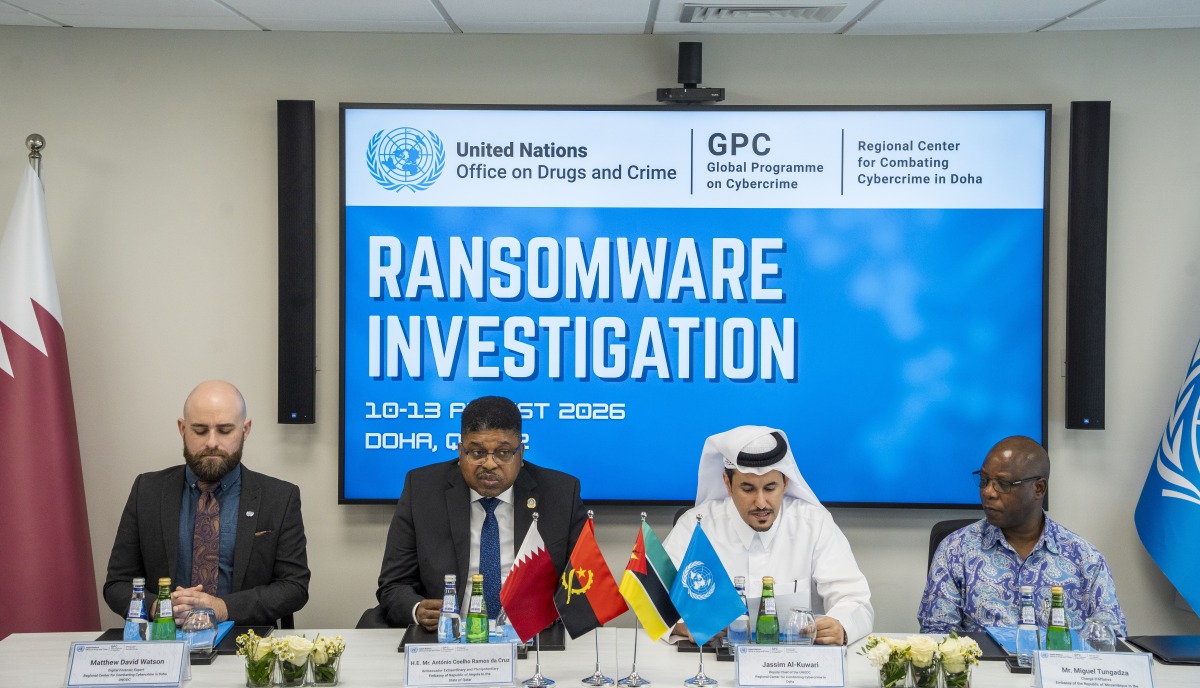
Ambassador of Angola H E António Coelho Ramos da Cruz (second left) with Chargé d’Affaires at the Embassy of the Republic of Mozambique in Qatar Miguel Raul Tungadza (right) and Deputy Chief of the UNODC Regional Centre for Combating Cybercrime Jassim Yousuf Al-Kuwari at the event.
Doha, Qatar: The Ambassador of Angola H E António Coelho Ramos da Cruz has praised Qatar’s efforts in combating cybercrime, saying they deserve great applause.
Speaking at the opening of a UNODC ransomware investigation training in Lusail, he highlighted the State’s strong partnership with the United Nations in building regional capacities against evolving digital threats.
The United Nations Office on Drugs and Crime (UNODC) Regional Centre for Combating Cybercrime in Doha yesterday opened a four-day foundation course on Ransomware Investigation, bringing together police investigators, public prosecutors and technical experts to strengthen regional capacities against one of the most pressing forms of transnational cybercrime.
The training, being held from August 10 to 13 at the centre’s facilities in Lusail, is designed for participants with limited prior experience in ransomware cases. It provides a structured introduction to ransomware behaviour, forensic acquisition and analysis, digital evidence handling, open-source intelligence, and the tracing of cryptocurrency payments linked to ransom demands.
Opening remarks were delivered by Deputy Chief of the UNODC Regional Centre for Combating Cybercrime Jassim Yousuf Al-Kuwari, Ambassador Ramos da Cruz, and Chargé d’Affaires at the Embassy of the Republic of Mozambique in Qatar Miguel Raul Tungadza.
In his address, Ambassador Ramos da Cruz expressed Angola’s strong appreciation for the initiative. “It is a great honour and privilege for me to participate in the opening of this important Ransomware Investigation training course, organised by the United Nations Office on Drugs and Crime,” he said.
He thanked the UNODC and the State of Qatar for their continued commitment to building the capacities of Member States in confronting cybercrime, describing it as one of the most complex and rapidly evolving challenges of our time.
“The Republic of Angola attaches great importance to enhancing the capabilities of its justice and law enforcement institutions. The participation of Angolan prosecutors, investigators and technical experts in this programme provides an excellent opportunity to acquire specialised knowledge, exchange best practices, and further strengthen international cooperation,” the ambassador stated.
He noted that ransomware, as a form of transnational organised cybercrime, poses significant risks to governments, businesses and citizens alike. Addressing the threat, he stressed, requires highly skilled professionals, advanced technological capabilities and close cooperation among states and international partners.
“We are confident that the knowledge and practical experience gained during this four-day course will further strengthen Angola’s capacity to prevent, investigate and prosecute cybercrime, thereby contributing to the protection of our institutions, our economy and our society,” Ambassador Ramos da Cruz said.
He reaffirmed Angola’s appreciation for the valuable work of the UNODC and for the excellent cooperation with Qatar in promoting security, justice and sustainable development, wishing participants a successful and productive programme.
The course is led by Cybercrime Investigation Expert Matthew David Watson of the UNODC. Sessions cover an overview of ransomware types, trends and Ransomware-as-a-Service models, encryption techniques, advanced persistent threat flows, digital evidence sources and admissibility, email and memory analysis, static and dynamic malware examination, clearweb and darkweb OSINT, cryptocurrency investigation and tracing, courtroom reporting, and legal challenges.
Practical exercises form a core component, including case studies on regional threat actors, data carving, RAM analysis using specialised tools, forensic investigation scenarios, ransomware OSINT, and cryptocurrency tracing.
The programme targets digital forensic investigators, cybercrime officers, financial analysts and prosecutors handling cases involving digital evidence. Participants are expected to apply the skills gained to improve identification, seizure and presentation of evidence in court.
The training reflects Qatar’s growing role as a regional hub for cybercrime capacity-building through the UNODC centre, supporting Member States in safeguarding institutions and societies against evolving digital threats.
Closing remarks and certificate distribution are scheduled for the final day, underscoring the shared commitment of the UNODC, Qatar and participating countries to effective international cooperation against cybercrime.