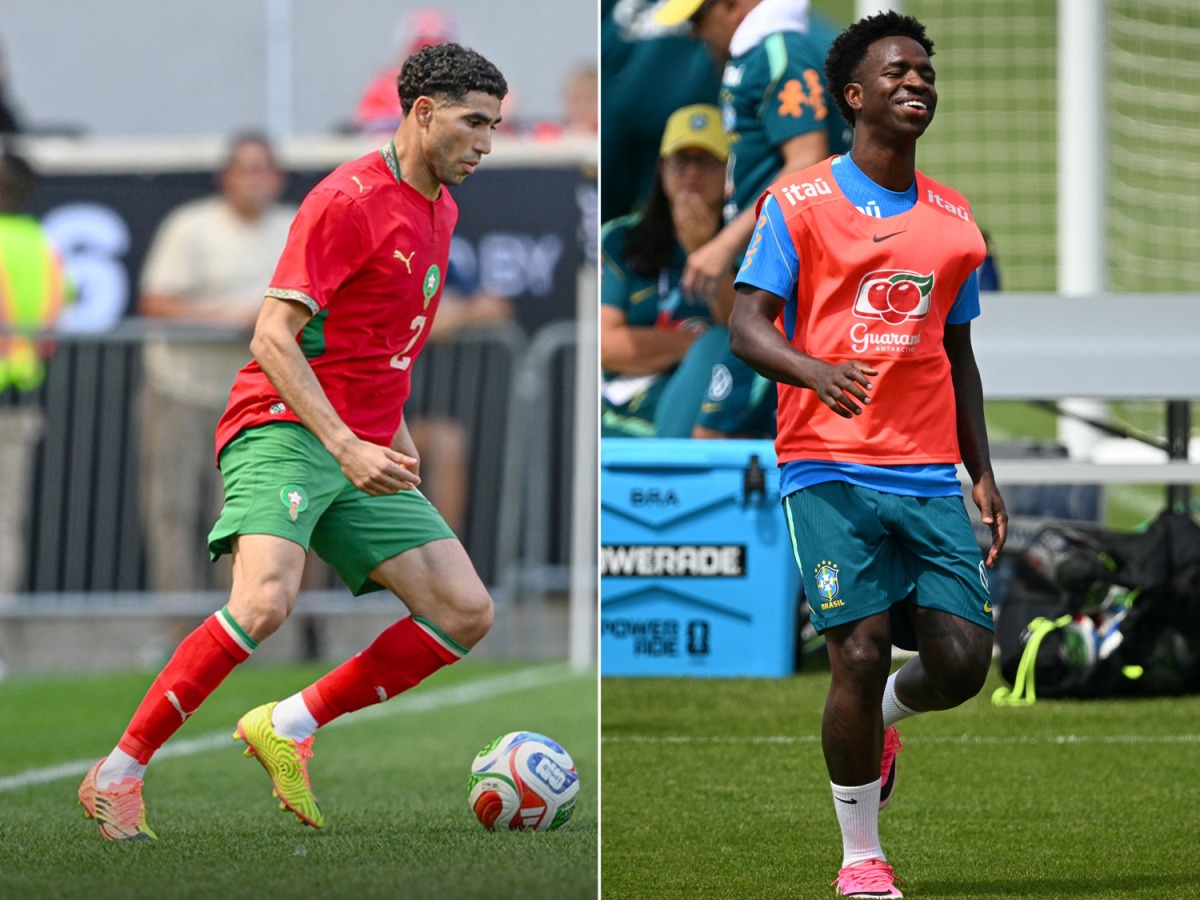
Doha, Qatar: When Brazil and Morocco meet in their opening match of the 2026 FIFA World Cup in the early of Sunday, the spotlight will naturally fall on the two faces of a new footballing era for their respective nations.
On one side is Vinicius Junior, Brazil’s electrifying winger and the face of the Selecao’s new era. On the other stands Achraf Hakimi, Morocco’s captain, and the driving force behind the Atlas Lions’ rise on the world stage.
For 90 minutes at MetLife Stadium, football’s most successful nation and Africa’s modern trailblazer may find their fortunes shaped by a duel measured in moments and mistakes.
The matchup is compelling because it pits one of football’s most devastating dribblers against one of its most complete full-backs.
Vinicius has established himself as one of the world’s most dangerous one-on-one attackers. His ability to isolate defenders and create chaos in transition has made him one of the most productive forwards in world football.
Yet few defenders are better equipped to handle him than Hakimi. The Moroccan captain possesses the recovery pace and tactical intelligence that have made him one of the game’s elite full-backs.
The intriguing aspect of this battle is that Hakimi is not a traditional defensive full-back who sits deep and waits. He attacks relentlessly.
That means Vinicius will not simply be trying to beat a defender; he will also be tracking one of Morocco’s attacking outlets.
Their rivalry is not new. Vinicius and Hakimi first crossed paths in the UEFA Champions League Round of 16 in 2022, when Real Madrid and Paris Saint-Germain produced one of the competition’s most memorable ties.
In the first leg Hakimi largely succeeded in limiting Vinícius’ influence, matching the Brazilian stride for stride.
However, in the return leg at the Santiago Bernabeu. Madrid mounted a famous comeback, Vinicius became increasingly influential, helping stretch PSG’s defence and turn the tie in Real’s favour.
The pair’s most recent meeting came at the same MetLife Stadium during the 2025 FIFA Club World Cup semi-final, where Hakimi helped PSG shut out a Real Madrid attack featuring both Vinicius and Kylian Mbappe in a dominant 4-0 victory. That history adds another layer to Sunday’s showdown.
From Brazil’s perspective, Vinicius remains the key to unlocking Morocco’s disciplined defensive structure.
Under Carlo Ancelotti, Brazil’s attack is designed to create isolated situations where Vinicius can attack defenders in space.
His ability to draw multiple defenders often creates space for Brazil’s other attacking threats. Brazil know that if Vinicius consistently wins his duel with Hakimi, Morocco’s defensive shape could quickly unravel.
Morocco, meanwhile, have built their recent success on organisation, resilience and tactical discipline. The Atlas Lions stunned the world by reaching the semi-finals in Qatar in 2022 and have since cemented their reputation as one of international football’s most difficult teams to break down.
Hakimi remains central to everything they do. Whether driving forward on counterattacks or recovering defensively against elite wingers.
There is also a fascinating risk involved. If Hakimi pushes too high, he could leave space behind him for Vinícius to exploit. If he stays deep to contain the Brazilian, Morocco lose one of their primary attacking outlets.
Brazil coach Ancelotti has described the encounter as “the most important” match of the group stage, underlining the significance of a fixture that could determine who finishes top of Group C.
Morocco head coach Mohamed Ouahbi highlighted the need for collective defending and attacking to neutralise Brazil’s dangerous wingers, while emphasising that Morocco respects but does not fear their opponents.
Their Group C meeting has already been identified as one of the standout clashes of the opening round. And when the whistle blows, all eyes will inevitably drift to Brazil’s left flank, where Vinicius and Hakimi will renew a rivalry that could ultimately decide the fixture.