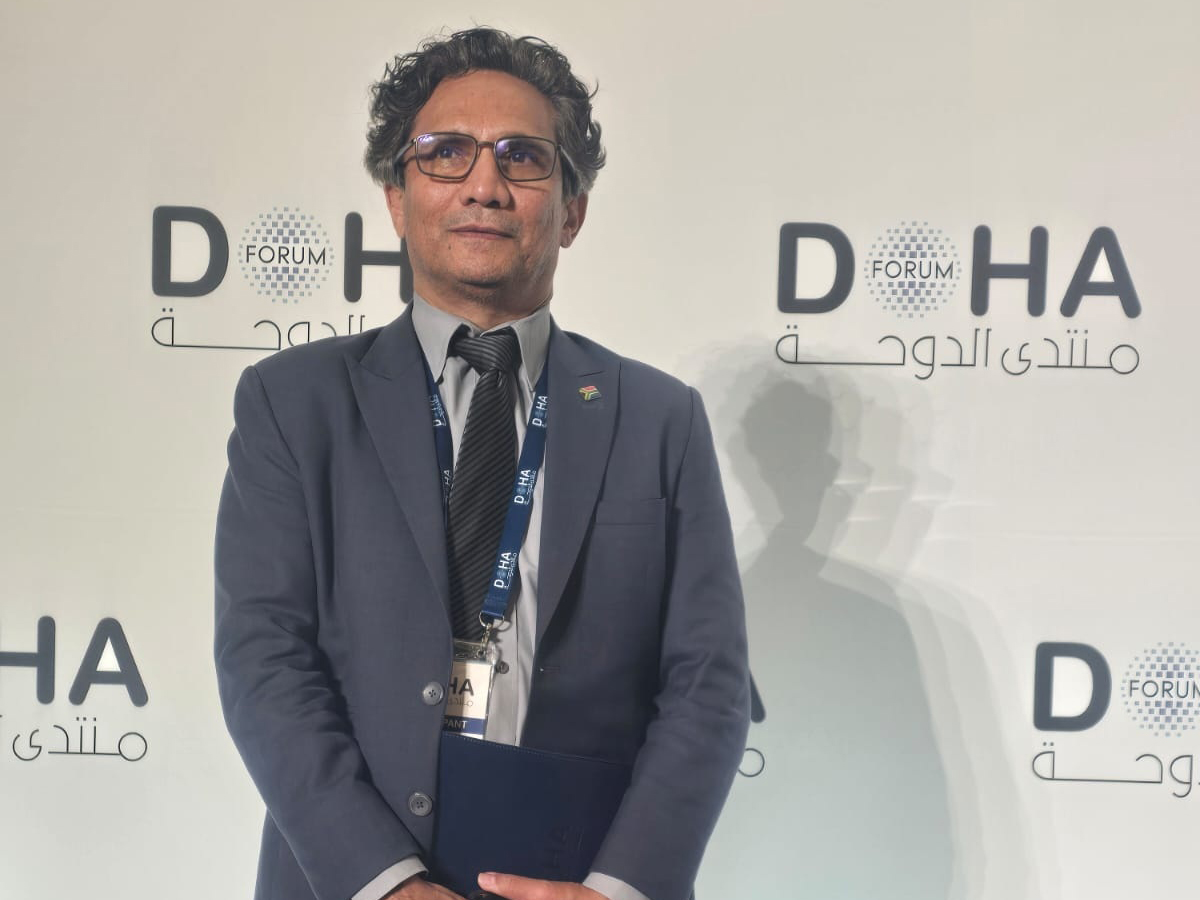
South Africa’s Director-General of the Department of International Relations and Cooperation (DIRCO), Zane Dangor
Doha, Qatar: South Africa’s Director-General of the Department of International Relations and Cooperation (DIRCO), Zane Dangor, has underscored the urgent need for global accountability and equitable diplomacy, describing this year’s Doha Forum as a timely platform centred on justice amid escalating geopolitical tensions.
Speaking on the sidelines of the Forum, Dangor said the 2025 edition stood out for its strong emphasis on ensuring that “justice must be seen to be done,” especially as the world grapples with widening conflicts and what he described as growing impunity in international affairs.
He warned that the ongoing war in Gaza risked becoming “the graveyard of international law,” citing the scale of civilian suffering and lack of accountability in the conflict.
Dangor, who serves as South Africa’s G20 sherpa, also reflected on the country’s recent chairing of the G20 summit, describing the negotiations as “brilliant” despite the voluntary absence of one member state.
“The summit successfully produced a declaration championing priorities critical to Africa, including the beneficiation of critical minerals at source and strategies to address mounting debt burdens across the continent,” he said.
He noted, however, that the United States’ subsequent stance barring South Africa from future participation contradicted established G20 protocols.
Qatar’s presence as a guest at the summit received notable praise from the South African diplomat, who highlighted the shared values between Doha and Pretoria.
“We both share a commitment to justice and peace,” Dangor said, noting that both nations are increasingly coordinating on mediation efforts and exploring ways to expand their cooperation beyond traditional bilateral relations.
On the Gaza crisis, Dangor emphasised a close alignment between the two countries, describing an active exchange of perspectives. Qatar, he said, continues to play a central role in mediation, working with all stakeholders toward a ceasefire.
South Africa, meanwhile, has focused on the “justice and accountability” dimension—an approach he stressed as essential to achieving durable peace. Both nations agree that any resolution “cannot just be peace; it has to be peace and justice.”
“This joint model of mediation and accountability is now being explored for application in other conflict zones, including Sudan, the Democratic Republic of the Congo, and Ukraine, with shared efforts aimed at preventing outcomes that reward aggressors,” he said.
While much of his time in Qatar is spent in meetings, Dangor described Doha—particularly Lusail’s Al-Andorra district—as a vibrant and welcoming environment that naturally fosters dialogue. “It is the kind of space that lends itself to bringing people together,” he said.