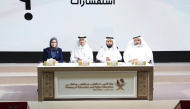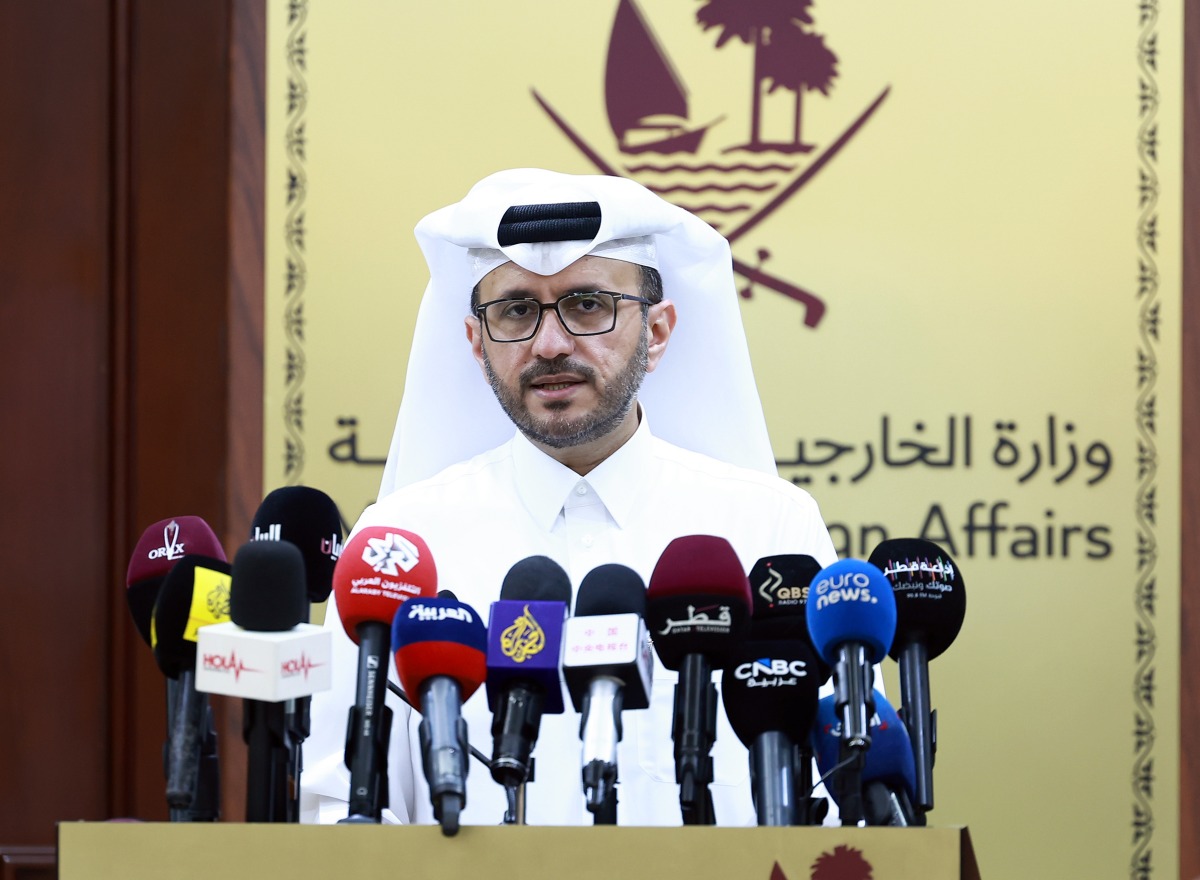
Doha, Qatar: Advisor to the Prime Minister and Official Spokesperson for the Ministry of Foreign Affairs Dr. Majed Mohammed Al-Ansari has said that Qatar rejects all forms of escalation and calls for restraint from all sides.
“The State of Qatar’s position regarding mediation has not changed. It fully supports the ongoing mediation efforts led by Pakistan, despite Qatar not being directly involved due to its focus on self-defense amid escalating threats in the region and continued Iranian attacks,” he said in weekly briefing yesterday.
He further said that Qatar is prepared for all contingencies, adding that the country had previously overcome even greater challenges and that there was full confidence in the leadership to take all necessary measures to ensure the stability of its markets and economy.
“Regarding mediation, Qatar’s position has not changed. We continue to support diplomatic efforts and existing channels. We are working to reduce escalation and prevent further tensions in the region. We have conveyed clear messages to all parties about the seriousness of the situation. Qatar rejects all forms of escalation and calls for restraint from all sides. The situation is highly sensitive, especially during these critical hours,” he said.
“We have been warning since 2023 that escalation left unchecked will get us into a situation where it cannot be controlled and we are very close to that point and this is why we have been urging all parties to find a resolution to find a way of ending this war before it is too late,” Majed Al-Ansari said.
Al-Ansari said that continuation of this war will have an impact on the region, on international economy and international energy markets, adding that “there are no winners if this war continues.”
He further urged all parties to refrain from any escalation that would harm not only the security situation in the region, but the environmental, humanitarian situation in the region.
“The attacks on certain critical infrastructures since the war has begun has taken us to the brink, and we don’t want to see more of that happening. There are a lot of dangers to that happening when it comes to food security, when it comes to water security, when it comes to environmental security, that we are still at the threshold of all of these challenges, and we hope that we can remain there and we are able to walk back from there to a more safe environment,” he added.
He further stated that Qatar will continue to defend its sovereignty against any aggression and that it is supportive of the efforts of Pakistan and the other mediators in finding a solution to this crisis.
Responding to a question about attacks on critical civilian infrastructre and also near Bushehr Nuclear Power Plant in Iran, he said: “We have always stated that attacks on civilian infrastructure, especially energy infrastructure, is putting all of us in danger. It is affecting the wealth of the people, the prosperity of the people, and the well-being of the people, in this region, and beyond. And it has a domino effect on energy markets and other markets in the world.”
He continued, “We have made it very clear that the attacks on this kind of infrastructure by any party should not be accepted. On the nuclear facilities, obviously we have evaluated the situation very closely, everything is safe up to this point, but obviously it is very dangerous when you see these kinds of attacks on nuclear facilities.”
To another question about GCC countries and Qatar’s strategy in case of escalation and attacks by Iran, Al Ansari said that there is a lot of coordination between the regional countries, the GCC, and “our militaries have been coordinating between them 24-7 throughout this crisis.”
He added, “From our position here in Qatar, we will defend our country against any aggression coming from any party. As we have done in the past weeks... we have shown that our military is capable of defending our country against Iran. We remain hopeful that a full escalation will not happen and mediation efforts by Pakistan will succeed for which and we stand ready to help. But right now, from the defensive posture, we are absolutely ready for any challenge that might come.”
To another question about trade movement through Strait of Hormuz, he said that Qatar is calling for the easiest, fastest, and safest way to end closure of the Strait of Hormuz. “The situation now is that we are in a war in the region that has engulfed all of us. All of our countries are facing missile attacks, drone attacks, and attacks on our civilian infrastructure. It is too early right now to talk about financial mechanisms to end the Strait of Hormuz crisis. Before discussing how the Strait is going to be run, we should, first of all, end this war, reach a resolution to the current escalation.”
He said that its closure constitutes a dangerous precedent and a clear violation of international law, and a direct threat to global security, supply chains, energy, and food. He stressed that the strait was a shared natural waterway that cannot be used as a tool of political pressure, calling for its immediate and safe reopening and ensuring freedom of navigation without any threats.
On Qatari gas carriers, Al Ansari said that all countries in the region and many international partners were suffering due to the closure of the strait, emphasizing that the State of Qatar’s priority in this regard was the safety of those working on these vessels and ensuring they were not exposed to danger in the absence of a clear mechanism for safe passage.
He added that the Strait of Hormuz was not like the Panama Canal or the Suez Canal, which were under the authority of specific states, but is a naturally open strait through which all ships and vessels pass.
To another question about President Trump’s deadline to Iran to reach a deal, Al Ansari said, “First of all, we were trying to defuse the escalation in the region since 2023 warning since then that escalation will get us into a situation where it cannot be controlled. And we are very close to that point.”
“And this is why we have been urging all parties to find a way to end this war before it is too late. And this is where we all need to focus for the people of the region, for international peace and security, for international economy, for international energy markets. There are no winners in the continuation of this war. There are only losers.”