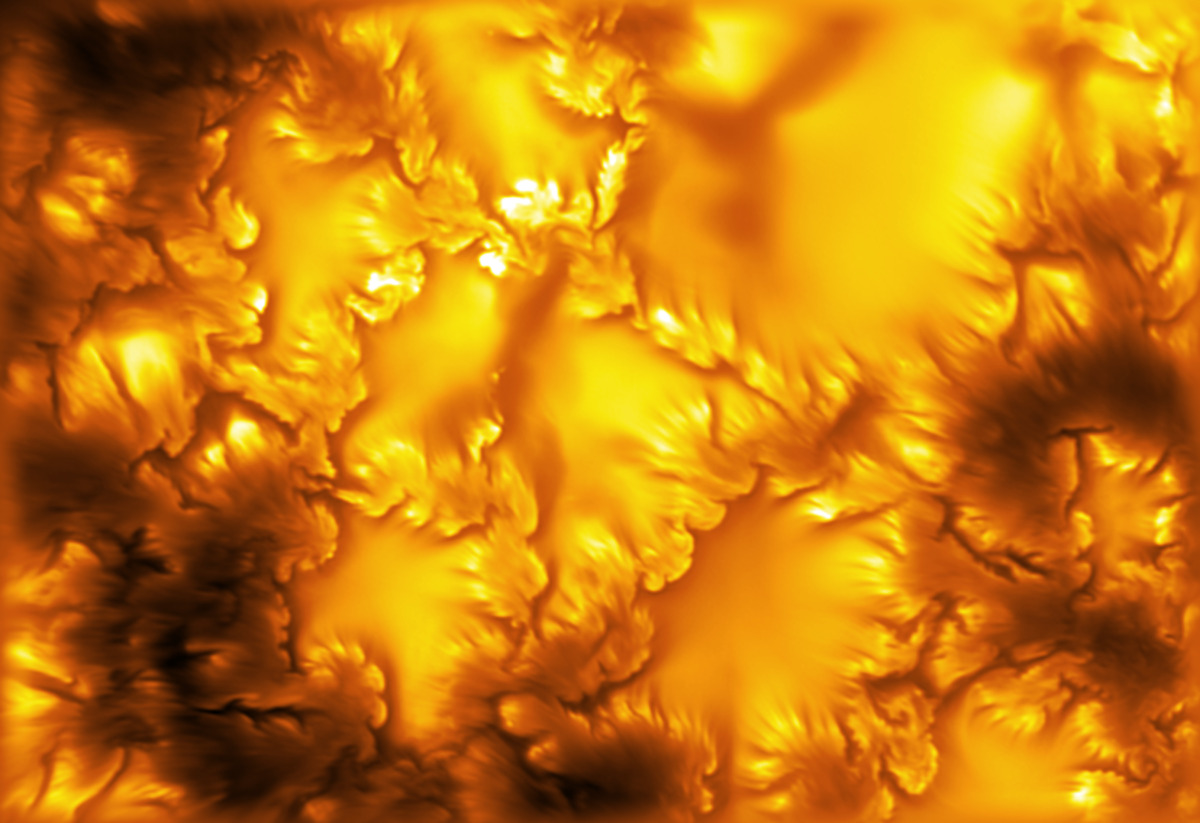
The highest-resolution image of the Sun's surface (photosphere) ever captured, taken at 416 nm by the Inouye Solar Telescope. It reveals deformed boundaries of magnetic elements and ultra-fine scale stripes, both associated with Kelvin-Helmholtz instability. Photo credit: NSF/NSO/AURA/MPS
Scientists have captured new images of the sun’s surface that show turbulent, vortex-like structures in unprecedented detail - a resolution roughly equivalent to spotting a blueberry from 70 miles away.
"It’s very difficult to produce such patterns, and to see them ubiquitously everywhere in the observed field of view was surprising and very exciting,” said David Kuridze, an astronomer at the National Solar Observatory and one of the lead authors of a paper outlining the findings in the peer-reviewed journal Nature on Wednesday.
The "surface” of the sun is really an unstable, roiling soup of plasma, heated to about 10,000 degrees Fahrenheit. The video released by researchers shows vortices of hot plasma that ebb and flow like bubbles in a pot of boiling water. Hot plasma is transported up from below the sun’s surface to a cooler area; as it cools, it drops back down to the inner parts of the star.
To take images of the sun, the researchers used the Daniel K. Inouye Solar Telescope in Hawaii. Its large aperture allowed them to capture uniquely small detail.

The U.S. National Science Foundation Daniel K. Inouye Solar Telescope, built and managed by the NSF National Solar Observatory, in Maui, Hawaiʻi. Photo credit: NSF/NSO/AURA
They released images on Wednesday at a spatial resolution of about 12 miles - giant on human scale, but very detailed for a star that measures about 865,000 miles across, or more than 100 times the diameter of the Earth.
"Previous observations in fact lacked the sharpness to resolve these features, making the solar surface appear much smoother, almost like an out-of-focus photograph,” said Vanessa Polito, a physicist at the Lockheed Martin Solar and Astrophysics Laboratory who was not affiliated with the study.
The paper published Wednesday presents the first empirical evidence that these detailed disturbances and vortices on the surface are created by a process called Kelvin-Helmholtz instability. The process occurs when two fluids or gases that are next to one another move at different speeds, causing wave patterns to form in between.
The effect can sometimes be observed in clouds, when one layer of air moves significantly faster than another below it. The resulting crests can resemble the curl of a Peeps marshmallow chick, or the Japanese painting "The Great Wave.”
"All these other mechanisms can now be analyzed based on that fact” that Kelvin-Helmholtz instability exists, said Friedrich Wöger, a senior scientist at the National Solar Observatory, which manages the Inouye telescope.
The latest discovery could help scientists unlock one of the biggest mysteries in the study of the sun and other stars: why its outer atmosphere, known as the corona, is so much hotter than its visible surface. This is the opposite of what happens in, say, a candle; as you move your hand away from the flame, you expect it to feel cooler, not warmer. Kelvin-Helmholtz instability is known as a way to break down energy flows into smaller and smaller patterns, potentially releasing small bursts of energy outward.
"I would expect the implications for coronal heating is where this work is most important,” Andrew Hillier, a physicist at the University of Exeter who was not involved in the study, wrote in an email. "This should inject extra magnetic energy into the corona at scales that are much easier to dissipate, making heating easier.”
This instability mechanism may also be important in understanding the way the sun builds up magnetic energy. The current theory is that forces in a magnetic field get wound up around each other, a process called flux braiding. When that tension is released, energy is released. The small swirling patterns created by Kelvin-Helmholtz instability may explain why the braiding happens in the first place.
Following this discovery, researchers hope to be able to use the Inouye telescope to map instability patterns in a way that quantifies the strength of the magnetic field.
"You need to have very sensitive instruments, but I think our telescope has that potential,” Kuridze said.