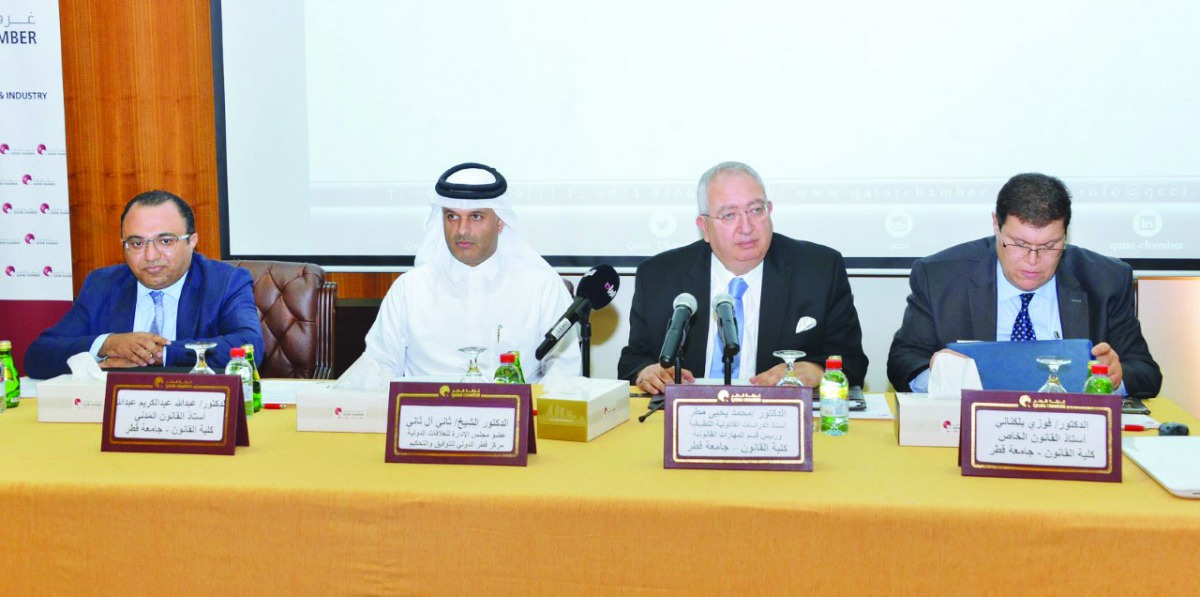
Dr Sheikh Thani bin Ali Al Thani (second left), Qatar International Center for Conciliation & Arbitration (QICCA) Board Member for International Relations at Qatar Chamber, and other participants at a seminar on Public-Private Partnership (PPP) held at QC
Doha: A panel of experts at a seminar on Public-Private Partnership (PPP) has recommended to set up a neutral body, like an antitrust organisation or competition commission in other countries, to safeguard the interests of all the stakeholders involved for the successful implementation of PPP projects in Qatar.
The panel of experts at a one-day seminar held at Qatar Chamber, who made several other recommendations, also echoed that the establishment of the neutral body will be of critical importance to monitor the quality of projects based on the PPP model. The body will also improve the confidence of private investors and help establishing a vibrant and sustainable economic diversification.
The PPP-business model also need to take into account various important factors such as the value-for-money, cost and benefit analysis, good governance, transparency, sustainability and balancing the risks among the parties involved in the project.
The seminar entitled :“Public-Private Partnership: Reality & Challenges in Qatar” was organised by Qatar International Center for Conciliation & Arbitration (QICCA) at Qatar Chamber in cooperation with the College of Law at Qatar University at the chamber’s headquarters.
The seminar ended with many recommendations including preparing the legislative and institutional frameworks necessary for a successful public-private partnership, and examining the experiences of successful experiments in other countries, as well as providing a database on the services that can adopt PPP.
It also recommended providing training programmes for governmental bodies to ensure the success of the negotiations between the two parties.
It addressed the “Public-Private Partnership: Reality and Challenges in the State of Qatar” and efforts made to adopt a special law on this subject, benefiting from comparative experiences and national needs.
The seminar was part of the project: “Toward Reforming the Economic Legislative Mechanisms for Achieving Legal Security in light of the National Policies of the State of Qatar “ which is a joint research between QICCA and the College of Law. The research aims to combine experts’ and businessmen views on PPP and take advantage of other experiences and making recommendations and conclusions about the PPP.
Addressing the seminar, QICCA Board Member for International Relations Dr Sheikh Thani bin Ali Al Thani said PPP has become a pressing national need, noting that it included a number of objectives that enhances the national economy’s resilience and strength.
He also noted that PPP helps in encouraging the private sector to participate in the projects held in the country and increasing investments and thereby increasing the social and economic development as well as enabling the government to implement its projects efficiently.
Sheikh Thani noted that Qatar National Vision 2030 underscored the importance of the private sector participation in the infrastructure projects of the country.
Research Project Manager and Professor of Applied Legal Studies and Head of the Legal Skills Department at the College of Law Dr Mohammed Yahya Matar said that Public-Private Partnership law is part of the government’s measures and decisions to strengthen and stimulate the private sector and support its role in the inclusive development of the country.
Elaborating the joint research project with QICCA, Matar said it would be extended for the next three years, noting that it is based on legal and commercial inquiries to the business community, and responding to inquiries regarding the PPP, assuring that the project is based on two elements: legislation and training.
Professor of Civil Law at the College of Law Dr Abdullah Abdulkarim Abdullah delivered a presentation on: “The importance of public-private partnership: the approach of international models”. He said that PPP helps in the development of international commercial transactions for the national economy, and the improvement of the country’s status of in international economic indicators.
“PPP contributes to increasing the attractiveness of foreign investment as well as to diversifying strategic options,” he added.
Dr Fawzi Belknani, Professor of Law, College of Law at Qatar University gave a presentation on: “Public-Private Partnership: The Contractual Framework” in which he said that PPP is an agreement between the administrative bodies of the country and the private sector with a view to providing services or implementing state projects.
He also noted that contractual partnerships included many forms, such as leasing, management, service, sale and franchise.
For his part, Qatar Chamber Economic Advisor Dr Mohamed Ibrahim said that the Qatar government exerted efforts and offered many initiatives through the ministerial group to stimulate and encourage the private sector to become an effective partner for the sustainable development.
He also noted that the PPP model for infrastructure projects is one of these initiatives, pointing out that it is based on the value-for-money basis according to available alternatives, cost and benefit analysis, social development, governance, transparency and sustainability with the aim to diversify sources of income and distribute risks in the interests of both parties.