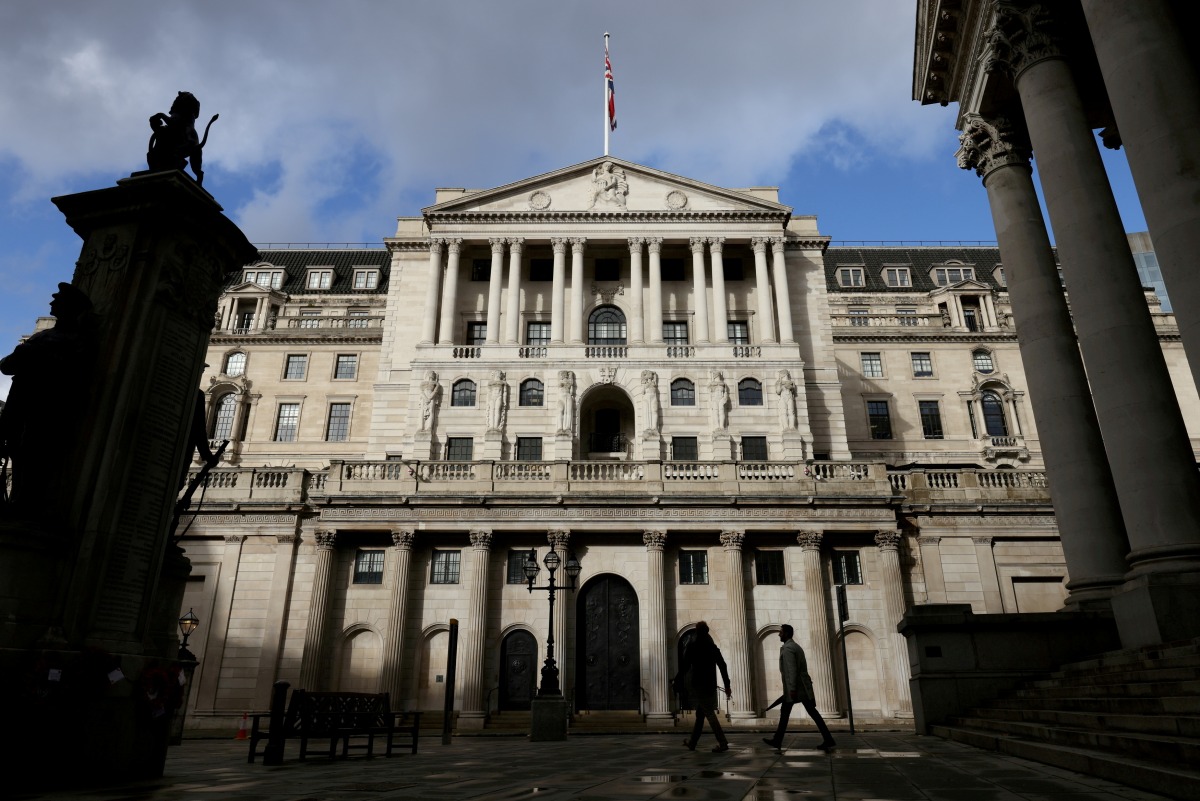
People walk past the Bank of England, in London, Britain, on October 31, 2021. REUTERS/Tom Nicholson/File Photo
London: It’s been a brutal summer for UK investors as August saw the biggest sell-off in years for the pound, gilts and corporate bonds.
The rout may not be over as Britain grapples with a toxic mix of double-digit inflation and a looming recession. Sterling is already near historic lows after losing almost 5% this month, the most since the aftermath of the Brexit vote in 2016. Government bond yields posted their the biggest monthly jump on record in August.
Funds are fleeing UK assets on the view that the Bank of England will struggle to raise interest rates fast enough to control a cost-of-living crisis, and foreigners sold sovereign debt in July at the fastest pace in four years. Worsening the outlook is speculation that a new prime minister could ramp up borrowing, just as the central bank starts offloading bonds from its portfolio.
"On a rolling quarterly basis, this is the worst outflow since 2020, which is the last time we had a ‘sell everything sterling’ market where cable, FTSE and gilts were selling off together,” said Antoine Bouvet, senior rates strategist at ING Groep NV, referring to the July bond outflows.
Leadership contender Rishi Sunak has warned it would be "complacent and irresponsible” to ignore the risk of markets losing confidence in the British economy. He has repeatedly accused rival Liz Truss, the favorite to be anointed prime minister next week, of making unfunded spending pledges that could further push up inflation and interest rates.
Goldman Sachs Says UK Inflation Is at Risk Of Topping 22%
The market’s selling spree has highlighted the country’s reliance on foreign investment, dubbed the "kindness of strangers” by former central bank chief Mark Carney. It’s been tumbling since Britain voted to leave the European Union, while the weaker pound and higher commodity prices are eating into the country’s terms of trade.
It’s a mix that has pushed up the yield on benchmark 10-year gilts by nearly 100 basis points this month, the most in Bloomberg records dating back to the late 1980s.
"With all the UK’s macro challenges -- twin deficits, double-digit inflation, more policy tightening, increased issuance -- for how much longer gilts will continue to find succor from non-residents is an open question,” UBS Group AG rates strategist Rohan Khanna wrote in a note. He expects 10-year yields to rise as high as 3.25%, a level last seen in 2011, from 2.8% at the moment.
While inflation and increased borrowing costs are hurting companies across Europe, the financing situation is especially acute in the UK. Shorter maturity corporate debt, the most sensitive to policy rates, saw yields surge nearly half a percentage point in August to almost 5%. That’s expanded the gap with the euro area to almost the widest since 2009.
The UK’s stocks have also had a bad month, with the benchmark FTSE 100 down nearly 2% in August, though that extends to more than 6% in dollar terms. That’s because of the weaker pound, which is now down more than 14% this year. At the same time, the more domestically-focused FTSE 250 index has slumped more than 5% given the inflation and recession fears.
London’s Stock Market Misery Grows as Delistings Add to IPO Woes
Paul Dales, chief UK economist at Capital Economics, thinks sterling could tank another 9% in the coming months, taking it to $1.05, its lowest-ever level seen in 1985,
"Our forecast that the energy crisis will push the euro zone and UK economies into recession while the US gets away with a milder slowdown suggests that the euro and the pound will weaken further against the US dollar,” he wrote in a note.