Doha, Qatar: In recent decades, Southeast Asia has been the most dynamic region in the world, showcasing the brightest economic growth performance. Within this region, the six largest countries of the Association of Southeast Asian Nations (ASEAN-6), which includes Indonesia, Thailand, Singapore, Malaysia, Vietnam, and the Philippines, have been among the fastest growing economies, with Singapore already reaching the status of an advanced economy, QNB said in its economic commentary.
Despite a challenging global environment, the six largest ASEAN economies entered 2026 from a position of strength. The ASEAN-6 countries grew firmly in 2025, outperforming expectations despite a challenging shift in global trade policy. 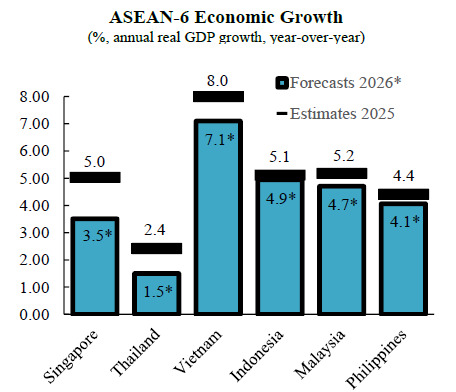
ASEAN-6 Economic growth (%, annual real GDP growth, year-over-year)
Within the bloc, performance was broad-based: Vietnam delivered an exceptional 8% expansion in 2025, the second-highest annual growth rate since 2011, driven by strong manufacturing, tourism, exports, and FDI. Indonesia grew at 5.1%, anchored by resilient domestic demand. Malaysia expanded by 5.2%, supported by substantial digital investment and strong export momentum.
Singapore benefited from global AI infrastructure investment and increased infrastructure spending. The Philippines maintained solid growth, while Thailand navigates structural headwinds including elevated household debt.
Across the bloc, inflation remained low in 2025, well below the region’s long-run average, preserving meaningful monetary and fiscal policy space. The region also undergone a shift towards intraregional demand. Robust FDI inflows into advanced electronics, electric vehicles, and digital services have meaningfully reduced the region’s exposure to external shocks. This provides a solid foundation as the region experiences a more difficult set of global headwinds.
The most immediate challenge is the energy shock triggered by the US and Israel-Iran conflict and the effective closure of the Strait of Hormuz, through which approximately 20% of the world’s oil and LNG normally flows, around 85% of all energy supply in Asia. Higher energy prices are raising production costs and consumer prices across the region, raising inflation.
The second headwind is US trade policy. The region has structurally reduced its direct US export dependence, with US-bound value-added exports falling from roughly one-third to approximately 20% of total exports and has even benefited from trade diversion as supply chains shift out of China.
However, the US investigations into excess industrial capacity across trading partners, including Indonesia, Malaysia, Thailand, and Vietnam added a new layer of uncertainty. This is especially true for Vietnam and Malaysia, which are perceived as potential transshipment points for Chinese exports.
The third headwind is the deceleration of Chinese demand, which is a critical end-market for much of ASEAN’s industrial output. Taking all these factors together, we see a broad-based growth moderation, with Southeast Asian growth slowing to 4.2% in 2026, down from 5.0% in 2025.
Despite the moderation, the growth outlook varies considerably across countries due to differences in economic structure, domestic demand, energy dependence, and exposure to external trade shocks. Vietnam and Indonesia stand out as the most resilient performers.
Vietnam is projected to grow at close to 7% in 2026, supported by robust FDI inflows, manufacturing, and strong domestic consumption. Indonesia, is projected to grow at 4.9%, anchored by resilient domestic demand and fiscal stimulus. Malaysia holds at 4.7%, underpinned by substantial digital investments and a strategic position in the global semiconductor supply chain.
Singapore, benefiting from its advanced institutional framework and global AI infrastructure investment, continues to attract high-value capital flows.
At the other end of the spectrum, Thailand faces the most challenging outlook, with growth projected at around 1.5% in 2026.
High household debt stands as the highest among ASEAN peers, compressing consumer spending at precisely the moment when energy costs are rising. The Philippines face acute inflationary pressure from higher oil prices, electricity rate adjustments, and transportation costs, keeping growth subdued, but still expected at 4.1%.
Looking ahead, the ASEAN-6 countries continue to grow at rates well above the global average, supported by young demographics, rising domestic consumption, deepening regional integration, and an accelerating digital and technology investment cycle.
The critical risk to this outlook is a prolonged US-Israel-Iran conflict that permanently embeds higher energy costs, erodes consumer confidence, and disrupts the supply chains that underpin ASEAN’s manufacturing base.
Nevertheless, the fundamental story of ASEAN in 2026 remains one of relative strength in a challenging global environment.