By Mohammed Osman
DOHA: The law which regulates the work of translation needs to differentiate between interpretation (simultaneous) and written translation, says an expert. Dr Amal Almalki, Dean of the College of Humanities and Social Science at Hamad bin Khalifa University (HBKU) said that the university has plans to introduce a master’s programme in interpretation (simultaneous) in addition to the current two programmes.
“We are in touch with the authority concerned at the Ministry of Justice to make sure that the law makes a difference between the work of an interpreter and a translator,” said Dr Amal Almalki.
She was speaking about the draft law which was approved in late January last year by the State Cabinet that defines experts, including translators. The theme of this year’s conference being attended by over 200 participants is “Politics of Translation: Representations and Power”.
Speaking to this daily on the sidelines of the 7th Annual International Translation Conference yesterday which kicked off at Qatar National Convention Centre (QNCC) and continues for two days, she said: “We have a plan to introduce after two years a master’s programme in interpretation (simultaneous) due to its importance for society and its close relation to security, safety and achieving justice”, as patients in hospitals and people facing trials in courts, for instance, need their help.
One of the aims of the conference is to raise social awareness about the importance of translation, its role in communication and society’s perception about translators should be changed, Al Malki stressed.
In her opening remarks, Al Malki pointed out that “this translation conference, which started seven years ago as a small intellectual gathering, has become an yearly reference for academics, media specialists and diplomats, as well as the general public”.
This year’s theme has resonated positively with the academic and professional communities and has proven yet again that the fields of translation and interpretation are interdisciplinary and span any field that has a human component to it.”
Asked why the theme of politics was chosen for this year’s conference, she said politics plays a major role in this region which is in turmoil and facing refugees crisis, so politics should not hinder cultural and intellectual dialogue between different nations and translation is one of the major means to bolster such dialogues.
The conference is organized by Hamad bin Khalifa University’s College of Humanities and Social Sciences (CHSS). The event’s keynote addresses, panels and workshops highlighted the crucial role translation plays in an increasingly globalized world as a powerful instrument often used to shape a narrative, the portrayal of an event, or a current situation.
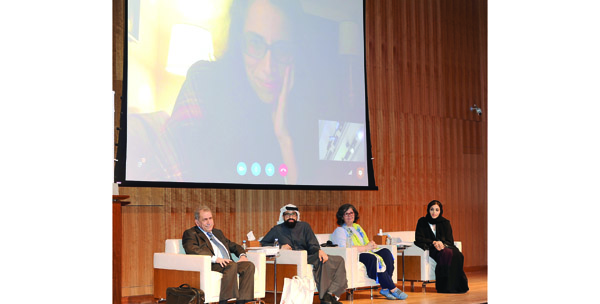
Al Malki commented on the importance of the field of translation and interpretation in her opening remarks. She noted: “Politics has played a role in this year’s conference. The unfortunate events in Belgium last week and the closure of the airport have made us both anxious and adamant in having our panellists from Belgium join us. Our team has worked closely on their travel logistics and I am very happy to say our colleagues from Belgium are here with us today”. Three of five from Belgium were managed to join the conference said Al Malki.
The conference brings local and international scholars, political commentators, media personalities, and the general public together to discuss some of the most critical challenges in the field.
Keynote speakers included Dr Henri Awaiss, Dean of the Faculty of Languages of Saint Joseph University, Beirut, Dr Joselia Neves, Associate Professor at Hamad Bin Khalfia University, Dima Khatib, journalist, writer and translator, and Sultan Sooud Al Qassemi, a well-known columnist and commentator on Arab affairs based in the United Arab Emirates, previously listed in Arabian Business as one of the World’s 100 Most Powerful Arabs in the “Thinkers” category.
Al Qassemi said: “It’s been five years since I had a small role in translating some of the events that occurred during the Arab Spring. I’ve never been asked to speak about that experience until now and it has really been a journey of self-discovery.”
“It is interesting to hear what other professionals have to say about the politics of translation and the translation of politics. Doha is a great place to hold this conference, with participants from around the world, including countries with varied political systems such as China, and Iran, and many of the Arab states, able to discuss this issue and speak about their experiences translating major political events.”
The first day of the conference continued with attendees engaging in simultaneous panel discussions, covering topics such as the politics of gender in translation, interpreting conflicts, and literary representations of power. Speakers from Qatar, Egypt, Spain, the United Kingdom, Portugal, China, Iran, Turkey, Belgium, Switzerland, Saudi Arabia, Morocco, Algeria, Canada and the United States participated, with the conference organizers selecting 32 abstracts from over 100 submitted.
Day two of the conference will explore topics such as translating the religious, ethical questions that emerge when covering political issues, and the linguistic perspective on political translation.
It will also feature a closing session with keynote speakers and special guests, including Dr. Ahmed Albanyan, Dean of the Institute of Translation and Arabisation (TAI) at the Imam Muhammad ibn Saud Islamic University in Saudi Arabia, Dr. Huda Moukannas, Professor at the Lebanese American University, and Dr. Hannelore Lee-Jahnke, professor from the University of Geneva - sharing reflections and major takeaways from the event. A series of workshops are also being offered in an effort to emphasize the crucial link between theory and practice with Dr. Mahmoud Al Batal, Professor of Arabic at the University of Texas, Austin and co-author of the well-known Arabic textbook series Al-Kitaab, leading a session on The Teaching of Writing in Arabic: Process, Product, and Assessment this year.
The impressive line-up of speakers at the 2016 conference, as well as its popularity among the community in Qatar, makes evident the growth and development of the annual event. In its seventh year, the conference has become the preferred Gulf-based platform for discussions in the field of translation and interpretation, drawing individuals from around the world to Qatar as HBKU continues to evolve and expand, guided by an aim to offer academic programmes that serve local and regional needs.
Shaima Ziara, a student enrolled in HBKU’s Master’s of Arts in Translation Studies programme, commented: “The Seventh Annual Translation Conference is a great opportunity for the students of the College of Humanities and Social Science to be exposed to a professional academic environment and explore the different approaches and conditions of translation. The conference offers students such as myself the opportunity to learn from experts working in various fields through the different panels and workshops that cover a wide range of topics,” Ziara said.
The Peninsula