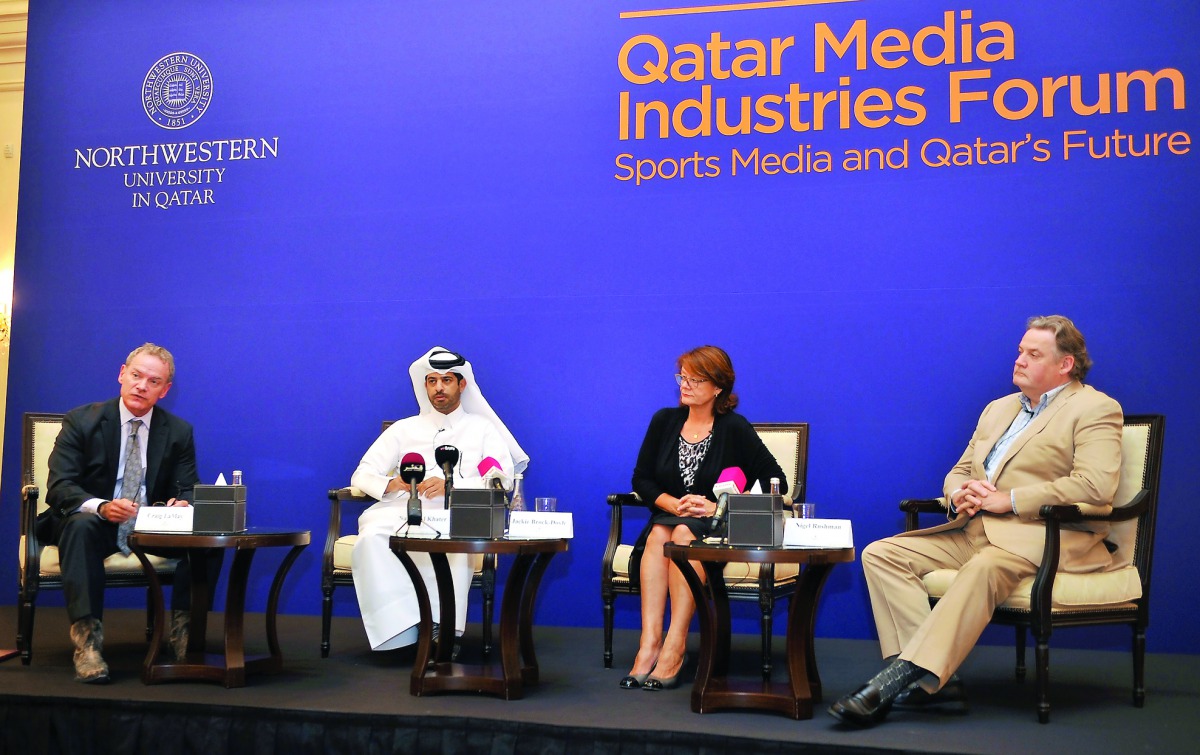
Nasser Al Khater (second left), Assistant Secretary General, Tournament affairs, Supreme Committee for Delivery and Legacy, and other officials at the Qatar Media Industries Forum “Sports Media and Qatar”s Future" in Doha. Pic: Abdul Basit / The Peninsula
Terming 2022 FIFA World Cup as ‘key catalyst’ in achieving 2030 National Vision, Nasser Al Khater, Assistant Secretary General, Supreme Committee for Delivery and Legacy (SC) said under changing trends of news-consumption, social media’s role had become important in sports coverage.
“Now people take interest in short video clips and brief texts. We have to work and develop skills how to create this kind of content to share human interest stories during future mega sports events in Qatar including 2022 World Cup,” Al Khater noted while taking part in a panel discussion at Qatar Media Industries Forum, hosted by Northwestern University in Qatar (NU-Q).
The theme of discussion was “Sports Media and Qatar’s Future”. He said negative stories about Qatar and 2022 World Cup started dying as “SC believed in engaging the media (national or international) and always cleared their misunderstandings and responded to their questions positively.”
“Another challenge we are facing is fast pace of advancement of technology and we are ready to adopt them and give maximum entertainment facilities to visitors to enjoy mega sport events in Qatar,” he said, citing example of modern trend of installing screens behind stadium seats to facilitate spectators to enjoy replays.
He said SC would also facilitate non-accredited media outlets to cover side stories of mega sport event. “Mainstream sports media usually covers sport event while social media platforms are used for sharing soft stories of human interest. These stories also help in promoting Brand Qatar,” he observed.
Al Khater said: “There are several factors to successful media strategies for such events. Crucially though, they must be, authentic and reflect host country’s aspirations for holding the mega-event in the first place. "
The panel discussion, which was moderated by NU-Q professor and sports media expert Craig LaMay, covered several areas in which Qatar has gained unique expertise in recent years.
In his opening remarks, Everette E. Dennis, dean and CEO of NU-Q, said the forum “brings together individuals and representatives from news organisations, television stations, PR firms, advertising, and other media companies to speak together at one place about many ways in which media industry in Qatar has grown and developed. This pace cannot slow now as it gears up to welcome even more visitors, athletes and journalists.”
Jackie Brock-Doyle OBE, executive director for communications at IAAF and former director of communications and public affairs for London Olympics 2012, said while host countries often focus on reacting to any negative coverage, “it is also essential to proactively reach out to your core stakeholders and anyone in support of a mega-event, as they are your most important ambassadors. Any host country’s communication and media strategy should be a balancing act between listening to critiques but also reaching out to supporters, who are able to tell your story in a more authentic and organic way.”