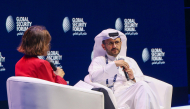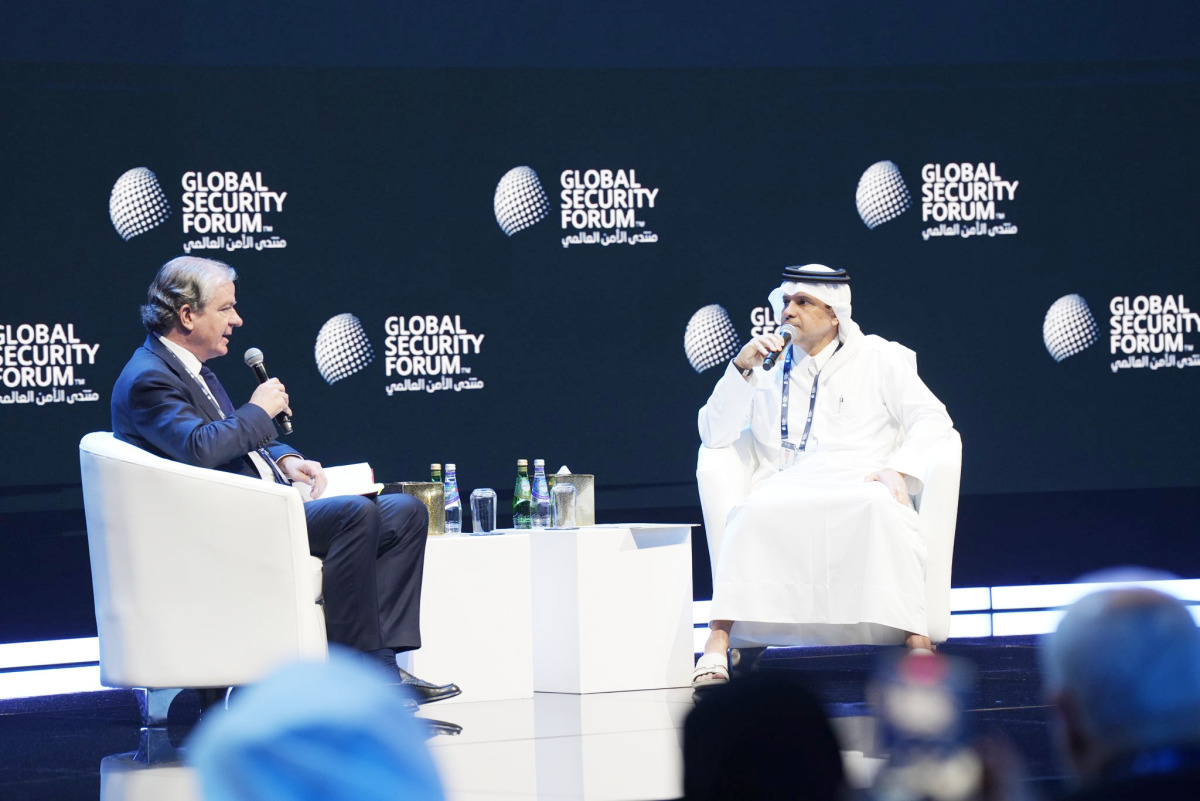
Deputy Prime Minister and Minister of State for Defence Affairs H E Sheikh Saoud bin Abdulrahman bin Hassan bin Ali Al Thani speaking at the Global Security Forum yesterday
Doha, Qatar: Qatar will soon announce a new defence partnership with regional allies and a defence hub in the country, Deputy Prime Minister and Minister of State for Defence Affairs H E Sheikh Saoud bin Abdulrahman bin Hassan bin Ali Al Thani said at the Global Security Forum.
Speaking in the opening session, “The Future of Alliances: Building Lasting Regional Security,” Deputy PM outlined Qatar’s assessment of regional security challenges, its defence priorities and the importance of strategic partnerships, while stressing that diplomacy and military preparedness must go hand in hand.
He said the planned initiatives form part of a defence strategy to build local capabilities in air defence, counter-drone measures, and cyber security and electronic warfare. “These were identified as priorities in a defence review conducted last year.”
The plan, he said, also covers ammunition, with Qatar either producing locally or investing in companies, alongside partners including the United States, the United Kingdom and France.
The Deputy Prime Minister said Qatar has faced three pronged threats since June 2025: violations of its sovereignty through external attacks, disruption of energy supplies from Qatar and the wider Gulf, and spillover from the conflict.
He warned that disrupted energy supplies would raise costs for consumers worldwide and said the shockwave had not yet reached the expected level.
He added that the instability in the Gulf would also disrupt east-west supply chains, Gulf aid to other nations, and Gulf investments abroad that create jobs in Europe and the United States. “These interconnected interests underscore the importance of maintaining security and stability across the Gulf,” he said.
The Deputy Prime Minister said Qatar is strengthening its own defence capabilities while continuing to work with allies and GCC partners to address emerging threats.
He described cooperation within the GCC as a foundation for regional security.
He also highlighted Qatar’s longstanding defence partnership with the United States, saying decades of cooperation had helped build military capabilities and improve the exchange of operational experience referring to air defence during the conflict.
Talking on Al Udeid Air Base, he emphasised that the facility is a Qatari base used by the United States and other international partners.
He said more than 20 countries had been represented there at certain times and that development of the facility would continue to meet the requirements of Qatar’s air force and army and its allies.
The Deputy PM said Qatar was also drawing lessons from attacks involving missiles, drones and other threats to ensure that its critical assets were better protected against future incidents. He stressed that Qatar would continue to strengthen its deterrence capabilities while remaining committed to preventing further escalation.
He said that mediation remained an essential part of Qatar’s strategy to prevent conflicts and support lasting regional stability. He described diplomacy and defence readiness as complementary, arguing that efforts to resolve disputes peacefully did not remove the need for a country to be prepared to protect itself.
Citing Qatar’s mediation between the Democratic Republic of the Congo and Rwanda, which he said began in 2022 and reached a conclusion in 2025, he noted that diplomatic initiatives often required sustained effort and patience.
On ongoing diplomatic efforts involving the United States and Iran, the Deputy PM said Qatar supported Pakistan’s mediation efforts and was working in coordination with partners, including Oman. He said the parties complemented one another through a collective approach, with the aim of reaching a resolution to the conflict.
On Iran, he said relations were built on trust until the events of June last year, with no incident before then. Lasting peace, he said, would require a regional dialogue involving the Gulf Cooperation Council states, Pakistan and Turkiye, in consultation with international allies.
“It should rest on trust and a non-aggression agreement that addresses concerns on all sides.” He pointed to Germany and France, which moved from decades of conflict to economic ties, beginning with Airbus, as an example.
He said that Qatar and the GCC oppose the imposition of transit fees in the Strait of Hormuz, except where provided for under applicable commercial law. He also warned that uncertainty surrounding the Strait of Hormuz and other maritime routes would affect energy supplies, markets and consumers, expressing hope that an agreement to end the conflict could be reached soon.
Asked about attacks on Qatari interests, H E Sheikh Saoud said Qatar was surprised by the attack on the Ras Laffan gas facility, and by a later attack on a leased ship about five days after a memorandum was signed in Geneva.