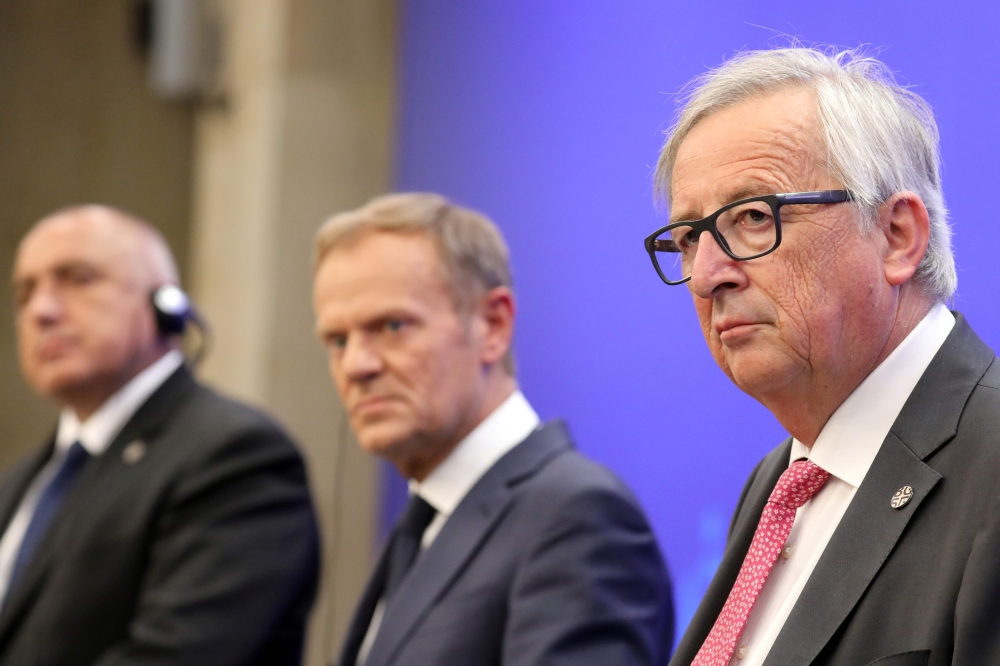
European Commission President Jean-Claude Juncker (R) reacts, next to European Council President Donald Tusk (C) and Bulgarian Prime Minister Boyko Borisov (L), during a joint press conference during an EU-Western Balkans Summit in Sofia on May 17, 2018.
SOFIA: The EU will on Friday begin moves to block the effect of US sanctions on Iran in the bloc, European Commission chief Jean-Claude Juncker said, as part of efforts to preserve the nuclear deal with Tehran.
"We will begin the 'blocking statute' process, which aims to neutralise the extraterritorial effects of US sanctions in the EU. We must do it and we will do it tomorrow morning at 10:30," Juncker said at a summit in Sofia on Thursday.
The European Union is trying to find ways to keep Iran in the 2015 accord by safeguarding the economic benefits Tehran gained in return for giving up its nuclear programme, after US President Donald Trump abruptly pulled out of the deal.
The "blocking statute" is a 1996 regulation originally created to get around Washington's trade embargo on Cuba.
It prohibits EU companies and courts from complying with specific foreign sanctions laws and says no foreign court judgments based on these laws have any effect in the EU.
But the row with the United States over the Cuba embargo was settled politically, so the effectiveness of the blocking regulation has never been put to the test.
Its value may lie more as a bargaining chip with Washington than its legal effectiveness, and last week an EU source acknowledged that the "political symbolic effect is potentially bigger than the economic effect".