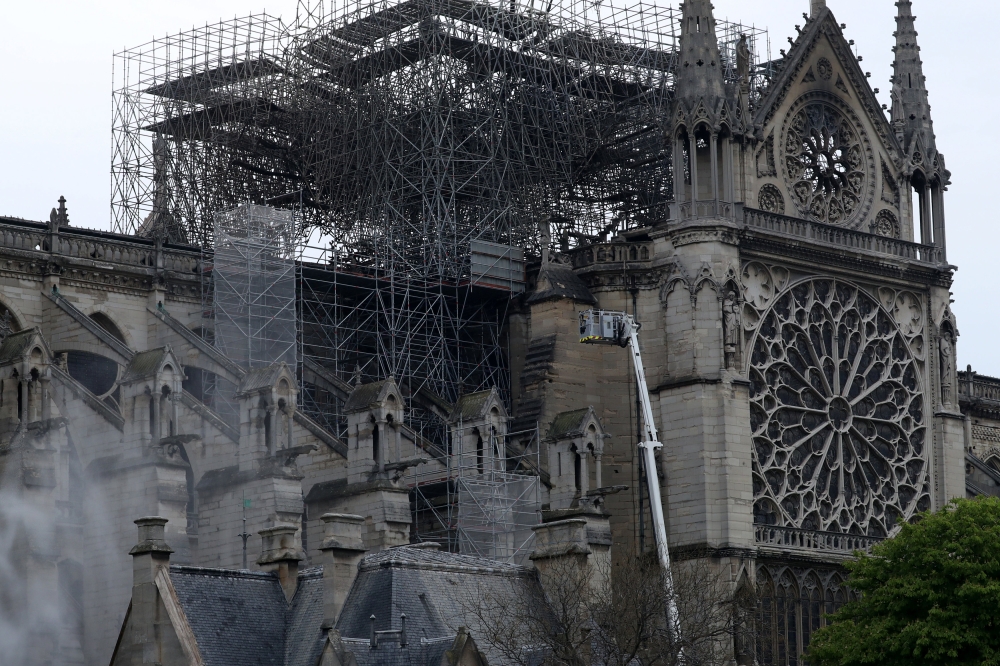
Firefighters work at Notre-Dame Cathedral in Paris, France April 16, 2019. A massive fire consumed the cathedral on Monday, gutting its roof and stunning France and the world. REUTERS/Yves Herman
The catastrophic fire that ripped through the Notre Dame Cathedral in Central Paris and seriously damaged large parts of the structure is now under control but still not completely extinguished.
"Fire risk being now removed, it’s now about the building itself,” deputy interior minister Laurent Nunes said early Tuesday morning after visiting the iconic 850-year-old Gothic monument. Firemen were still hosing the south side of the transept, and a district around the cathedral was sealed, as military and police patrolled the area. Experts will meet as early as 8 a.m. local time to determine if the building structure is stable and if firemen can now work inside to cool the building, Nunes said.
President Emmanuel Macron late Monday evening vowed to rebuild the cathedral after it was ravaged in the fire, leaving France in shock over the extensive damage to one of the nation’s most iconic landmarks.
The blaze raged for more than four hours before Macron declared the two bell towers and facade had been saved. Flames had engulfed the roof, snaking up the ornate spire before it collapsed as smoke billowed out into the evening skyline of the French capital. Around 500 firefighters battled the inferno.
"We will rebuild Notre-Dame because that’s what the French people want,” said Macron, who was visibly moved. "That’s what our history deserves, because that is our destiny.”
The historic church, located on one of two islands in the middle of the Seine River, had been under renovation and scaffolding had covered much of the top structure. French Deputy Interior Minister Laurent Nunez said it’s too early to say what caused the fire while Paris prosecutors have opened an investigation.
Live television images transfixed viewers around the world and Macron postponed a major speech as flames ravaged the cathedral that has towered over Paris for centuries. It had come through long-range German bombardment during World War I and was spared damage during World War II. The president called for donations to reconstruct the monument and said he would draw on the world’s best talents for the task. French billionaire Francois Pinault pledged 100 million euros ($113 million) to the effort.
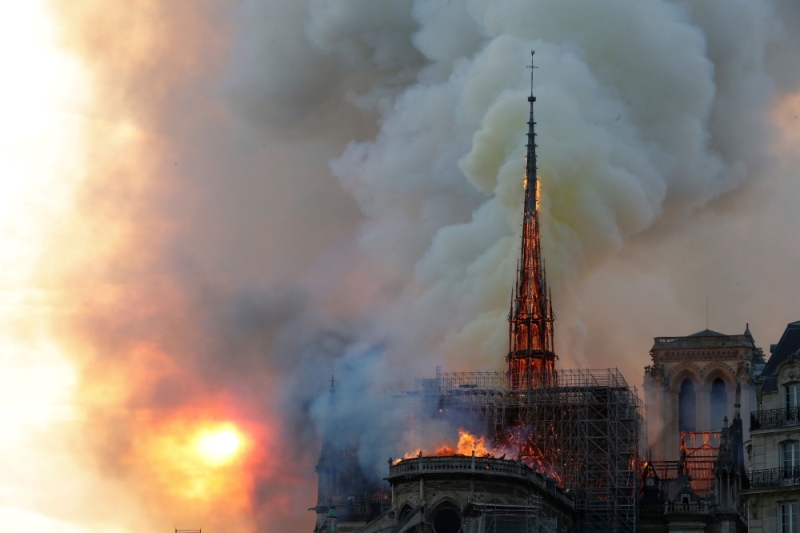
Smoke billow and flames burn from the roof of the landmark Notre-Dame Cathedral in central Paris on April 15, 2019. AFP / FRANCOIS GUILLOT
Bystanders including priests were cordoned off from the blaze on Monday, with many singing and praying, or standing by in silent disbelief. Thousands of people were evacuated from the building after the fire broke out and hundreds of onlookers remained on the scene as ashes fell onto surrounding streets. At least one fire fighter was seriously injured.
Some of the centuries-old artwork and relics from the cathedral were removed by firefighters, according to Paris Mayor Anne Hidalgo. She wrote on Twitter she was at a loss for words "to express the pain I feel in the face of the ravaging flames. Tonight Parisians and the French mourn this symbol of our common history.” Early Tuesday, it was still unclear what exactly had been saved from inside the church.
"It is eight centuries of history going up in smoke,” said Marion Lacroix, a 54-year-old Parisian. "It’s the heart of the country. I think that in our generation, people won’t see Notre Dame built again. It’s over.”
The flames lapping the famous landmark is just the latest in a string of tragedies to strike the French capital. In 2015, Paris was the site of two of the worst terror attacks in the country’s post-WWII history. Since last November, the city has also been under siege every Saturday as clashes between the so-called Yellow Vest protesters and police have turned violent. Macron canceled a major policy speech as the extent of the fire became clear.
Notre Dame is a major tourist destination, with the number of visitors swelling to as many as 50,000 a day, especially during periods like holy week in the Christian calendar leading up to Easter.
The fire-fighting effort was bolstered by reinforcements from outside the city and helicopters could be seen flying overhead, although weren’t being used to drop water because of the risk the extra weight would lead to further structural collapse. Boats pumped water from the river to battle the blaze.
U.S. President Donald Trump and other leaders from around the world expressed their solidarity with Paris including German Chancellor Angela Merkel, British Prime Minister Theresa May and Dutch Prime Minister Mark Rutte.
The fire ravaged a center of French Catholicism where some of the nation’s historical events were celebrated. Construction got underway in the 12th century, though the current structures are mostly the result of renovations carried out in the 19th century following damage during the French Revolution.
The cathedral was at one time in a state of total disrepair and close to the point of being demolished, but was later saved by Napoleon who himself was crowned Emperor in 1804 inside the cathedral.
The interior of the cathedral is 427 by 157 feet, with its 115-foot-high roof. Two massive early Gothic towers crown the western facade, which is divided into three stories and has its doors adorned with early Gothic carvings and surmounted by a row of figures of Old Testament kings.
"This is horrible,” said Julien Ciprelli, a 19-year-old politics student living in Paris. "‘I saw the smoke from the classroom. I had to come.”