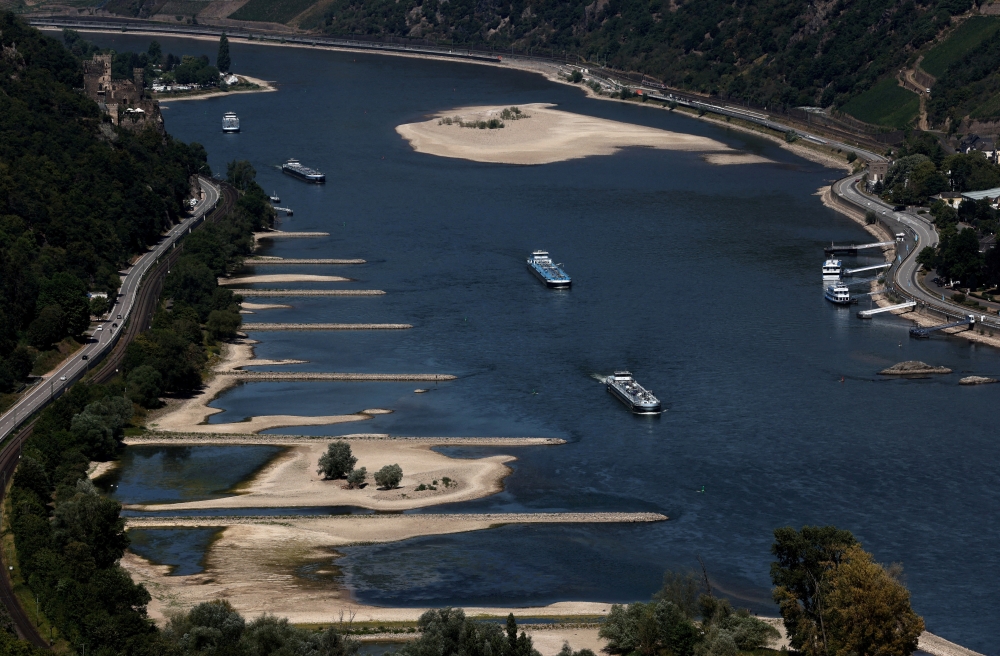
Transport vessels cruise past the partially dried riverbed of the Rhine river in Bingen, Germany, August 9, 2022. REUTERS/Wolfgang Rattay/File Photo
The Rhine River’s water level at a key waypoint hit a new low, risking the transit of fuel and other goods on the waterway as Europe’s climate crisis exacerbates its energy-supply crunch.
The marker at Kaub, a particularly shallow point west of Frankfurt, briefly dropped to 30 centimeters (11.8 inches) earlier Monday before edging back up, the latest German government data show. It is forecast to fluctuate around 31-33 centimeters as the week progresses.
"The current water levels on the Middle and Lower Rhine are currently at an exceptionally low level for this time of year,” the Rhine Waterways and Shipping Authority, known as WSA, said in a statement. "They are the result of the lack of precipitation in recent weeks and months.”
The Rhine is western Europe’s most important river for the transport of fuel and other industrial goods. Many barges find it uneconomical to transit past Kaub when the water level there is at 40 centimeters or below. The marker is not the actual depth of the river, but rather a reference for navigability.
It wasn’t immediately clear on Monday how the drop to 30 centimeters at Kaub affected river traffic. The WSA said it hasn’t imposed shipping restrictions, noting that when water levels are low, less cargo can be transported.
Last week, shipping company Contargo, which also operates terminals, said that a drop at Kaub to below 40 centimeters would prompt it to largely discontinue its barge business on the middle and upper Rhine. Neska Container Line B.V. said on Aug. 11 that its barges weren’t able to call at Cologne and Dusseldorf -- downriver from Kaub -- and that inland waterway barge handling would be possible again from around Aug. 19.
The measured water-level at Kaub hasn’t been this low at this time of year since at least 1990, according to official data compiled by Bloomberg. Prior to November 2013, data are tallied on a daily, rather than intraday basis. In late 2018, the level fell as low as 24 centimeters.
Energy prices on the continent have soared as a heat wave bears down upon the region. Benchmark natural gas futures rose on Monday, while German year-ahead power jumped to a new record.