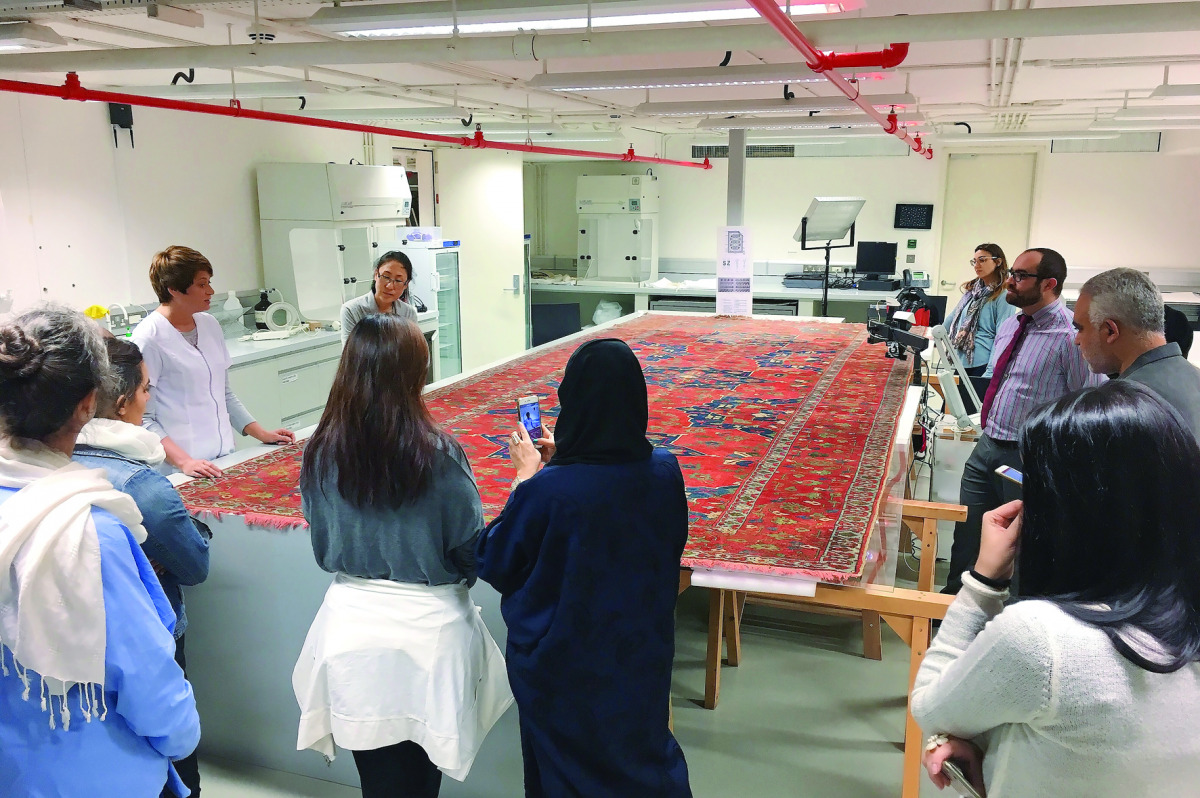
Tatiana, one of the textile conservators, explains the conservation process for a Turkish Ushak carpet dating to between late 15th to early 16th century at the MIA Conservation Laboratory, yesterday.
Doha: Sixteen carpets dating back hundreds of years are undergoing interventive conservation at the Museum of Islamic Art (MIA) conservation laboratory in preparation for an important exhibition featuring a massive collection of Islamic objects from the Ottoman, Safavid, and Mughal empires.
“The next exhibition called “Imperial Threads: Motifs and Artisans from Turkey, Iran and India” is related to the movement of design throughout different Islamic empires particularly the Mughal of India, the Safavid of today’s Iran and the Ottomans of today’s Turkey,” Aristoteles Georgios Sakellariou, Head of Conservation Department, said at an exclusive tour of the conservation laboratory yesterday.
Although these motifs can be seen in objects like metal work and ceramics, the movement of the motifs are best exemplified through the carpets which are the biggest and most spectacular, he added. Unknown to many, the Museum of Islamic Art has a conservation laboratory which conserves various objects acquired by the museum.
“The MIA’s conservation section is the best in Qatar and specialises in Islamic Art including books, manuscripts, textiles, jewellery, wood, metal works, ceramics and glass,” explained Sakellariou, adding conservation works are done for future exhibitions or for loans.
Following international standards, everything is recorded from the moment the object enters the museum until it is stored or exhibited, as well as the treatment applied on each object is reversible. The laboratory is divided into two sections. While the upper portion is devoted to smaller objects, the lower part, which is probably the only laboratory located below sea level , is fully dedicated for bigger pieces including carpets and textiles.
But before the carpets are exhibited and enjoyed by thousands of visitors to the museum, a team of expert conservators exert great effort, painstakingly conserving the carpets to make them suitable for display.
The conservation process for 16 carpets which will be shown at the upcoming exhibition took more than a year, said, Tatiana, an expert conservators specialising in textile which includes carpets.
Conservation treatment mainly comprises full examination for documentation which includes microscopic analysis to identify the fibres and level of deterioration, cleaning and reinforcing the weak parts, added Tatiana.
Microscopic analysis is also undertaken to identify the details and techniques used for carpet construction which reveals the place where it came from that is essential to determine the type of fabric used, she explained.
About a hundred objects including 25 carpets mainly dating from the 16th to 18th century will be showcased at the exhibition which will open on March 15 and run until November 4 next year.