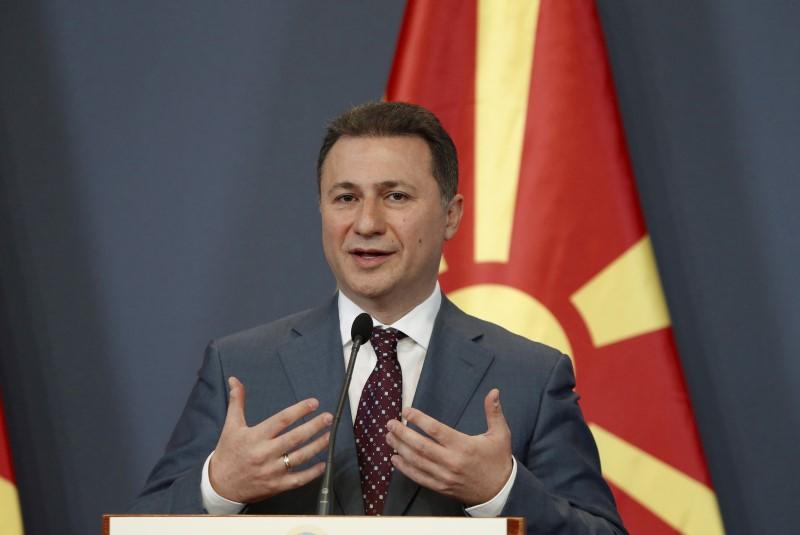
Nikola Gruevski speaks during a news conference with Hungary Prime Minister Viktor Orban in Budapest, November 20, 2015. Reuters
The convicted former prime minister of the Republic of Macedonia said he has fled to Hungary and applied for political asylum there, challenging Prime Minister Viktor Orban’s balancing act between mainstream European politics and its nationalist fringe.
Orban faces a tough decision. He can grant asylum to Nikola Gruevski, the Macedonian leader who escaped to Hungary to avoid starting a two-year prison term for abuse of office, and further erode his image among Europe’s mainstream political elite. Or he can reject it and abandon an ally he campaigned for and possibly anger Russian President Vladimir Putin.
"It’d be embarrassing for Orban at home and abroad to grant the asylum request to a convicted Balkan politician,” said Attila Juhasz, an analyst at Political Capital in Budapest. "There’s nothing that would explain it, except for the Russian influence.”
Macedonia’s current government has accused Gruevski, who led the Balkan nation for more than a decade, of deliberately fueling a decades-old dispute with neighboring Greece, which has blocked it from joining the EU and the North Atlantic Treaty Organization. That made him an awkward ally for Orban, who has campaigned for Gruevski despite always pushing for EU expansion into the Balkans.
Armored Limo
Gruevski, a nationalist like Orban who has led a propaganda campaign against Hungarian-born U.S. investor and philanthropist George Soros, resigned as prime minister three years ago following a scandal triggered by leaked tapes that alleged his government illegally wiretapped more than 20,000 people. After losing a 2016 election, he was convicted for ordering the Interior Ministry to hold a tender for an armored Mercedes limousine worth 35.2 million denars ($643,000) for his personal use.
Gruevski said he had escaped to Budapest just as he was about to begin a two-year jail term. His VMRO-DPMNE party, whose headquarters was surrounded by police last night, accused the government of "political persecution.” Authorities in Macedonia launched a nationwide search for the former premier.
"In the past few days I’ve received countless death threats,” Gruevski said on his official Facebook page. "I’m in Budapest now, and I’ve sought political asylum from the Hungarian authorities.”
The Hungarian government spokesman didn’t react to questions about Gruevski’s whereabouts and whether his asylum request would be granted. Gruevski’s trip would be difficult for him to undertake legally since his passport was ordered to be seized by a court last year.
Where’s Gruevski?
Hungarian Foreign Minister Peter Szijjarto wouldn’t confirm or deny any information on Gruevski’s whereabouts, and told reporters in Budapest that he wasn’t able to comment on asylum requests. The Foreign Ministry in Skopje said it’s working to verify whether Gruevski is in Hungary, according to an emailed statement.
"We don’t know if there’s been an escape,” Macedonian Prime Minister Zoran Zaev told reporters in Skopje. "To conclude this, we need to conclude clearly that he’s outside the country. Let’s leave the authorities to do their job.”
Gruevski’s arrival in Hungary would complicate Orban’s strategy of being an ideological ringleader to Europe’s nationalist movements while keeping a foot in its mainstream camp.
Last week, Orban backed a resolution at the congress of the biggest party in the European Parliament, the European People’s Party, condemning populism. The measure, at least temporarily, helped unite a political family in which several members had urged the expulsion of Orban’s Fidesz party for its crackdown on civil liberties.