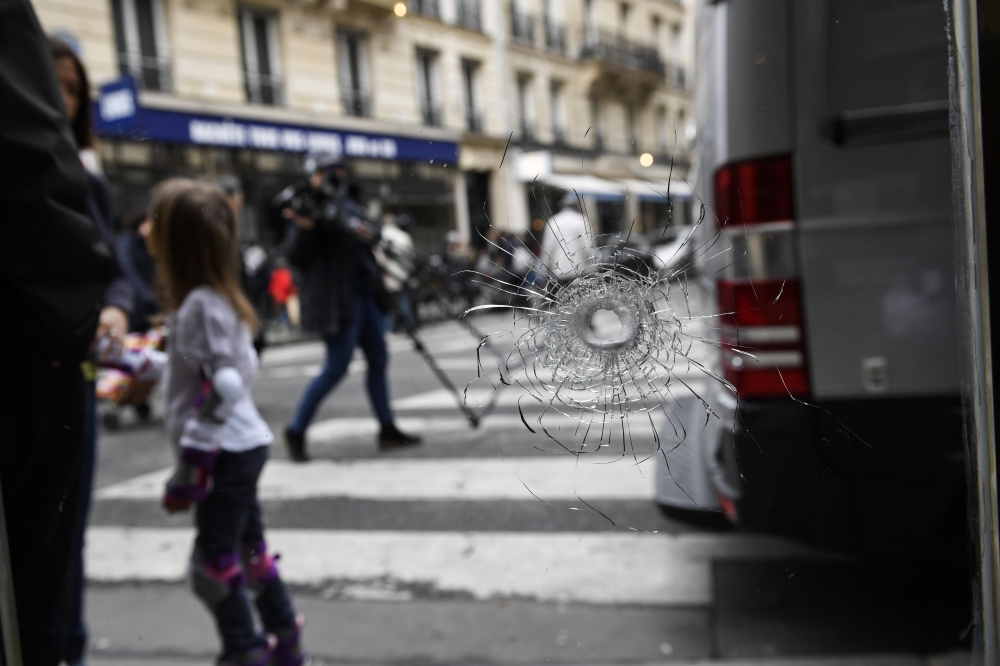
A bullet hole, seen on the window of a cafe located at the crossroads between the streets Saint-Augustin and Monsigny, is pictured on May 13, 2018 in Paris, the day after a knifeman killed one man and wounded four other people. AFP / Eric FEFERBERG
Moscow: A knife attack in Paris that killed one man on Saturday, carried out by a French citizen born in Chechnya, is the latest of numerous suspected terrorist acts linked to the troubled Russian region.
The Chechen warlord Akhmed Chatayev, who was killed in 2017, was believed to be behind an attack the previous year at Istanbul's Ataturk airport in which 45 people died.
Turkish officials said the attack was carried out by suicide bombers from the area as well as the ex-Soviet central Asian nations Uzbekistan and Kyrgyzstan -- which in recent years have also proved to be a hotbed of extremist violence.
Uzbekistan-born Abdulkadir Masharipov confessed to gunning down 39 people at the Reina nightclub in Istanbul on New Year's Eve 2017, while the 2013 Boston Marathon bomber Dzhokhar Tsarnaev was born in Kyrgyzstan.
Tsarnaev's father was Chechen and his mother was from Dagestan, an equally troubled neighbouring Russian region.
Over the past 20 years, Russia has fought two fierce wars with separatists in Chechnya, leading to the radicalisation of the territory and beyond.
Radical groups see Muslims in the Russian Caucasus and Central Asia, who still face discrimination and harsh treatment by the authorities, as potential recruits.
Islamist militants from the North Caucasus frequently target Russians through suicide bombings and other attacks.
But it is rare for Chechen jihadists to chose targets outside Russia, the French academic and Islamist expert Mathieu Guidere told AFP.
"The priority target for Chechens is not Westerners. From this point of view, (the Paris attack) is something of a turning point because up to now, Chechen propaganda has been focused on 'kill all the Russians' rather than 'kill Westerners'," he said.
The reprise could be linked "to (Chechen Islamists') inability to carry out serious actions against the Russians in Syria or Russia, which makes the Islamic State group decide to use them against Westerners instead."
He said Chechens in IS pushed their propaganda within Chechen communities abroad.
Fighting in the Middle East
The most notorious attacks by Chechens in Russia were the Beslan school siege, in which 331 people died, and a hostage-taking in a Moscow theatre in 2002 in which left 125 dead.
More recently, IS claimed a shooting at an Orthodox church in Dagestan in February in which five women were killed.
Militants from the Caucasus and Central Asia have boosted the ranks of IS in the Middle East.
When the Kremlin launched its air campaign in Syria in 2015 to support President Bashar al-Assad, one of Moscow's main justifications was that its forces were targeting Russian jihadists before they returned home.
The director of Russia's state security service FSB, Alexander Bortnikov, said late last year that at least 4,500 Russians had left the country to fight alongside "terrorists" in the Middle East, North Africa and other regions.
Chechen Information Minister Dzhambulat Umarov was on Sunday eager to play down the link between the area and the Paris attack.
Such crimes know "no nationality, no faith, no motherland and no flag," he said in comments to Russian radio.
But Russian Senator Konstantin Kosachev, who chairs the committee for international affairs, said the attack proved the need to tackle terrorism at its source.
"The lines of defence from this global threat must be drawn where it is conceived, financed and encouraged," he said.