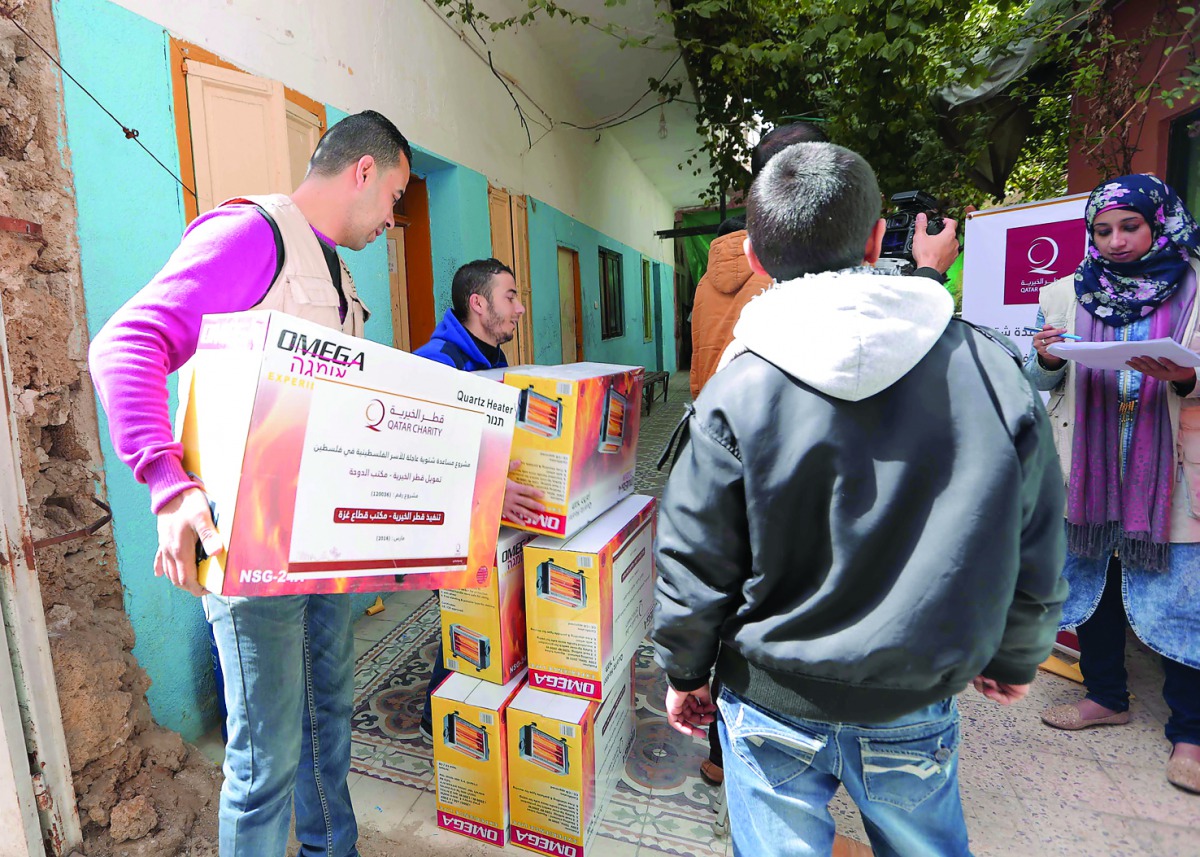
Representatives of Qatar Charity distributing lighting units to the citizens of Gaza.
Qatar Charity (QC) has provided 1,000 battery-powered lighting units to poor families in Gaza to help them cope with frequent power outage in the area. A total of 7,000 people are expected to benefit from the project “Safe Lighting for Poor Families in Gaza Strip”.
The project provided an alternative lighting source for frequent outage due to electricity crisis in Gaza because of blockade. The lightening unit is equipped with a battery, electronic panel and external USB port. A unit can light up a house completely.
QC aims at helping the poor families in Gaza Strip to overcome the electricity crisis, providing a suitable environment for students to follow up their study at night and protecting these families from house fires resulting from using candles and kerosene lamps. It is worth mentioning that using candles and kerosene lamps for lighting in Gaza have caused house fires that led to the death of some people.
The project will improve the daily life of poor families, facilitate the studying process for students, serves hundreds of poor families and protect their members from asthma and shortness of breath (Dyspnea (diseases resulting from inhaling the odours of candles and kerosene lamps, which are used as alternative lighting sources.
The units will help to prevent house fires which usually result from using those lighting sources. “Lately, there was a house fire which led to the death of three children”, said Mohammed Abu Halloub, QC’s Gaza Office Director.
QC implements several development and humanitarian projects which provide different services in the Gaza Strip. The project has helped the poor people who are suffering from power cuts for 18 hours per day in the Gaza Strip due to the imposed siege on the Strip which prevents the development of the only power station in Gaza.
QC provided the Ministry of Health with 200,000 liters of fuel as a quick response to the urgent appeal that the MOH had made. This enabled 13 hospitals to continue to offer medical services for 800,000 people. This project was implemented to provide fuel to operate the generators of the MOH’s facilities in order to compensate for the dire shortage in electricity which the ministry suffers from. This important project enabled the citizens to receive health services without any obstacles.