By Sidi Mohamed
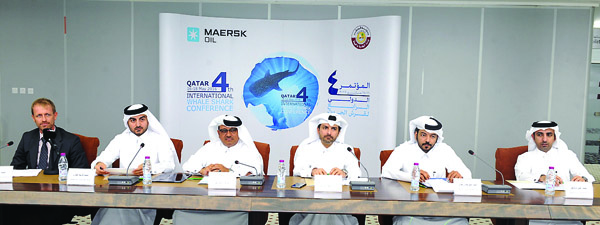
DOHA: With a high number of whale sharks frequenting Qatari waters every year, the country has got the rare privilege of hosting the fourth International Whale Sharks Conference from May 16 to 18.
The conference, being held for the first time outside the US, is hosted by the Ministry of Municipality and Environment, in collaboration with Maersk Oil Research and Technology Centre. It is supported by Qatar Whale Shark Research Project. The conference every three years is expected to bring together 100 experts and researchers, representing 28 countries, including the US, South Africa, Sri Lanka, Mexico, Singapore. It aims to enhance international cooperation in preserving whale sharks and will give an opportunity for participants to exchange ideas and experiences in the field. It will also discuss studies on biological diversity.
Qatar has more than 400 documented whale sharks in Al Shaheen oil field, which is considered an international number, said Mohamed Al Jaidah, Head of the project at the ministry.
Whale sharks frequent Qatari waters every year and gather in Al Shaheen, the largest offshore oil field in Qatar, in numbers only seen in few places around the world.
Al Jaidah was addressing a press conference at the ministry headquarters, attended by other officials from the ministry and Maersk Oil.
He said Qatar has more whale sharks compared to neighbouring countries. Al Shaheen field is also rich in other species of fish and the sea temperature is suitable for breeding.
He said the project has delivered good results and some of the research findings were published in international scientific magazines.
Studies show that Qatari marine environment has a rich biodiversity, especially near Al Shaheen field. A documentary film was made on whale sharks in Qatar and showed a massive gathering of sharks spotted on the coasts of Qatar.
The average length of a whale shark is between eight and nine metres and weighs about 30 tonnes. It feeds on fish eggs.
Studies have found that whale sharks come to Qatari waters to feed on Tuna eggs and due to the presence of industrial coral reefs around the Qatar Maersk-operated platforms in Al Shaheen oil field. The summer months between April and September witness gathering of over 100 whale sharks daily, in Al Shaheen field.
Mohamed Saeed Al Mohannadi, Director, Fisheries Department at the ministry, said Qatar is keen to achieve sustainable development in fish resources. The annual fish production is between 12,000 and 15,000 tonnes which meet some 80-85 percent of local demand.
“Hosting such a conference is a chance for us to show the world that Qatari waters are not polluted by oil, as some people think. It is clean and marked by its biological diversity,” said Al Mohannadi.
He said the ministry has set a plan to protect Al Kanad (king fish) by organising fishing and other GCC countries have agreed.
“We have also taken measures to protect Al Hamour and Al Shaari fish.”
The Peninsula
The Peninsula




![Passengers queue at the terminal hall after flights resumed at Imam Khomeini International Airport, amid a ceasefire between the US and Iran, in Tehran, Iran [Majid Asgaripour/WANA via Reuters]](/get/image/20260425_1777110195-687-thumb_small_92.JPG?1777110195)