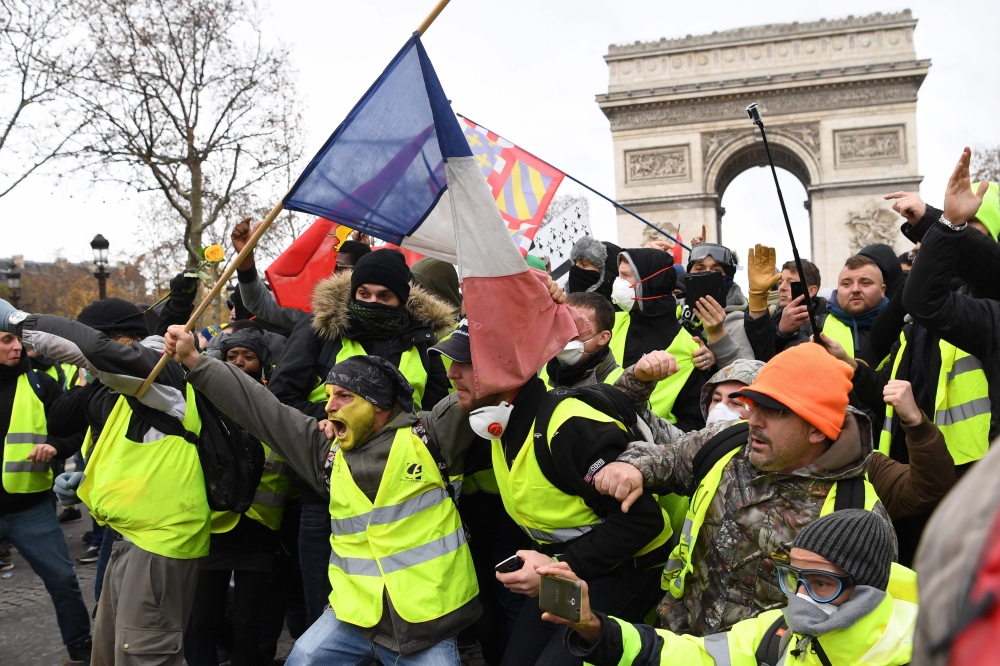
Protestors wearing "yellow vest" (gilet jaune) gesture on December 8, 2018 near the Arc de Triomphe in Paris during a protest against rising costs of living they blame on high taxes. AFP / Eric Feferberg
Secluded in his Presidential palace, Emmanuel Macron is looking for a miracle. An angry France is waiting to see if he finds one.
Macron is due to address the nation on Monday evening. Everyone, from Yellow Vest protesters to his dwindling number of supporters, is anticipating some solution to end the downward spiral of Europe’s second-largest economy, started last month with a grass-roots movement against fuel tax hikes.
Government spokesman Benjamin Griveaux promised on Sunday his boss would bring "tailor-made solutions’’ to "find the way back to hearts of French people.”
"Macron has left things go for so long now that people are waiting for a grand gesture,’’ said Arthur Goldhammer, a researcher affiliated with Harvard University’s Center for European Studies.
"He finds himself in an impossible situation where he has to admit his errors, not change the substance of his mandate and offer a whole new sequence of priorities.’’
‘Crucial Moment’
Goldhammer called Macron’s planned address a "crucial moment of his presidency.’’
The French leader will speak -- his office has declined to hint at any substance -- after four consecutive Saturdays of protest and street violence. A newly-formed association of Yellow Vests has called for a fifth Saturday of demonstrations on Dec. 15, but is insisting that it be "peaceful.’’
Before his address, Macron is organizing a series of meetings, including on Monday morning, with unions, political opponents and Parliament chiefs. On Friday he met with mayors of Paris suburbs who claimed on Europe 1 radio that they gave him "a hard talk’’ on what they consider his failures.
The youngest French leader since Napoleon, who has not made any public appearances or comments since Dec. 5, is facing a political and economic quandary.
Experts say there is no way for Macron, who has already backed down on energy tax hikes, to meet the many and often contradictory demands of the diverse group of protesters. His proposals could also add to France’s economic burden -- billions of euros that would eventually have to be offset by spending cuts -- that will be closely watched by the European Union and by markets.
No Pleasing Everybody
Voters are split on whether the president can continue with his plans to reform France after the protests. In an Ifop poll released Monday in La Lettre de l’Expansion weekly, 49 percent of respondents believe said he’ll still be able to enact meaningful change while 51 percent said he won’t.
'This result signals that Emmanuel Macron’s five-year mandate is not over,” Frederic Dabi, deputy head of Ifop, told La Lettre.
Macron has several options: cancel his measures that dented into retirees pensions; repeal his cuts to wealth tax; push companies to give workers a one-time cash bonus that is taxed; restore housing benefits to the level he inherited last year; cancel the speed limit on rural roads that angered many; suspend or postpone talks to squeeze unemployment benefits; or take on reforming the pension system.
But he is constrained from the outset: The Labor Minister Muriel Penicaud, said on Sunday the government will not raise the minimum wage. Édouard Philippe, the prime minister, said France could not afford to deepen its deficit. 'That’s my only prerequisite,' he said.
Macron may also hold informal meetings with ordinary citizens in the next months, the French media reported.
Urging a solution, French Finance Minister Bruno Le Maire said on Sunday the Yellow Vests movement has been "a catastrophe for our economy.” The end of the fuel tax increase will cost the state 4 billion euros ($4.6 billion) for 2019.
For the maverick politician who campaigned on a platform of transformation that would bring his version of a "revolution” to France, the address will be a balancing act.
Foreign Minister Jean Yves Le Drian, an early Macron backer and a close adviser in government, said on RTL radio on Sunday that the president needed to talk to the people 'directly’’ and offer them "a new social contract.” That contract, he said, should "prepare them for what the 21st-century welfare state and wealth sharing should be.’’