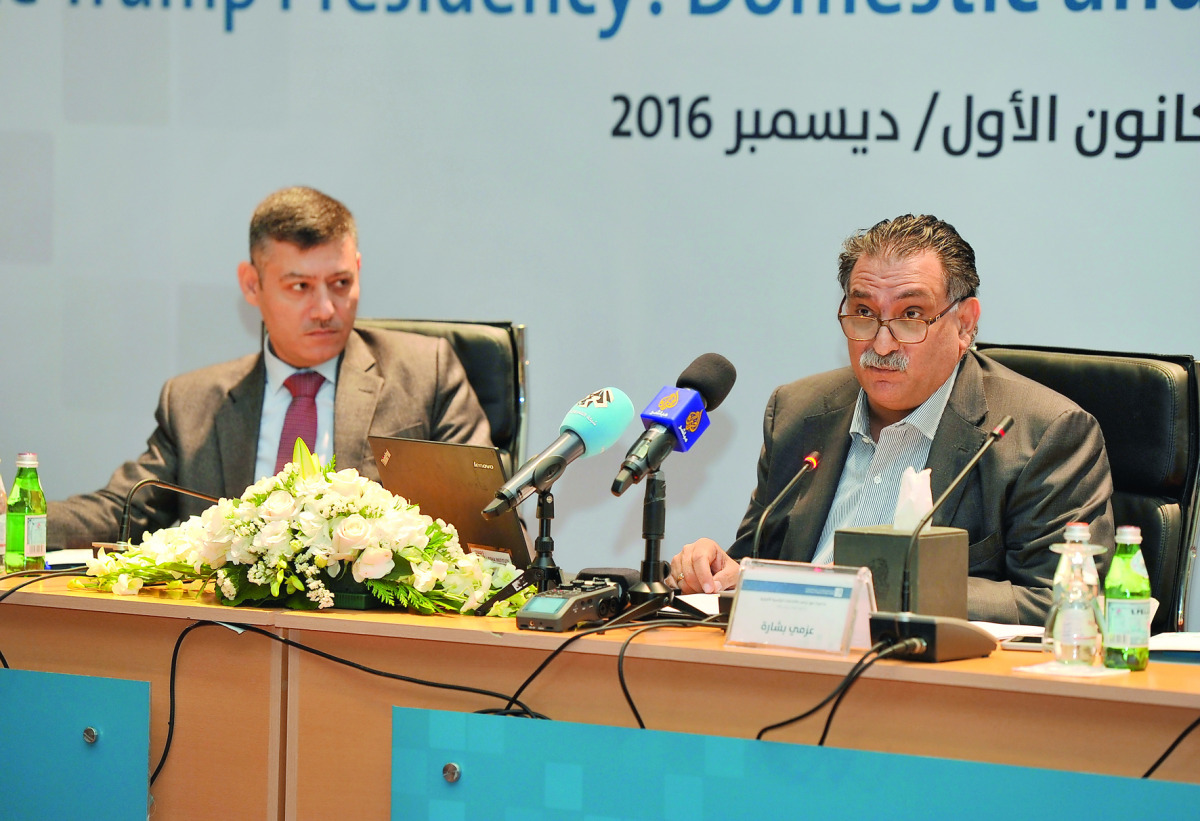
Marwan Kabalan, Associate Researcher, Policy Analysis Unit Coordinator, and Azmi Bishara, General Director of the Arab Center for Research and Policy Studies, at the opening session.
The major challenge for President-elect Trump will be internal conflicts on identity as well as economic, political and cultural issues rather than Middle East issues and the Pacific Ocean, said a senior analyst and intellectual.
Trump, who used statements similar to “pubs discourses” during his election campaign, gained the support of elders and labour whose fear of immigrants and economic problems related to the financial crisis of 2008 has been greatly exploited by Trump, said Azmi Bishara, General Director of the Arab Center for Research and Policy Studies.
Bishara, who was speaking yesterday at the opening session of one-day academic workshop examining the impacts of the election of Trump, held at Doha Institute, highlighted that the rising new right movements in Europe share common views with the right in US and these include the anti-elite and establishments, anti-globalisation and free trade, exploitation of Islamophobia and fear of migration and the wave of refugees.
The financial crisis which led to the damage of many industrial areas, and made many industries move to other countries with cheaper manpower, have made the white labour class in the US and Europe stand against free trade, globalisation and support the rising right, said Bishara.
Ironically, the traditional white labour forces are against equity with black Americans, women and other minorities, Bishara underlined.
Trump, who won with Electoral College and not the majority of votes, will confront with wide segments of the society based in major cities and whose quality weights are much higher than their demographic weights. These groups will defend not only their interests but their way of life, Bishara observed.
Trump is not interested in understanding the Middle East’s complicated issues, and his understanding of the region, its people and culture is very superficial, but the complications of the regional issues will force him to deal with them, said Khalil Gahshan, head of Arab Center for Research and Policy Studies in Washington.
Asked by The Peninsula precisely what Trump wanted from this region, Gahshan said nobody knows exactly, but in general he wants constant partnership in protecting US interests in the region. Trump want to rebuild US defence and security relations on a new basis replacing the basis set up in the post-WW II era.
"There is GCC countries' concern about his relations with Iran and the nuclear deal, and chaos in Syria and Yemen but I expect he will be more strict towards Iran and its intervention in the region," Gahshan said. Furthermore, he added that Trump, who criticised Obamas’ policy in this region, could easily be provoked by terrorist groups and dragged into the region’s conflicts. He lacked experiences in dealing with this region’s affairs because he is the first president coming from outside the institution and never took an official position. "I am very worried of his personal character more than the election promises he made," Gahshan emphasized.
If Trump implemented his election promises, it means the US foreign policy will witness major changes not experienced for decades, said Marwan Kabalan, Policy Analysis Unit Coordinator at the Arab Center. Trump thinks the current world is chaotic, rejects multilateralism and believes in domestically driven foreign policy, Kabalan added.
Joe Macaron, Middle East Analyst at the Arab Center Washington DC, said Trump's policies could be understood from his personal character. In contrast to former US Presidents who were optimistic, Trump has dim view of America, and major challenge for him will be lack of harmony between his team because he is not dedicated to his supporters. He is the first US President without doctrine, vision and ideology, making it difficult to understand his foreign policy, Macaron stressed.
"The GCC countries' concern is justifiable because Trump does not feel concerned with chaos in the region, although I do not expect dramatic changes in US policies in the region," said Macaron. Macaron said that it is early to know Trump’s policies on this region but generally speaking "I could say he will do the same like Obama and reduce the US military presence in the world to reduce expenses but military bases will exist because they are part of strategy to make America great."
“The Trump Presidency: the View from within the United States”, “The Ghosts of Karl Marx and the Ultimate Triumph of the US Confederacy”, “Explaining the Trump Victory and “The Rise of Trump: Political, Economic and Demographic Factors” were also discussed.